
Agile Offshore Development: How to Make It Actually Work

In this article
- What agile offshore development actually is
- Why most agile offshore setups break
- The three things that made it work for me
- Running agile ceremonies across time zones
- Treat the offshore engineers like part of the team
- How to structure the team as you scale
- What good looks like, and what to measure
- Onboarding decides the first three months
- Frequently asked questions
- The model is simple, the discipline is not
Quick Answer: Agile offshore development pairs sprint-based delivery with engineers in another country. It works when you hire a dedicated, long-term team and run your own ceremonies across the overlap hours, not when you hand a spec to an outsourcing firm and wait. The teams that succeed treat offshore developers like real members of the team, with the same standups, code reviews, and ownership as everyone else. That mindset matters even more once you see offshore software development in 2026 and how AI has changed the work. The choice between Scrum sprints and a Kanban flow model is one of the most common decisions distributed teams face; the Scrum vs Kanban comparison covers that decision directly. The broader question of whether Agile still makes sense in an AI-assisted world is where these offshore delivery practices are headed. Distance changes the math too, because the benefits of agile show up differently on a distributed team.
I’ve hired developers in Russia, Belarus, Latin America, India, Pakistan, and the Philippines.
Some of those experiments worked. Most of the early ones did not. At Stackify I ran what I now think of as a four-country test: developers in St. Petersburg in 2012, a dev firm in Uruguay, engineers in Colombia, and finally a team in the Philippines in 2018. The Philippines team grew past 20 developers and was part of why the company sold in 2021.
The reason I bring up the failures is that most agile offshore development fails for reasons that have nothing to do with the developers. There are smart people all over the world. According to the Stack Overflow Developer Survey, roughly 90% of professional developers don’t live in the United States. The talent is not the problem. It comes down to staffing the software development life cycle offshore without losing the communication.
The problem is how companies set the work up. Most offshore collaboration fails because people simply hand a bunch of requirements over to an outsourcing firm. Then they expect to get back a successful project.
That’s not how good software gets built, onshore or offshore.
This guide is the version I wish someone had handed me in 2012. It covers what agile offshore development actually is, why the standard setup breaks, and the specific way to run sprints, standups, and ownership when half your team is twelve time zones away. It is also why sprint capacity planning for a distributed team has to account for decision latency, not just available hours.
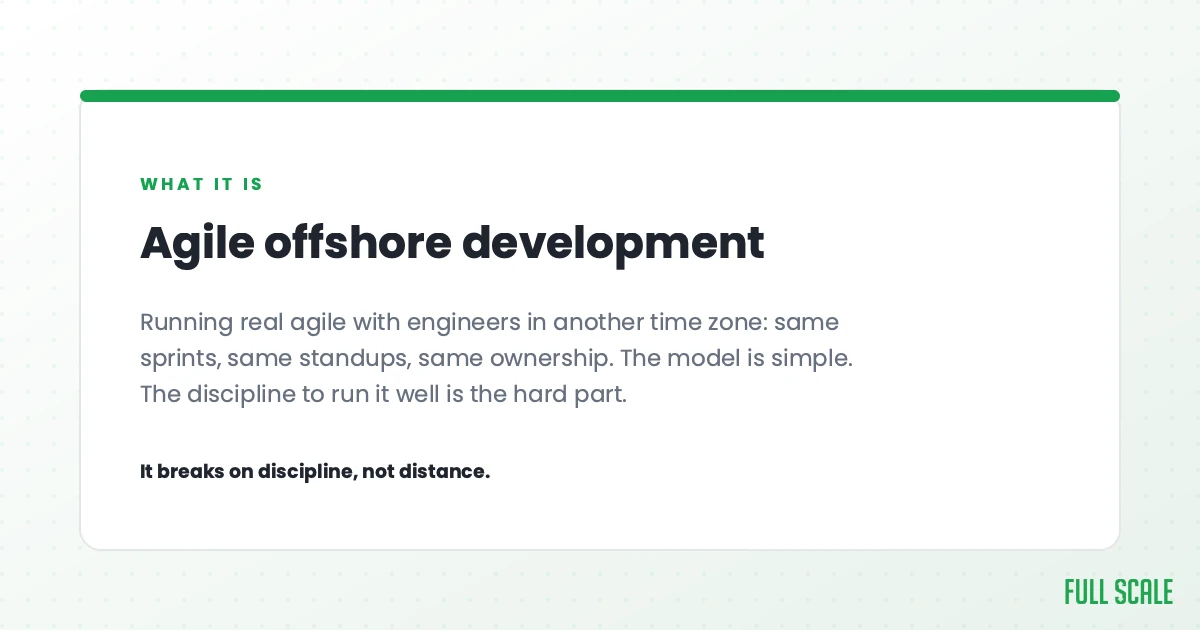
What agile offshore development actually is
Agile offshore development is a way of building software where the engineers work from another country, usually one with lower costs. The team still runs the core agile loop: short sprints, working software, and constant feedback. The harder question is how you judge that loop from another time zone, which comes down to measuring the team by what it ships, not by how busy it looks.
The key word is iterative. Old-school offshore software development was a handoff. Write a spec, ship it overseas, get code back months later. Agile development replaces that with two-to-four-week sprints, daily check-ins, and constant course correction. Done right, your offshore engineers are in your standups and your backlog, not waiting at the end of a conveyor belt. Whoever runs those standups, often a Scrum Master, has the same job whether the team sits local or offshore. Martin Fowler made this case back in 2006, and it has only gotten more true as remote work spread. The question of which framework fits best, and when Agile actually wins over Waterfall, is worth settling before picking the team structure.
Offshore is mainstream now. Deloitte’s 2024 Global Outsourcing Survey found that most companies already use offshore teams in some form. The reason they do it is rarely talent scarcity. It’s cost of living. You can hire strong global talent for 50 to 70 percent less than US rates, not because the engineers are worth less, but because a salary that’s modest in San Francisco is life-changing in Manila. My brother-in-law in the Philippines works at Jollibee, the country’s biggest fast food chain, for about $1.25 an hour. That’s not a hypothetical. That’s my actual family. The same gap that makes a fast food job pay $1.25 an hour makes a senior engineering salary go a very long way.
So the math is real. The hard part is the operating model.
Why most agile offshore setups break
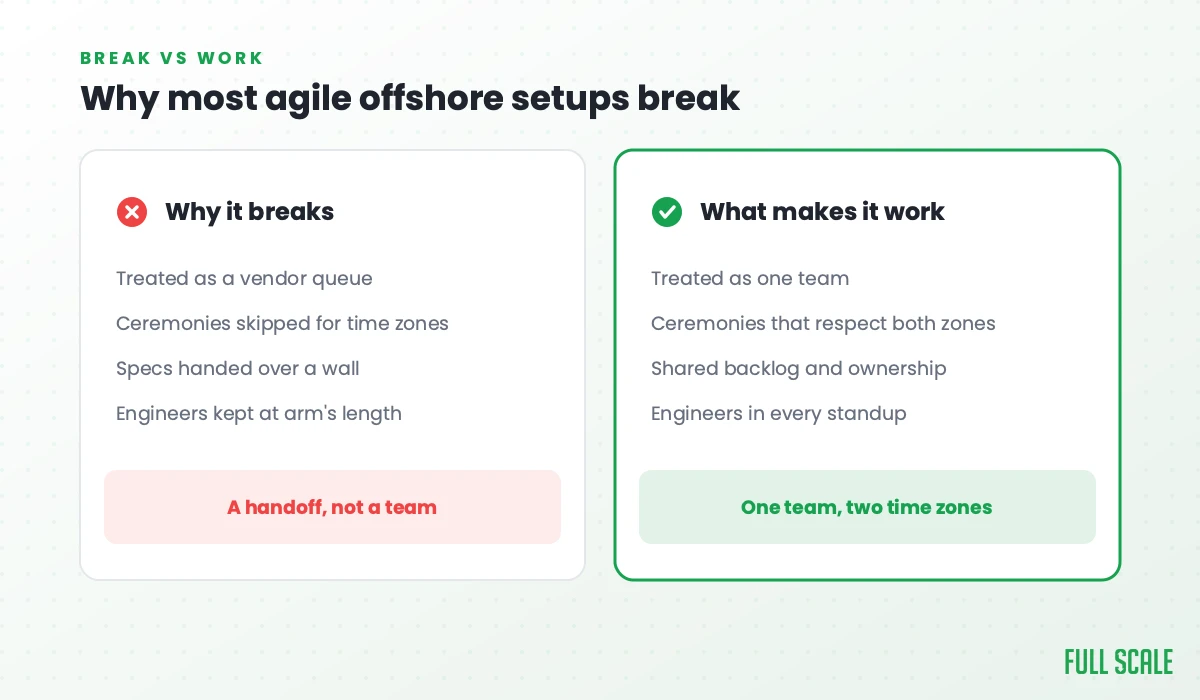
When I ask a founder why their last offshore attempt failed, the story is almost always the same. They hired a firm, sent over a list of features, and got back something that technically matched the spec but missed the point. Nobody pushed back. Nobody asked why. The work came in late and wrong, and the relationship died.
Here’s the pattern under that story.
They bought a project instead of a team. A project has a start, an end, and a contract that rewards the vendor for hitting the letter of the spec. The vendor has no reason to care whether your product succeeds after the invoice clears. We aren’t in this for some three-month project, and neither should you be.
They couldn’t actually talk to the people writing the code. A lot of offshore firms route everything through one technical project manager. Every other developer hides behind that person, either because of English gaps or because of cultural rules about who’s allowed to talk to the client. You end up with a team you can’t communicate with and a middleman in the way of every decision.
They picked the location for the rate, not the fit. Software development is about communication more than anything else, so the communication problems that derail software projects hit a badly run offshore team hardest. English fluency matters, cultural expectations matter, and whether a developer will speak up when they don’t understand something matters more than the hourly rate on their invoice.
That last point is why I’m careful about where I hire. The Philippines is special. There’s no real language barrier, Filipinos speak English fluently and grow up consuming American culture, and their communication is top notch. The Philippines is also the third-largest English-speaking country in the world, which is a big part of why I ended up choosing it over India and other regions.
The three things that made it work for me
Looking back at the four-country test, the difference between the attempts that worked and the ones that didn’t came down to three choices.
- Location. I stopped optimizing for the lowest possible rate and started optimizing for communication. That’s how I landed on the Philippines after trying several other regions.
- Teams, not projects. I hired developers to work directly for me on a long-term basis instead of buying a scoped deliverable. This is the core of staff augmentation: hire talent to work for you, don’t hire them just for a project.
- Team structure. I kept technical leadership in-house and let local leads manage the day-to-day, so the offshore engineers always had someone accountable and reachable.
None of those three are about agile ceremonies. They’re about the shape of the relationship. You can’t fix a broken offshore model with more standups. Get the relationship right first, then the agile mechanics actually have something to hold onto.
If your team already works well remotely, it will work well globally too. The skills are the same: write things down, trust people, and measure outcomes instead of hours.
Running agile ceremonies across time zones
Once you have a real team, the agile loop needs small adjustments for distance. Not a new framework. Just a few deliberate changes to the ceremonies you already run.
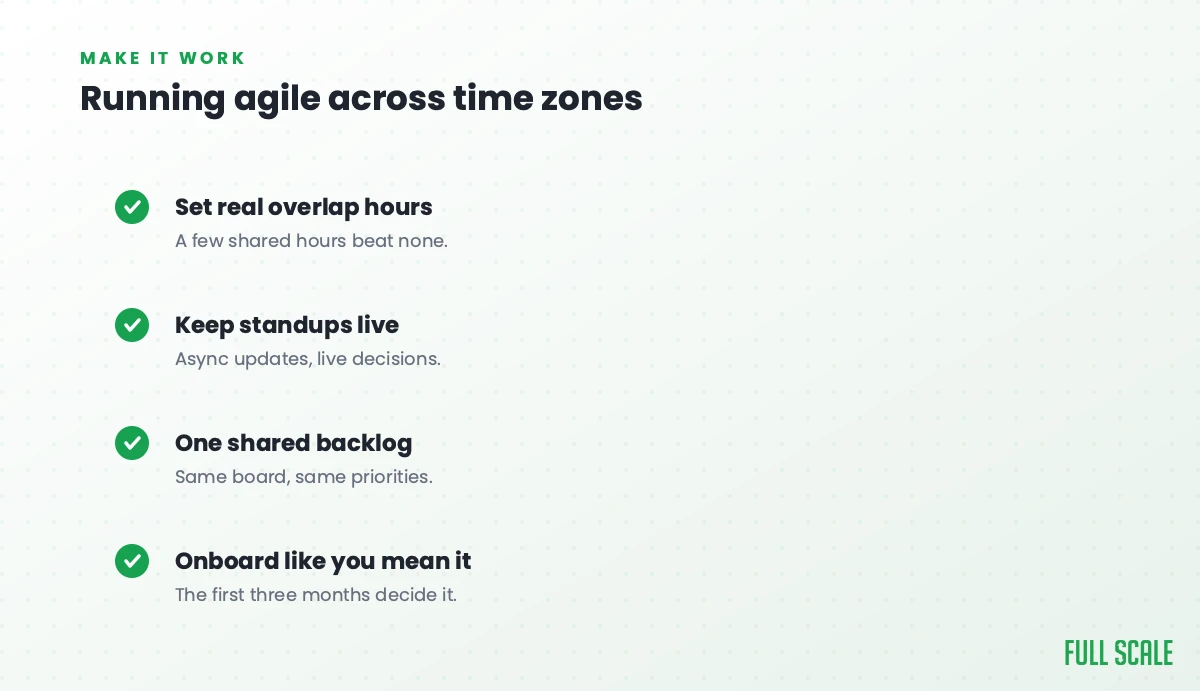
Find your overlap and protect it
The Philippines is about 14 hours ahead of Kansas City, where I’m based. That sounds impossible until you realize you only need a few good hours together, not a full day.
At Full Scale we staff three overlap patterns depending on what the client needs:
| Overlap pattern | What it looks like | Best for |
|---|---|---|
| Half-day overlap | 4 to 6 shared hours, the most common setup | Most teams; plenty of time for standups and pairing |
| Full US hours | The engineer works a 9 PM to 5 AM Philippine shift | Teams that need real-time coverage during US business hours |
| Async-first | Minimal live overlap, one daily standup window | Mature teams that document well and don’t need much sync time |
Most customers find the half-day overlap is plenty. The mistake is trying to force a distributed team into a co-located rhythm and then getting frustrated when it doesn’t fit.
Adjust the four ceremonies, don’t abandon them
Daily standup stays daily, but it happens on video during the overlap window. You want to see faces. Video matters because you need to see whether someone actually understood you, not just whether they said yes. That face time is also part of how to motivate offshore developers, since people stay engaged when they feel seen rather than tracked.
Sprint planning works best split in two: an async prep pass where the team reads the stories and leaves questions, then a live session to confirm scope. That way the meeting itself is short and the thinking already happened.
Retrospectives improve when you collect input in writing before the live discussion. People who are quiet on a noisy video call will often write down the most useful feedback.
Backlog refinement can run mostly async in a shared tool like Jira or Trello, as long as someone owns keeping it current.
A quick warning. Recording your standups and planning sessions sounds like overhead until the one week someone is out sick or a holiday falls on a different day in two countries. Then it’s the thing that keeps the sprint from stalling.
Treat the offshore engineers like part of the team
This is the part teams skip, and it’s the part that decides whether any of the above works.
The companies that get real results from agile offshore development don’t run a separate offshore process. They run one process, with the same standups, the same Slack channels, the same code review standards, the same approach to remote pair programming on a distributed team, and the same definition of done. The engineer in Cebu opens pull requests against the same repo as the engineer in Chicago and gets the same feedback.
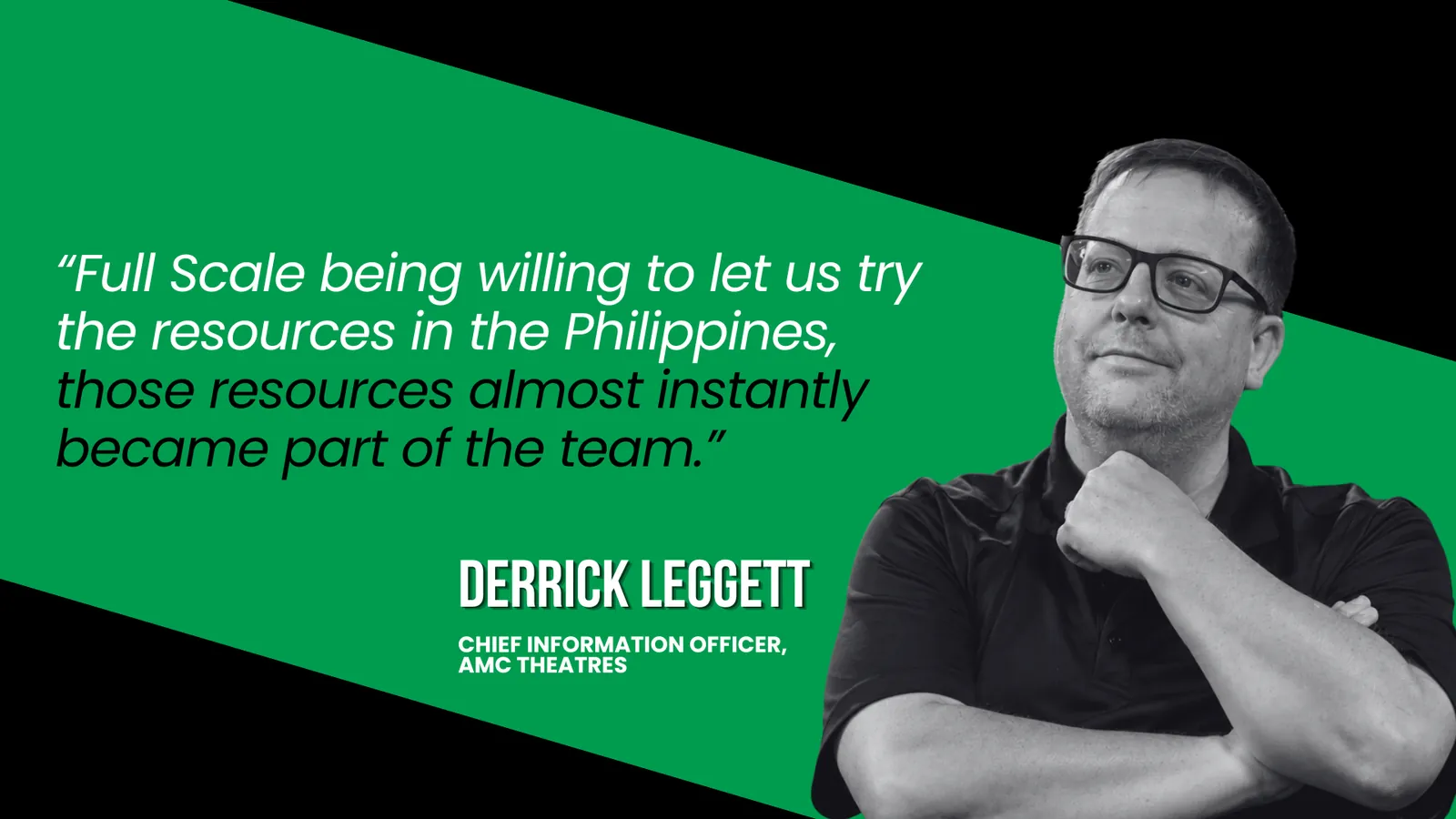
AMC Theatres is the clearest example I’ve seen. Their CIO built a global team where the developers in the Philippines are treated as full AMC engineers, not contractors held at arm’s length. The AMC team has flown out to our Cebu office, done karaoke with the engineers, and spent time together outside of work. That’s not a perk. That’s what makes the team a team.
LendingStandard came to us after local hiring in Kansas City stalled, and their CEO has said the integration with their in-house team was the part that surprised him most.
Offshore works when the developers care about the product the same way your in-house engineers do. There’s no middleman in between. That is what makes offshore actually work.
I call the result a win-win-win: a win for the engineer who gets a real opportunity, a win for the client who gets strong engineering at a sustainable cost, and that’s what makes it a win for us.
How to structure the team as you scale
A single offshore developer is easy. The questions start when you want five, or fifteen.
The structure that has held up for me is small teams that own a piece of the product end to end. A group with the front-end, back-end, and QA skills to ship a feature without waiting on anyone else. Each group has a local lead who runs the day-to-day and reports up to the technical leadership you keep in-house. Microservices architecture helps here, because clear service boundaries let each group work in parallel without stepping on each other.
When you grow, you have two real choices. Add people to existing groups, which keeps domain knowledge concentrated but slows coordination. Or spin up new groups with their own focus, which preserves the small-team feel but means more cross-group communication. There’s no universal right answer. It depends on whether your bottleneck is depth in one area or breadth across many.
What doesn’t change is the principle: you always need technical leadership in-house. Offshore engineers can own enormous amounts of the work. Someone on your side still owns the architecture and the why.
What good looks like, and what to measure
You can’t manage a distributed team on gut feel, but you also shouldn’t drown it in dashboards.
The metrics that actually tell you something are the same ones that matter for any agile team, read with a little patience for the ramp. Velocity dips at the start of any new team and recovers as people learn the codebase. Cycle time, defect escape rate, and how often work stalls waiting on a decision tell you more than raw output in the first couple of months.
The softer signal matters just as much. At Full Scale, a Customer Success Manager sits between the client and the engineers and has the conversations neither side can easily have directly. The engineer who’s confused but doesn’t want to look bad, the client who’s frustrated but doesn’t want to seem difficult. That relief valve is a big part of why our developer retention runs over 93 percent. Retention is a metric too, and on a long-term team it’s one of the most important ones.
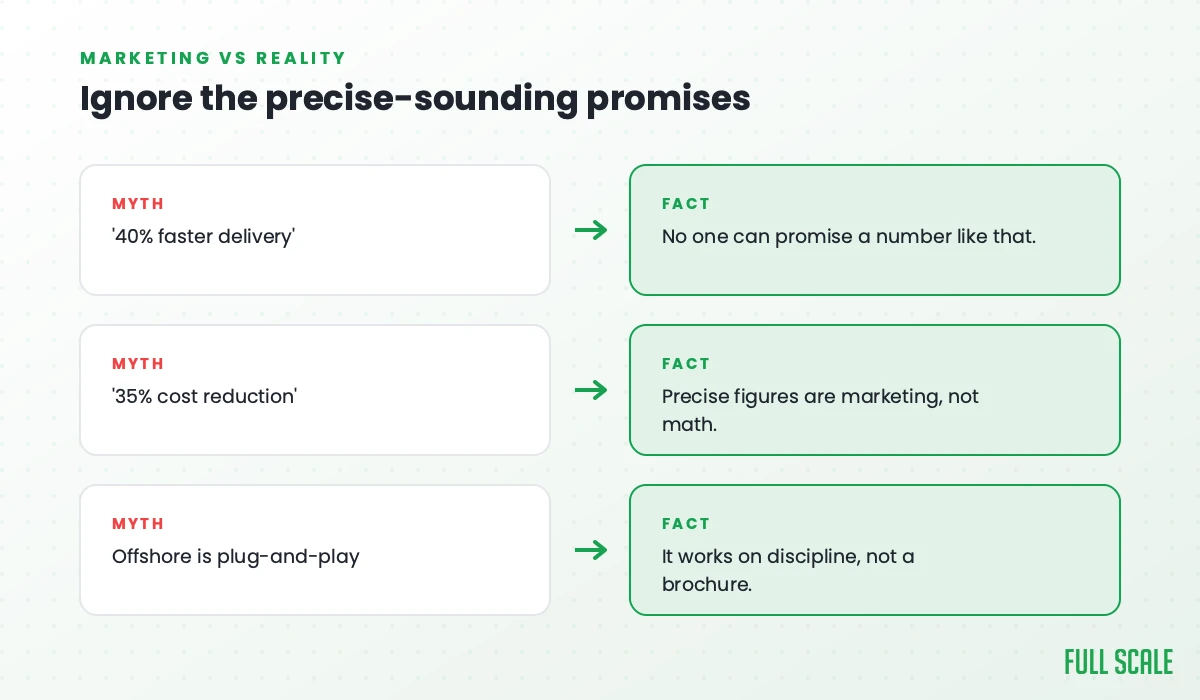
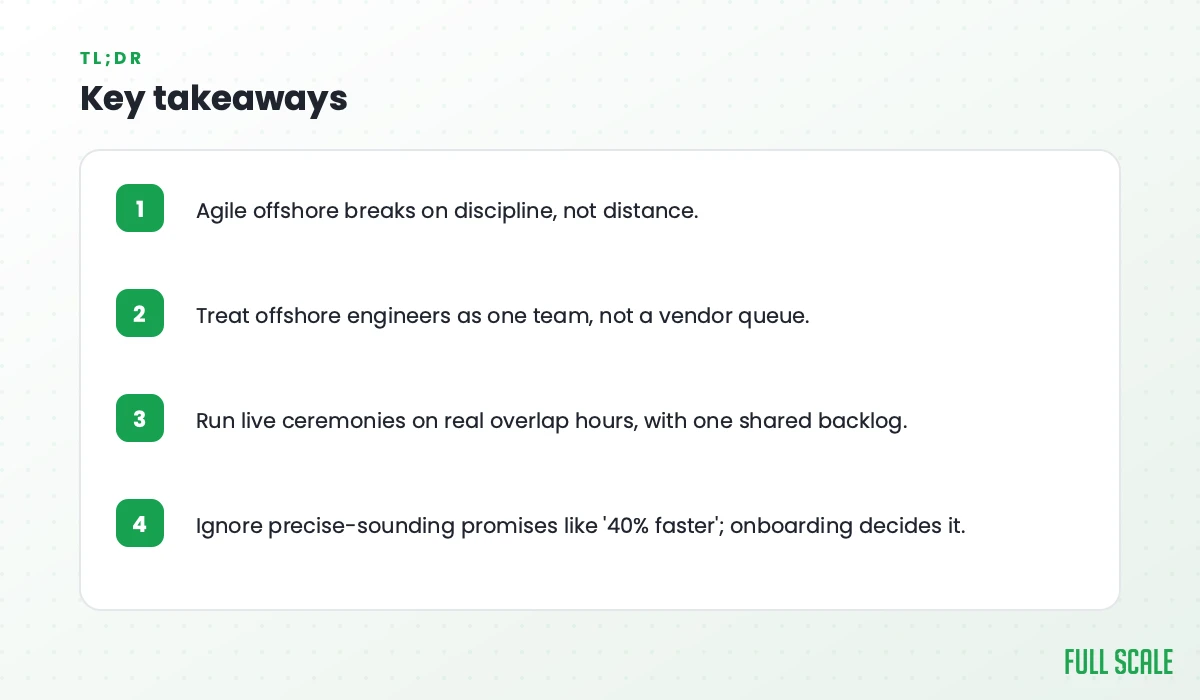
A note on the numbers you’ll see elsewhere. A lot of offshore marketing throws around precise figures like “40% faster delivery” and “35% cost reduction.” Be skeptical. The honest version is that a well-run offshore team gives you the same quality for a lot less money. How much less depends on your stack, your region, and how well you run the team.
Onboarding decides the first three months
The fastest way to waste the cost advantage is a slow, sloppy start.
Good developer onboarding for an offshore engineer looks like onboarding for any new hire, with extra care on context. Week one is setup and getting to know the team. Week two is learning the product, ideally paired with someone who already knows the code. By week three they should be shipping small changes. By week four they’re taking real tasks.
Pairing a new offshore developer with an experienced teammate for those first weeks does more than any document. Most of what makes someone productive is the stuff nobody writes down: why the code is shaped the way it is, what’s safe to touch, and who to ask. That transfers through conversation, not a wiki.
Frequently asked questions
How do you implement agile in offshore software development?
Run one process, not two. Put your offshore engineers in the same standups, sprints, backlog, and code review as your in-house team, hold the live ceremonies during your overlap hours, and move the rest async. The setup matters more than any single ceremony.
What is the best way to manage an offshore agile development team?
Hire a dedicated long-term team rather than buying a fixed project, keep technical leadership in-house, and use local leads for day-to-day coordination. Communicate on video so you can see whether people understood you, and measure outcomes instead of hours.
How much does agile offshore development save?
Hiring global talent typically costs 50 to 70 percent less than equivalent US rates. The gap comes from cost of living, not lower skill. The exact savings depend on the region, the seniority of the engineers, and how efficiently you run the team.
How much time zone overlap do you need?
Most distributed teams do well with three to four hours of daily overlap across time zones, which is enough for a video standup and some pairing. Teams that need full US-hours coverage can staff a shifted schedule, and mature teams that document well can run almost fully async.
Why do offshore agile projects fail?
They usually fail because a company hands requirements to an outsourcing firm and waits, with no shared process and no direct line to the developers. The fix is to treat offshore engineers as part of one team with shared ownership, not a vendor at the other end of a spec.
The model is simple, the discipline is not
Agile offshore development is the agile you already know, run with a team you’ve chosen to build instead of a project you’ve chosen to buy. Agile is just one of the software development methodologies you can pick from, and going offshore doesn’t change which one fits.
Get the three things right. Pick for communication, hire a team and not a task, and keep technical leadership at home. Then run your normal sprints across the overlap hours and treat the engineers like the colleagues they are.
There are smart people all over the world. The companies that figure out how to actually work with them are going to win.
If you want help building a dedicated offshore team in the Philippines, that’s what we do at Full Scale. The full story of how I got here is in Product Driven, and the Product Driven newsletter goes deeper on building and running engineering teams every week.