
Software Development Team Structure: Roles, Models, and What AI Actually Changed

In this article
- The team structure everyone still draws
- What AI changed, and what it didn’t
- More product thinkers per developer
- The Three C’s that decide whether the new structure works
- Roles, reconsidered for the AI era
- Team Topologies still holds up
- How the new structure can still fail
- How to structure a team now
- Structuring an offshore or distributed development team
- Frequently asked questions
- Build a team that’s structured for how software actually gets built now
Quick Answer: A software development team structure is the mix of roles that turns an idea into shipped code: a tech lead, several developers, a product manager, a QA engineer, and often a designer, arranged as a generalist, specialist, or hybrid team. Full Scale’s take: AI now handles much of the coding, so the structure needs more product thinkers per developer, not more developers, or the team ships the wrong thing faster.
Almost every guide on software development team structure draws the same picture: one or two senior developers, a few mid-level and junior developers, a product manager, a QA person, maybe a designer. Call it a pod, call it a squad, give it a tech lead, and you have the standard team. It’s a useful baseline, but only a starting point for thinking about the different types of software engineers a growing product eventually needs.
That picture is fine as far as it goes. It was just drawn before the bottleneck moved.
AI changed what a developer does all day. The boilerplate, the scaffolding, the first draft of the tests, the glue between systems, all the typing that used to fill an engineer’s week is getting automated. And when a developer can suddenly produce far more code in a week than before, the thing that limits a team stops being how fast it writes software. It becomes whether anyone made sure they were building the right thing.
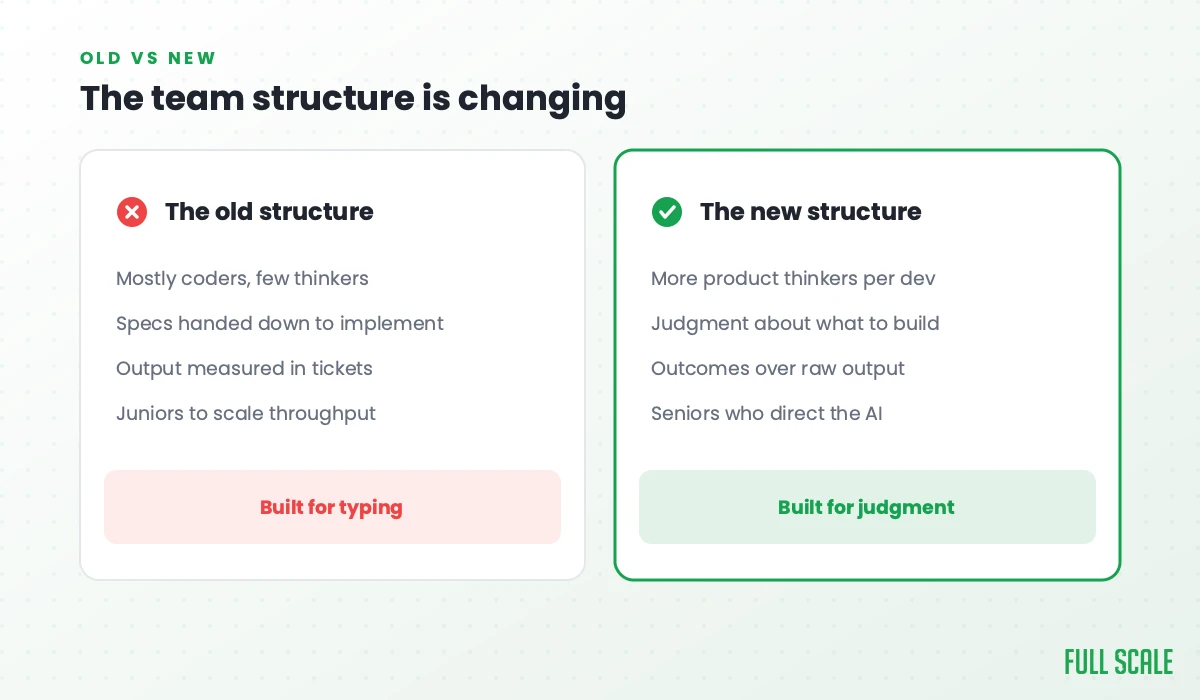
That single change reshapes how you should structure a team. The old org chart optimized for output, because output was scarce. The new one has to optimize for judgment and direction, because that’s what’s scarce now.
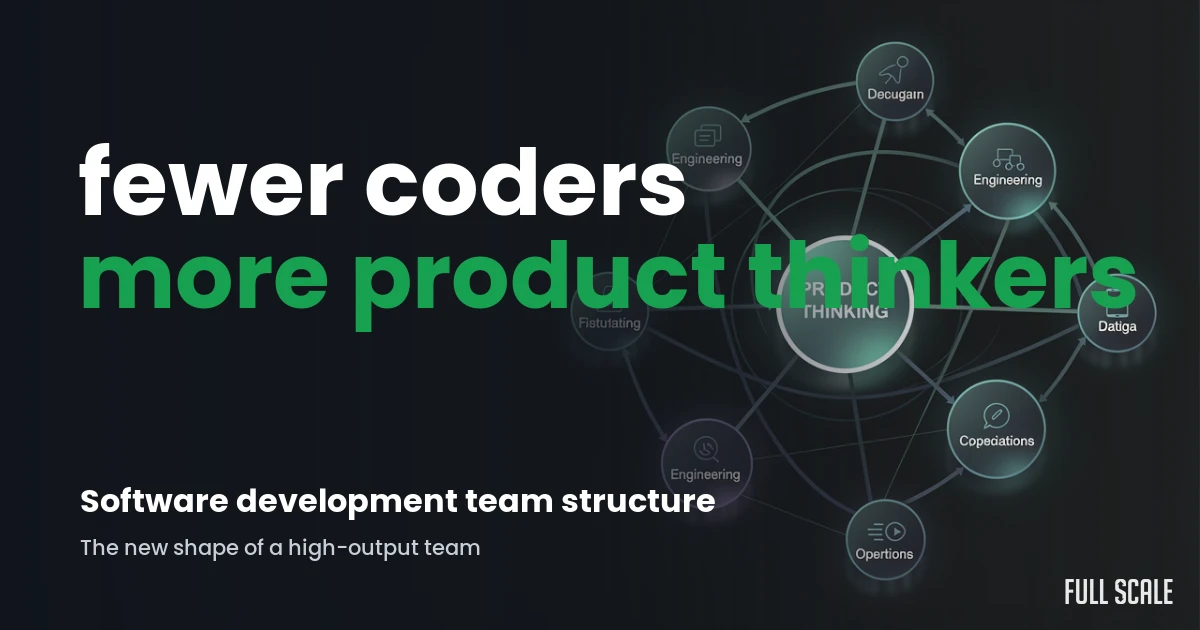
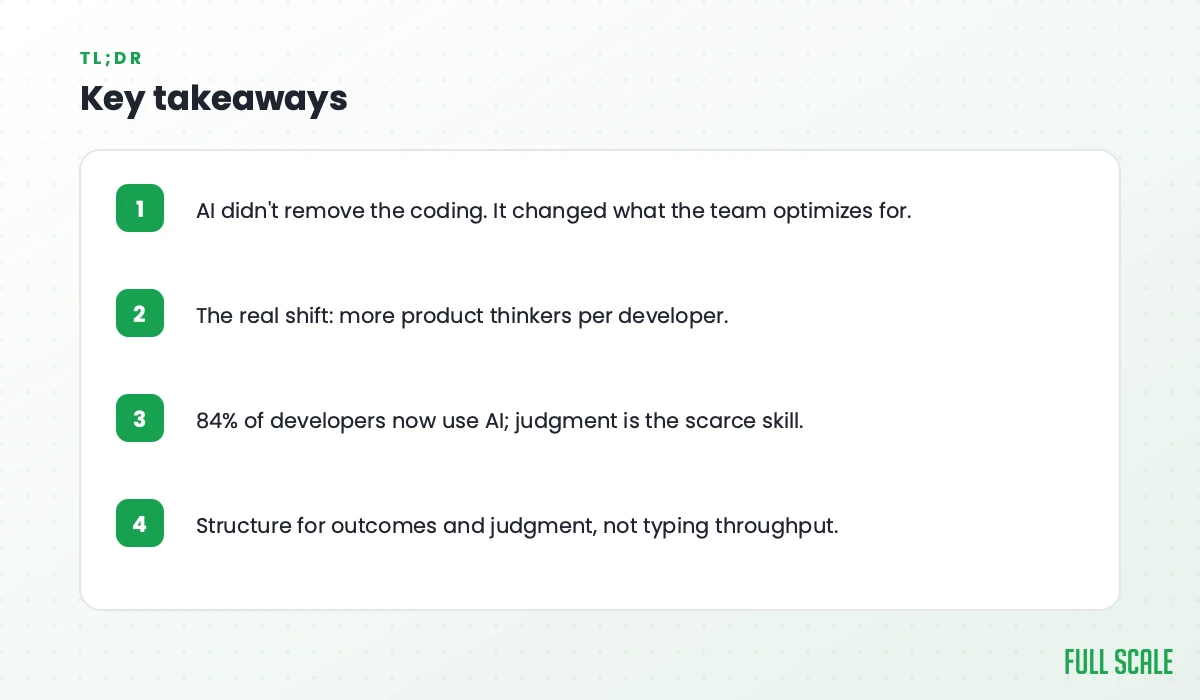
The best software development team structure now has more product thinkers per developer, not more developers.
This guide covers the classic models first, so you have the map everyone else is using. Then it gets into what actually changed and what to do about it.
The team structure everyone still draws
Before the rethink, it helps to know the standard shapes, because they’re still the vocabulary buyers and engineers use. People search for this under different names. Some call it software development team structure, others say software engineering team structure or team structure in software engineering, and plenty just call it software team structure. They’re all asking the same thing: who should be on the team, and how should they work together.
Most teams are built from some mix of these roles. A tech lead or senior engineer who owns architecture and mentors the rest. Mid-level and junior developers who do the bulk of the building. A product manager (PM) or product owner (PO) who decides what gets built and why. A quality assurance (QA) engineer who tests it. Often a designer, sometimes a dedicated DevOps engineer, sometimes a solution architect on bigger systems. On teams running Scrum, you may also have a Scrum Master to facilitate the process and clear blockers. It helps to know where each person fits in the software engineer title hierarchy before you decide how to structure the team.
How you arrange those people usually falls into one of three shapes.
| Team shape | What it is | Best for |
|---|---|---|
| Generalist | Developers who each handle front end, back end, database, and testing | Early-stage products, small teams, fast pivots |
| Specialist | Each person owns a narrow area of deep expertise | Complex systems that need real depth in one place |
| Hybrid | A core of generalists plus a few specialists | Most growing companies, larger builds with deadlines |
There’s also the old split between traditional and agile. A traditional team runs top-down with clear command lines and handoffs. An agile team is built to collaborate and self-manage, with the people closest to the work making more of the calls. Most modern teams lean agile, and for good reason. But structure matters less than whether the team actually talks to each other, which is the real story of software development collaboration. The methodology question itself, particularly how Agile compares to Waterfall on structure and team fit, shapes which of these configurations works best.
This is the map almost every article on the topic draws. It’s a fine map. The problem is that it was drawn for a world where writing the code was the hard, slow, expensive part. That world is going away.
What AI changed, and what it didn’t
Here’s the line I keep coming back to with our own engineers and with the founders I talk to.
Pure coders will be replaced by AI. Problem solvers will run technology organizations. It’s also why the old software engineer vs software developer line is dissolving.
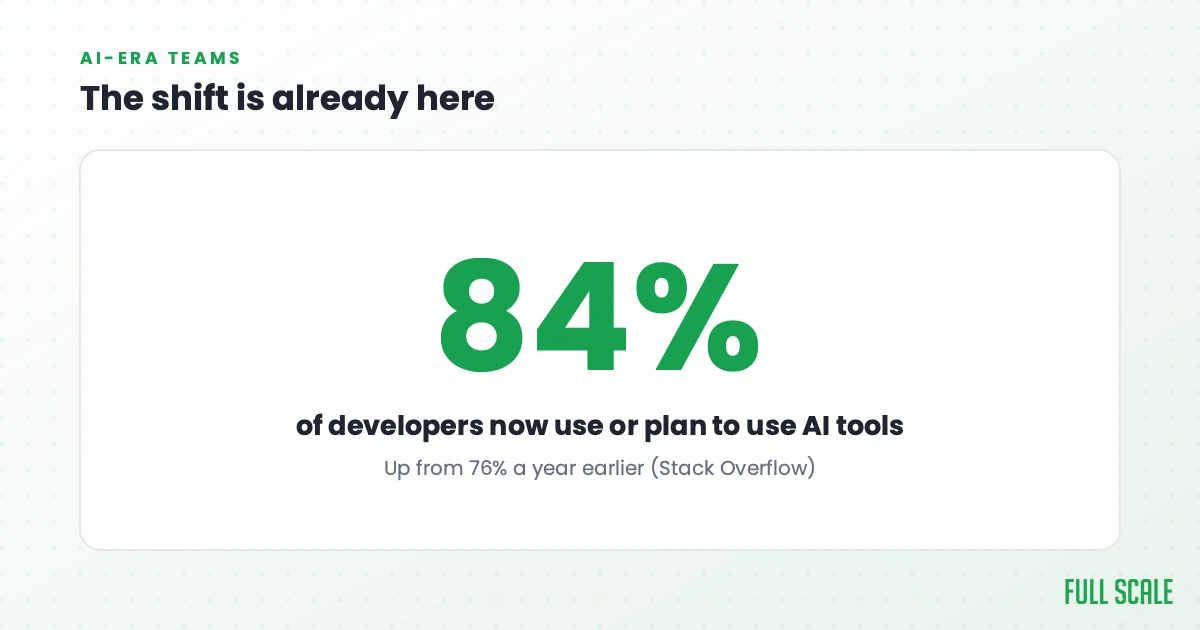
The mechanical part of the job, the part that’s actually just typing, is the part AI is best at. According to the 2025 Stack Overflow Developer Survey, 84% of developers now use or plan to use AI tools in their work, up from 76% a year earlier, and nearly half use them every single day. The first draft of a feature, the unit tests, the CRUD endpoints, the config, all of it comes out faster than it used to.
What AI is not good at is knowing what to build. The same survey found that developers trust AI’s accuracy the least and avoid it the most for the high-judgment work: 69% don’t want AI doing their project planning. The single biggest frustration, named by 66% of developers, is AI output that’s “almost right, but not quite.” Someone still has to catch the “not quite.” Someone still has to decide what was worth building in the first place. Deciding that is the real job now, which is why a minimum viable product was always about validation rather than code.
That’s the whole shift in one sentence. The bottleneck was always understanding the problem, not typing the code.
When the typing gets cheap, the value of everything around the typing goes up. Did we understand the customer? Is this the right feature? Did anyone check that the thing the AI generated actually solves the problem and not just compiles? Those questions used to get squeezed in between sprints. Now they’re the whole game. You can read more on how this is reshaping the day-to-day in our breakdown of AI’s impact on developers. Who you put on each part of running the software development life cycle is the real decision now that AI does the typing.
More product thinkers per developer
Here’s where team structure actually has to change.
Under the old model, one product manager could feed a handful of developers. The PM wrote specs, the developers worked the queue, and the slow part was the building. The ratio of one product person to five or six engineers made sense because the engineers were the constraint.
Flip the constraint and the math breaks. When developers ship features in a day that used to take a week, a single PM can’t define work fast enough to keep them pointed in the right direction. The team starts shipping more, faster, in directions nobody fully thought through. You end up building the wrong thing at record speed. It also raises the stakes on how you release, which is where feature flags to control what goes live earn their keep.
So the modern software development team structure needs two things the old one didn’t. It needs more product capacity per developer, whether that’s more product managers or product owners in the mix. And it needs developers who think like product people themselves, who ask why before they ask how. On a deeply technical product, that extra product capacity sometimes takes the shape of a technical product owner who can read the code.
This is the idea I wrote a whole book about. Product Driven makes the case that the problem in most software teams was never code quality or technical skill. It’s product thinking. Done means the customer sees value, not just that the code shipped. That used to be a nice philosophy. Now it’s the actual job description, because the part that wasn’t product thinking is the part the machine took over.
It’s the same reason I’ve said for years that you don’t need rockstar developers, you need rockstar requirements. Knowing what to build was always where the real value sat. AI just made that painfully obvious.
There’s a real cost to this, and it’s worth naming. Pushing product thinking onto developers means pushing ownership onto them too. A modern team is a smaller group of people who each own a real piece of the product, not a row of coders waiting for specs. Engineers who think like owners outperform the ones who wait for tickets, every time. But ownership only works if you actually give it to them, with the context and the trust to make real calls, not a ticket queue with extra steps.
The Three C’s that decide whether the new structure works
If developers are going to carry more product judgment and more ownership, three human skills decide whether that works. I call them the Three C’s: communication, curiosity, and courage. They’re the through-line of everything I teach our engineers, and they map directly onto the five pillars in the book.
Communication. The job is moving from writing code to understanding problems and working with people. For a developer, that means writing clearly, asking good questions, and saying so when something doesn’t make sense. For a leader, it means giving the team real vision, real focus, and real clarity, over and over, not once in a kickoff deck. A team that can’t communicate will build exactly what the ticket said and exactly the wrong thing.
Curiosity. This is what I tell every engineer at Full Scale who’s nervous about AI. As long as you stay curious, you’ll be fine. Be curious about how AI changes your job and how you can use it. The developers who treat it as a threat to hide from are the ones who fall behind. The ones who poke at it, break it, and figure out where it helps are the ones who level up.
Courage. Someone on the team has to be willing to say “this spec is wrong” or “the AI wrote something that looks right and isn’t.” That takes psychological safety. Vibe coding only works if you’ve coded long enough to know when the AI is wrong, and a junior engineer will only flag it out loud if the team makes it safe to. Courage is the difference between a team that catches the “almost right, but not quite” and one that ships it.
None of these are new skills. They were always what separated good teams from busy ones. AI just removed the busywork that used to hide the difference.
Roles, reconsidered for the AI era
The roles on the org chart mostly keep their names. What changes is what each one is actually for. The broader question of whether Agile itself is still the right framework as AI changes how teams build is worth reading alongside the team-structure question.
Product managers and owners become the constraint
This is the role you probably need more of. When developers can build faster than anyone can decide what to build, product capacity is what limits the team. If you’ve been running one PM across two squads, that ratio is now a bottleneck. Worth understanding the difference between a product owner and a product manager before you staff up, because you may need both kinds of thinking.
Engineers shift from typing to judgment
You need fewer pure coders and more product-minded builders. Senior engineers spend more time reviewing, directing, and sanity-checking AI output than hammering out lines themselves. The traits that make a developer great now lean even harder toward judgment, communication, and the instinct to ask whether the work matters, not raw typing speed.
QA moves from coverage to judgment
When a machine writes a lot of the code and a lot of the tests, QA’s job isn’t to write more test cases. It’s to find the edge cases the AI didn’t think of, validate that AI-generated tests actually test something real, and own the question of whether the product behaves the way a human expects.
Tech leads and architects matter more, not less
AI sees the file in front of it. It doesn’t see your whole system, your data model, or the decision someone made two years ago that everything now depends on. Somebody has to own that. The architect and tech lead roles get more important as individual output goes up, because more code generated faster means more ways to quietly wreck the architecture.
One side effect of all this: AI nudges teams toward capable generalists with product instincts over narrow specialists. When the mechanical depth is cheaper to get from a tool, the person who understands the problem and can move across the stack is worth more than the person who only goes deep in one corner.
Team Topologies still holds up
If you want a framework for this that doesn’t fall apart the moment the tools change, read Team Topologies by Matthew Skelton and Manuel Pais. It’s one of the few team-design books that ages well, because it organizes teams around the flow of value and around cognitive load, not around a specific tech stack or process fad.
It lays out four fundamental team types:
- Stream-aligned teams own a single slice of the product end to end.
- Platform teams build the internal tooling other teams use in a self-service way.
- Enabling teams help other teams pick up new skills.
- Complicated-subsystem teams own the parts that need deep specialist knowledge.
Why it matters more now: when AI raises each person’s output, cognitive load becomes the thing you have to manage. A team drowning in too many systems and too much context won’t think clearly about any of it, no matter how fast the AI types. The stream-aligned team that owns one product slice end to end is the natural home for the product-thinking developers we’ve been describing. They have a clear problem, a clear customer, and the room to actually own the outcome. That idea ties straight back to Conway’s Law: your software ends up shaped like your team structure, so structure the team around the value you want to deliver.
How the new structure can still fail
The shift is real, but it creates new ways to fail. These are the leadership headaches I hear about most right now.
Blurred roles. When everyone is “kind of a product person,” it gets murky who actually owns a decision. Pushing product thinking onto developers is good. Letting accountability go fuzzy is not. Someone still has to own each call, even on a team where everyone contributes to it.
The PM bottleneck nobody staffed for. Teams ramp up their code output, keep one product manager, and wonder why they’re shipping more and accomplishing less. Good execution can’t fix the wrong problem. If you only scale engineering capacity and not product capacity, AI just helps you build the wrong thing faster.
Throwing cheap bodies at a structure problem. When teams feel slow, the reflex is to add more developers, ideally cheap ones. I call this cheapshoring, hiring the cheapest developer you can find and hoping volume solves it. It doesn’t. If the real problem is that nobody’s deciding what to build, ten more junior developers make it worse, not better. More hands on a broken structure is just more confusion.
Fake ownership. It’s easy to tell developers they’re “empowered” and then gate every decision, shift direction weekly, and pull support the moment something goes sideways. That’s not ownership, and engineers see through it fast. If you want people to think like owners, you have to actually hand over the keys.
How to structure a team now
You don’t need a 90-day transformation plan. You need a few principles that match where the constraint actually is.
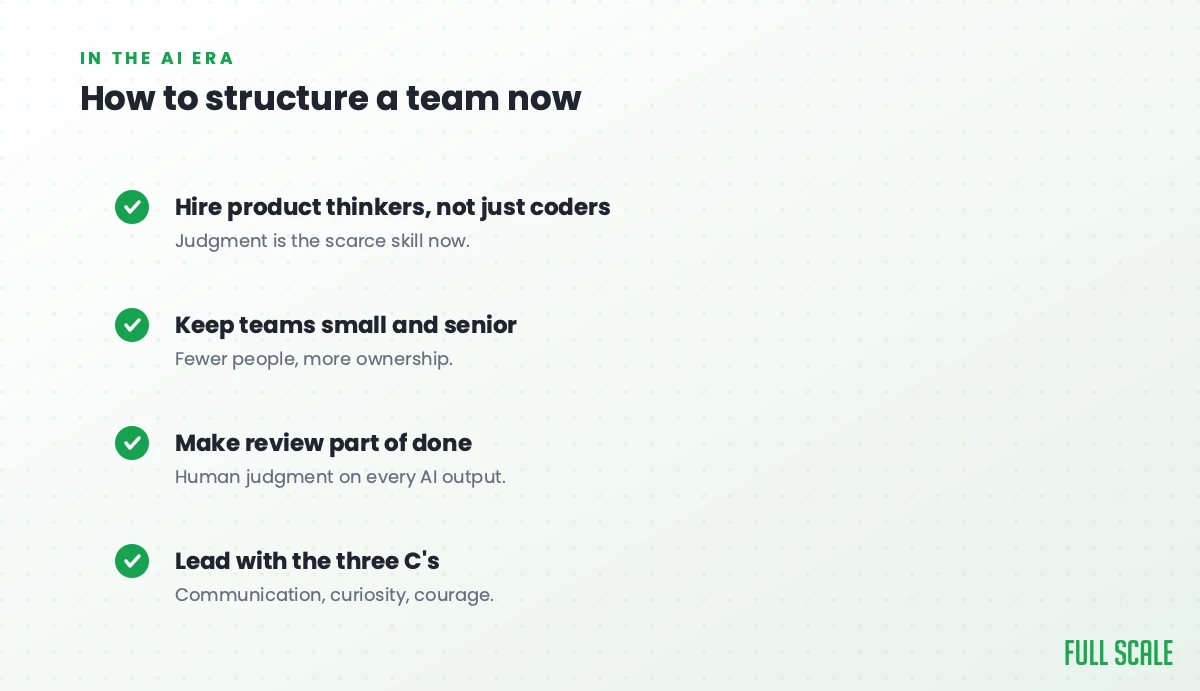
- Staff for product capacity, not just engineering capacity. Before you add another developer, ask whether the limit is really how fast you build or how clearly you’ve decided what to build. Often it’s the second.
- Give every developer a real piece to own. Not a ticket queue. A problem, a customer, an outcome they’re responsible for. That’s where product thinking actually grows.
- Keep senior judgment in the loop. On architecture and on AI output. Speed without someone watching the system is how you generate technical debt at machine scale.
- Size in-house versus dedicated and offshore by what has to live in-house. Product leadership, architecture, and the people closest to your customers belong on your side. Build capacity does not have to.
That last point is where most of the companies I work with land. They keep product and senior technical leadership in-house, then add build capacity through a dedicated development team or a staff augmentation model instead of trying to hire a dozen engineers locally in a market where that takes months. A senior US engineer runs roughly $150,000 to $185,000 in base salary alone, per the Bureau of Labor Statistics, before you add benefits and overhead, so staffing a whole team that way gets expensive fast. The model works because the team is treated as one team, with the same ownership and product thinking, not as a vendor on the other side of a wall. We do this with developers in the Philippines for companies that need to scale without burning their whole budget on local senior salaries. If that’s the road you’re considering, our guide to the dedicated team model walks through how to set it up so it actually behaves like part of your team. For teams building web applications, our custom web app development service provides that dedicated build capacity without the local hiring lead time.
There’s a version of this that’s wrong for you, and it’s worth being honest about it. If your work is a one-off, well-scoped project, you don’t need a standing team at all, a project shop is fine. And if your real problem is that nobody has decided what to build, no team structure will save you. Figure out the product first, and if you want the best engineering management books on exactly that shift, I put together a list.
Structuring an offshore or distributed development team
An offshore development team needs the same essential roles as a local one: product leadership, a tech lead or architect, developers, and QA. What changes is where each role should live. The split Full Scale sees work across 80+ active client teams is to keep the roles that decide what to build close to your customers, and let build capacity live wherever the talent is.
| Role | Where it belongs | Why |
|---|---|---|
| Product manager / owner | In-house | This role is your new constraint, and it has to sit close to customers and revenue. |
| Architect / tech lead | In-house, at least one | Someone on your payroll has to own the system the AI can’t see. |
| Developers | Offshore works well | Build capacity scales offshore without the six-month local hiring slog. |
| QA engineers | Offshore works well | Judgment-based QA travels fine when the tester is embedded in the team. |
| DevOps | Either | Put it wherever your infrastructure knowledge already lives. |
The part teams get wrong is treating the offshore half as a separate structure with its own rules. The offshore developers belong in the same standups, the same code reviews, and the same ownership conversations as everyone else. The moment you run “the onshore team” and “the offshore team” as two org charts, you’ve built a vendor relationship with extra steps. If you’re weighing this model, start with what an offshore team actually is and how to manage one day to day before you draw a single box on the chart.
Frequently asked questions
What is the best software development team structure?
There’s no single best structure, but most companies do well with a hybrid team: a core of capable generalists plus a few specialists where depth really matters. What’s changed is the ratio. The modern software development team structure needs more product capacity per developer, because AI removed the bottleneck on writing code and moved it to deciding what to build.
How has AI changed software development team structure?
AI automates much of the mechanical coding work, so individual developers produce far more output. That makes the scarce resource judgment and product direction rather than typing speed. Teams now need more product managers per developer, developers who think like product owners, and senior engineers focused on reviewing and directing AI output rather than just writing code.
How many product managers do you need per developer now?
There’s no fixed number, but the old ratio of one product manager to five or six developers is increasingly too thin. When developers ship faster, a single product person can’t define work quickly enough to keep the team aimed correctly. The fix is either more product managers and owners, or developers who carry real product thinking themselves, and usually both. If you lean toward growing your own, it helps to understand how to become a product manager, because the best ones usually come up from inside.
What roles do you still need on a software development team?
You still need product management, engineering, QA, and technical leadership. The roles keep their names but change in focus. Product roles become the constraint, engineers shift toward judgment and product thinking, QA moves from writing test coverage to validating AI output and edge cases, and architects and tech leads matter more because someone has to own the system the AI can’t see.
Is the small pod model dead?
No, the small cross-functional pod is still a strong structure, especially the stream-aligned team that owns one product slice end to end. What’s dead is the version where the pod is mostly coders fed by one product manager. The modern pod weights more heavily toward product thinking and shared ownership.
Which roles should stay in-house when you use an offshore development team?
Keep product leadership and at least one architect or tech lead in-house, because those roles carry your customer context and own the system as a whole. Developers, QA, and most build capacity work well offshore when they run as part of one team with the same ownership expectations. The ratio shift AI caused applies on both sides: an offshore team of pure ticket-takers has the same problem as a local one.
What is the typical offshore software development team structure?
A typical offshore software development team structure mirrors the standard pod: a product manager or owner, a tech lead or architect, two to five developers, and a QA engineer. The usual split keeps product leadership and at least one senior technical owner in-house while the developers and QA sit offshore, joined to the same standups, code reviews, and ownership expectations as the rest of the team. The structure fails when the offshore half is run as a separate org chart behind an account manager instead of as part of one team.
What is the offshore development team structure for small vs large projects?
A small project runs well as a single hybrid pod: a few generalist developers, a product owner, and QA, with a tech lead keeping an eye on the system. A large project splits into multiple stream-aligned teams that each own a product slice end to end, usually backed by a platform team and more product capacity per developer. The in-house versus offshore split stays the same at both sizes. Keep product leadership and architecture close to your customers, and scale the build capacity offshore as the project grows.
Build a team that’s structured for how software actually gets built now
Your team structure is the single biggest lever on whether AI makes you faster or just helps you build the wrong thing faster. If you’re rethinking how your engineering org should be built, and especially if you need to add product-minded developers without a six-month local hiring slog, schedule a call with Full Scale. We’ll talk through what should stay in-house and what you can build with a dedicated team.
Software development is changing, but the companies that remember it was always about understanding the problem are the ones that win.