Outsourcing Development vs. Staff Augmentation: Why One Gets You January 1 Productivity (And One Doesn t)
Most CTOs think “outsourcing” and “staff augmentation” are the same thing.
They’re not.
One gives you a vendor relationship that creates communication nightmares. The other gives you team members who feel like they’ve been with you for years—by Week 2.
If you tried outsourcing development before and it failed, you probably used the wrong model. Here’s the difference between staff augmentation and outsourcing—and why it matters for your January 1, 2026, team plans.
What You'll Learn in This Article:
- The critical differences between outsourcing development and staff augmentation that determine success or failure
- Why your offshore project failed (it wasn't the developers—it was the model)
- The exact 4-week timeline from "we need developers" to "developers shipping code" by January 1
- Real cost breakdowns showing 50-60% savings vs. local hiring with transparent pricing
- Which model fits your situation and how to avoid the mistakes 68% of companies make
What's the Difference Between Staff Augmentation and Outsourcing?
Outsourcing development means hiring a vendor company to deliver a project. You work with project managers who coordinate offshore developers you never meet.
Staff augmentation means hiring developers directly who work as extensions of your team. They’re on your Slack. In your standups. Using your processes. The vendor only handles payroll and compliance.
Think of it this way: Outsourcing is like renting a car from Enterprise. Staff augmentation is like hiring a driver who becomes your full-time chauffeur—you just don’t handle their payroll.
| Factor | Traditional Outsourcing | Staff Augmentation |
|---|---|---|
| Relationship Type | Vendor (external) | Employee (integrated) |
| Communication | Through PM middlemen | Direct (Slack, email, standups) |
| Management | Their project manager | Your engineering lead |
| Team Integration | Minimal (weekly calls) | Full (daily collaboration) |
| Contract Type | Project-based (locked in) | Month-to-month (flexible) |
| Developer Focus | Multiple client projects | Your company exclusively |
The staff augmentation software development model delivers 83% success rates with 92-95% retention according to recent industry analysis. Traditional outsourcing? 57.3% turnover rate according to the Bureau of Labor Statistics, which kills momentum and burns budgets.
Here’s the reality: Outsourcing gives you a vendor relationship. Staff augmentation gives you team members. If this sounds like hiring a local developer, that’s the point.
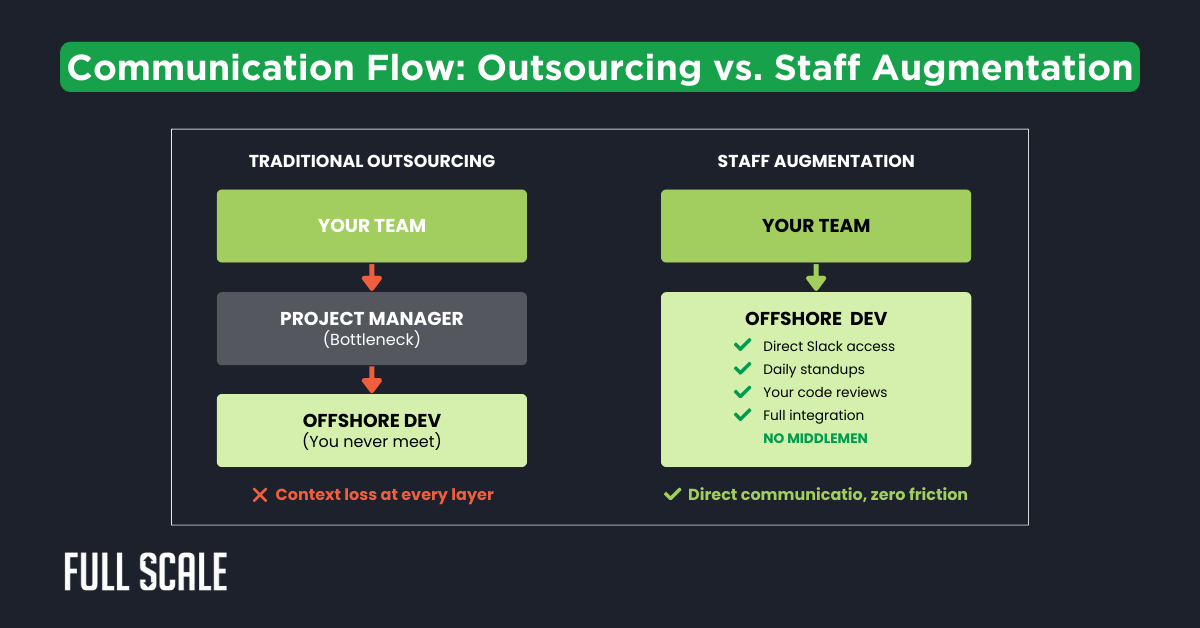
Traditional outsourcing creates layers between you and developers. Staff augmentation eliminates middlemen entirely. Your offshore developers work exactly like your local team—because they ARE your team.
Why Your Offshore Project Failed (It Wasn't the Developers)
Let’s be honest. You tried offshore before. It was a disaster.
Communication sucked. Quality was inconsistent. Developers disappeared mid-project. You swore off offshore forever.
But you made one critical mistake: You used outsourcing development when you should’ve used staff augmentation. According to Bureau of Labor Statistics data, 57.3% of software developers in traditional outsourcing arrangements experience high turnover. That’s not a developer problem—it’s a model problem.
Here are the five reasons offshore development models fail with traditional outsourcing:
The Middleman Bottleneck
Project managers create communication delays. Your requirements go through telephone—what you said, what the PM heard, what they told the developer, what the developer understood.
Ever played telephone? That’s your product specs by the time they reach the actual coder.
Contractor Mentality
Developers aren’t invested in your success when they’re vendor employees working on 3-4 client projects simultaneously. They deliver minimum viable output. No proactive thinking. No ownership.
Why would they care? You’re not their employer. They’re reassigned next quarter anyway.
Misaligned Incentives
Here’s what nobody tells you: Traditional outsourcing agencies profit from MORE hours, not efficient code. Scope creep is their business model.
Your vendor makes more money when projects take longer. Think about that.
Integration Theater
“Integration” in outsourcing means weekly status calls where a PM reads updates. Your offshore team operates in a silo. No direct designer access. No PM collaboration. Separate tools, separate processes.
If your “integrated” offshore team doesn’t have direct Slack access to your product designers, you’re not integrated.
Talent Roulette
You don’t control who’s actually writing your code. That “senior React developer” on the proposal? It could be a junior who Googles half their work.
Agencies rotate developers between projects constantly. 45% of software developers in outsourcing arrangements stay less than 2 years. Your codebase becomes a relay race where nobody finishes what they started.
The Truth Bomb
Congrats on your offshore team! Unfortunately, you also hired their account manager, project coordinator, and three layers of overhead you'll never meet but always pay for.
I’ve lived this nightmare. At VinSolutions, we tried traditional outsourcing three times. Three different vendors. Same problems every time.
The breakthrough came when we hired developers directly—treated them like our Kansas City team, just in a different timezone. Retention jumped. Quality improved. Communication got easier.
That’s the model we built Full Scale around.
How Staff Augmentation Actually Works
Here’s what staff augmentation software development looks like in practice. No theory. No marketing fluff. The actual week-by-week process.
Week 1: Your Requirements, Your Interview
You define exact role requirements—senior React dev, 5+ years, microservices experience, whatever you need. We present 2-3 pre-vetted candidates within 7 days.
You interview them directly. Technical questions, culture fit, coding challenges—whatever matters to you. You make the hiring decision. Don’t like the candidates? We find more.
No PM filtering. No “here’s who we assigned you.” You choose.
Week 2: Direct Integration
Developer starts. Gets direct access to your Slack, Jira, GitHub, Figma—all your tools. Joins daily standups. Sprint planning. Retrospectives.
Reports to YOUR engineering lead, not our project manager. Because we don’t have project managers. That’s the whole point.
Suppose this sounds like hiring a local developer, perfect. You’re getting it.
Week 3-4: Full Productivity
The developer contributes to actual sprints. Code reviews with your team. Direct communication with designers and PMs. Becomes a functioning team member.
Clients tell us it feels like “they’ve been here for months” by Week 3. Teams implementing staff augmentation report 83% success rates compared to 40% with traditional outsourcing.
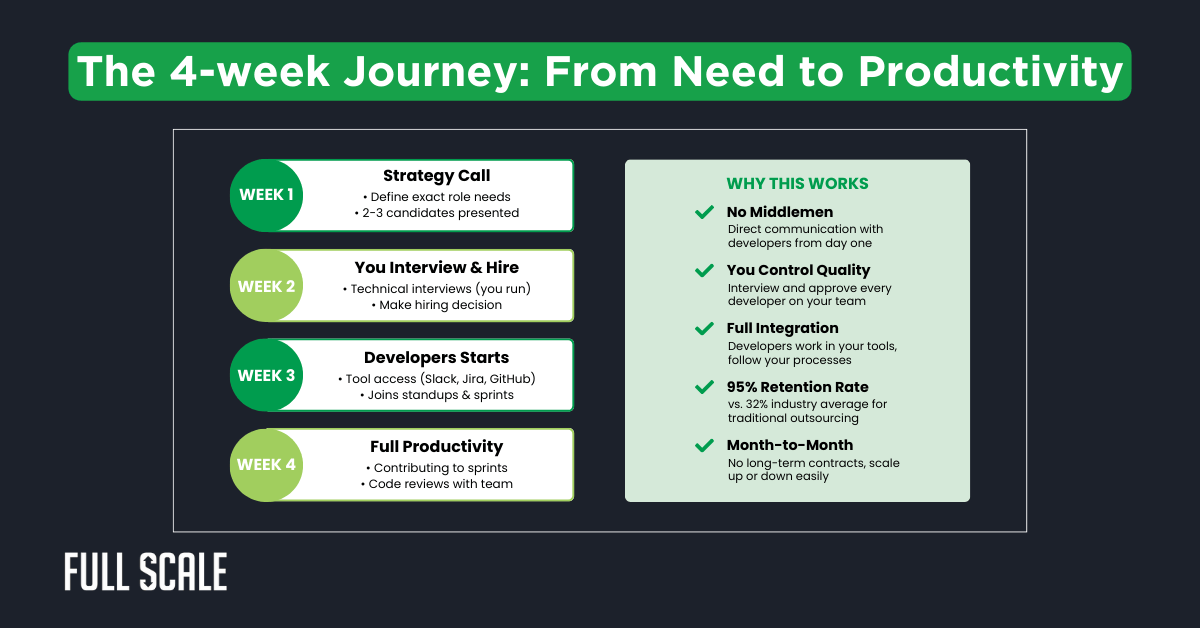
The 4-week timeline from initial call to productive developer. No 90-day hiring cycles. No vendor lock-in. Just developers who work like they’re yours—because they are.
The Retention Difference That Actually Matters
When developers feel like real team members—not disposable contractors—they stay. Our 95% retention rate vs. the 32% industry average isn’t luck.
It’s the model. Developers have career growth. Training budgets. Promotion paths. They work for ONE company (yours), not juggling three client projects.
That compound knowledge matters. A developer who’s been on your codebase for 18 months is 3-4x more productive than a constant rotation.
Ready to See How This Works for Your Team?
Book a 30-minute strategy call. No obligation. No high-pressure sales.
Schedule Your Call →The January 1, 2026 Reality Check: Side-by-Side Timeline
You’re reading this on December 3, 2025. Let’s do math. December 3 to January 1 = 29 days.
Traditional outsourcing development takes 4 weeks to START. The model doesn’t fit your timeline. Staff augmentation can get you productive developers by New Year’s Day.
Here’s what actually happens:
| Date | Traditional Outsourcing | Staff Augmentation (Full Scale) |
|---|---|---|
| Dec 3, 2025 | Contact vendors, wait for proposals | Book strategy call, define exact roles |
| Week 1 | Review 5-7 proposals, compare vague offerings | Interview 2-3 candidates, make decision |
| Week 2 | Negotiate contracts, wait for "team assembly" | Developer starts, gets tool access |
| Week 3 | Meet PM, discuss requirements (again) | Developer contributing to sprints |
| Jan 1, 2026 | Still in requirements, zero code | Developer shipping features ✓ |
| Jan 31, 2026 | First code (maybe), misaligned | Sprint velocity up, considering Dev #2 |
⏰ Timing Reality Check
Start this week = productive developer January 1. Wait "until after holidays" = still interviewing January 15. You have 29 days to make this decision. Traditional outsourcing won't get you there. Staff augmentation can.
Which Model Is Right for You?
Not everyone needs staff augmentation. Sometimes, traditional outsourcing development actually makes sense. Here’s the decision framework.
Use Traditional Outsourcing When:
One-time, self-contained project with fixed scope: Example: “Build us a mobile app based on these exact wireframes, launch in 3 months, done.” The project has clear boundaries. Vendor delivers. You move on.
No internal technical leadership: If you don’t have a CTO or senior dev to guide work, you need PM oversight. Someone has to manage developers. Might as well be the vendor.
Want zero day-to-day involvement: You’re willing to pay a premium and accept less control for hands-off delivery. Tradeoff acknowledged upfront.
Use Staff Augmentation When:
Building/scaling ongoing product development: Most software companies. Your product is never “done.” You need a team that grows with you, not a vendor that disappears when the contract ends.
Have technical leadership in place: CTO, VP Engineering, or Senior Dev who can manage and mentor. These developers work FOR you, so you need someone to lead them. Learn more about scaling with staff augmentation.
Want full control and direct communication: Your team, your standards, your processes. No middlemen. No communication barriers. Developers in your Slack answering to your engineering lead.
Need long-term team members, not contractors: Retention compounds. A developer who’s been on your codebase for 18 months knows your architecture. They prevent bugs before they happen. They mentor new hires. That’s worth more than rotating “resources.”
Want developers who think like owners: They’ll tell you when something’s a bad idea. They’ll suggest better approaches. They’re invested in success—because they’re YOUR team.
🎯 The Simple Test
Do you want a vendor or a team member? If you said team member, you need staff augmentation. Choosing outsourcing for ongoing product development is like hiring Uber drivers to be your company fleet. It works... until you realize you should've just hired drivers.
What You Actually Pay: Staff Augmentation Benefits Include 60-70% Cost Savings
Let’s talk money. Real numbers. No hidden fees.
According to Full Scale’s transparent pricing, here’s what offshore team integration actually costs:
| Cost Factor | US Local Hire | Traditional Outsourcing | Staff Aug (Full Scale) |
|---|---|---|---|
| Senior Developer | $150-200K/year | $80-120/hour | $4,500-5,500/month |
| Benefits/Taxes | +30% ($45-60K) | Included (marked up) | Included in rate |
| Recruitment | $30K agency fee | "Free" (hidden) | Included |
| PM Overhead | N/A (direct) | $20-40/hr (mandatory) | $0 (you manage) |
| Annual Total | $195-260K | $140-200K+ | $54-66K |
| Savings vs Local | Baseline | 25-30% | 60-70% ✓ |
That outsourcing “savings” vs local? Half goes to PM overhead you don’t need. With staff augmentation, YOU keep those savings.
Interactive Cost Calculator: See Your Actual Savings
Calculate exactly how much you’ll save with staff augmentation vs. local hiring. Adjust the numbers to match your situation and see the difference.
Your Cost Savings Calculator
See exactly how much you'll save with Full Scale's staff augmentation model
Ready to unlock these savings? Book a strategy call and start building your team.
See How We Can Help You →Use the calculator to see your actual savings based on your team size and local market rates. The numbers are real. The savings are substantial.
💰 What You Can Do with $477K+ in Savings
- Hire 7 MORE developers (10 total for the price of 3 local)
- Fund your entire AWS bill for 18 months
- Launch that new product line your board keeps asking about
- Actual impact on your roadmap instead of budget constraints
Stop thinking “cost per developer.” Start thinking “features shipped per dollar.” Staff aug wins 2-3x. According to the U.S. Bureau of Labor Statistics, the median annual wage for software developers was $133,080 in May 2024—making offshore staff augmentation even more compelling.
How Full Scale Does Staff Augmentation Differently
Every staffing company claims they’re “different.” Here’s what actually makes Full Scale different—with proof.
You Interview. You Decide.
Most staffing companies “assign” developers to you. We present 2-3 candidates. You interview them—technical questions, culture fit, everything. You make the hire decision.
Don’t like the candidates? We find more. No assignments. No surprises.
Direct Tool Access from Day 1
Your developers get direct Slack, Jira, GitHub, and Figma access. No ticketing systems. No PM gatekeepers.
They work exactly like your Kansas City team—just in a different timezone. Explore our comprehensive IT staff augmentation services.
Your Management Structure
Developers report to YOUR engineering lead, not our project manager. Because we don’t have project managers. That’s the entire point.
If a staffing company won’t let you interview candidates directly, they’re hiding something. Probably skill level.
Developer Career Growth
We treat developers like long-term employees, not disposable contractors. Career development. Training budget. Promotion paths.
That’s why our retention is 95% vs. the 32% industry average. Treating people well isn’t just right—it’s why clients get better outcomes.
US-Based Contracts
You sign with a US entity. US legal protection. US customer support. We handle all Philippines compliance, payroll, and benefits.
You get offshore cost advantages without operational complexity. Learn about our staff augmentation playbook for implementation.
📊 Real Client Transformation
SaaS Company: Tried project outsourcing twice. Both times: communication breakdown, misaligned expectations, developer turnover after 6 months.
Switched to Full Scale's Staff Augmentation:
- Week 1: Interviewed 3 senior React developers
- Week 2: Hired 2, both started same day
- Week 3: Developers shipping features
- Month 6: Scaled to 12 developers
- 18 months later: Zero turnover, team velocity 3x
Their CTO: "I forgot they're offshore. They're just my team."
🏥 Healthcare Tech Startup Success
Challenge: Series B healthcare startup couldn't find senior backend developers locally. Urgent HIPAA-compliant API needed for Q1 launch.
Full Scale Solution:
- 3 senior backend developers (Python, Node.js) in 2 weeks
- Full HIPAA training and compliance certification
- Direct integration with US-based security team
- Shipped API 6 weeks ahead of schedule
- $180K saved vs. local hiring in first year
VP Engineering: "Quality exceeded our US candidates. Communication was seamless. We've since scaled to 8 Full Scale developers."
💳 FinTech Company Scaling Story
Challenge: Payment processing platform needed to 3x engineering capacity. Local salaries ($220K+) made growth unsustainable.
Full Scale Solution:
- Started with 2 developers (trial period)
- Scaled to 15 developers over 9 months
- Built dedicated frontend and backend teams
- $1.2M annual savings vs. local hiring
- Used savings to fund mobile app development
CTO: "We wouldn't have survived Series A without Full Scale. The cost savings bought us 18 extra months of runway."
Your Move: December Call = January Productivity
Here’s what happens when you book a strategy call this week:
Call 1 (30 minutes): Strategy Discussion
We cover your team structure, roles needed (senior React dev? DevOps? Full-stack?), tech stack requirements, timeline, and goals.
No high-pressure sales. No vague promises. Just an honest assessment of fit.
Week 1: Candidates
We provide 2-3 pre-vetted candidates per role. Detailed resumes, portfolios, and code samples. Scheduling for YOUR technical interviews.
You decide which to interview. What questions to ask. Whether to make offers.
Week 2: Onboarding (If You Move Forward)
Contracts signed (US entity, month-to-month). Developer gets tool access. Kickoff call with you, the developer, and our team.
That’s it. No long-term lock-in.
Week 3: Productivity
Developer joins standups. Works in your repos. Communicates directly with your team. Ships actual code.
Two Paths Forward
❌ Path 1: Do Nothing
- Wake up January 15, 2026
- Still short on developers
- Still behind on roadmap
- Still dealing with recruiter spam
- Q1 goals already compromised
✓ Path 2: Book a Call This Week
- 30-minute strategy call (no obligation)
- Meet candidates by next week
- Productive developer by January 1
- Q1 goals actually achievable
- $300K+ saved vs local hiring
December slots filling fast • No credit card required
Month-to-Month. No Lock-In.
This isn’t a marriage. Month-to-month contracts. Doesn’t work? 30 days’ notice. Does work? You’ll wish you started sooner.
Why Partner with Full Scale?
Here’s what makes us the right staff augmentation firm for your team:
✓ 95% Developer Retention Rate vs. industry average of 32%. Our developers stay because they’re treated like people, not resources.
✓ 2-Week Start Times: From strategy call to productive developer. No 90-day hiring cycles. Perfect for hitting January 1 deadlines.
✓ Direct Integration Model: No project managers. Your developers work directly with your team from day one. Full Slack, Jira, GitHub access.
✓ US-Based Contracts & IP Protection: Sign with a US entity. Full IP protection. US legal framework, you understand. We handle Philippines compliance.
✓ Transparent, Fixed Pricing: $4,500-5,500/month for senior developers. No hidden fees. No surprises. Calculate your exact savings above.
✓ You Interview & Approve Every Developer: We don’t assign. You choose. Technical interviews run by your team. Don’t like candidates? We find more.
✓ Month-to-Month Flexibility: Scale up or down. No long-term contracts. Thirty days’ notice either direction. Try before committing.
✓ 60+ Tech Companies Trust Us: From startups to established enterprises. See how we help companies scale.
✓ Specialized Skill Access AI/ML engineers, DevOps specialists, cloud architects, mobile developers. Access skills unavailable in your local market.
✓ Focus on Developer Career Growth Training budgets, promotion paths, and professional development. We maintain 95% retention, and you get experienced, motivated developers.
Outsourcing means hiring a vendor company that assigns developers you never meet, managed by their PMs. Staff augmentation means hiring developers who work directly for you—on your Slack, in your standups, managed by your team leads. The vendor only handles payroll. Different relationship, different results.
Two weeks from the strategy call to the developer starting. Week 1: Interview candidates. Week 2: Developer onboarded with tool access. Compare that to 90-day local hiring cycles or a 4-week outsourcing setup.
The first 2 weeks are an evaluation period. Not working? We replace at no cost. Month-to-month contracts mean no long-term lock-in anyway. Compare that to local hiring: 3-month search, $200K salary, 6-month ramp time. If they don’t work? You’re $100K in and 9 months behind.
Full Scale pricing: Senior developers $4,500-5,500/month. Junior developers $2,500-3,500/month. QA engineers $2,500-3,500/month. Compare to $195-260K annually for US senior developers. That’s 60-70% savings with transparent, fixed monthly costs. Use our calculator above for your exact numbers.
We run entire engineering organizations offshore now. Backend infrastructure, Kubernetes, microservices, 99.99% uptime. Clients trust offshore teams with production systems and on-call rotation. If they trust offshore devs with 3 AM production issues, your “too complex for offshore” theory needs updating. Learn more about offshore development capabilities.