Nearshore vs Offshore: When Each Wins (From a CEO Who’s Hired Both)

In this article
- Nearshore vs Offshore: The Definitions
- Nearshore vs Offshore: The Real Comparison
- The Time Zone Question (Most Posts Get This Wrong)
- When Nearshore Wins
- When Offshore Wins
- Onshore vs Nearshore vs Offshore: The Three-Way Comparison
- Real Examples From Hiring Globally
- Frequently Asked Questions About Nearshore vs Offshore
- The Bottom Line
I’ve personally hired developers in four offshore and nearshore countries: Uruguay, Colombia, Russia, and the Philippines. Each one taught me something different about what actually makes the model work. Full Scale’s own placement count is now past 700, and I’ve written up what those hires taught me about the Philippines specifically.
Most nearshore-vs-offshore posts treat the choice as a time-zone math problem. It isn’t. The real variable is what hours your team actually works. And that doesn’t track the country your developers live in nearly as cleanly as most ranking pages claim.
Here’s the framework that explains when each model wins, and why the “time zone edge” of nearshore is smaller than most posts make it look.
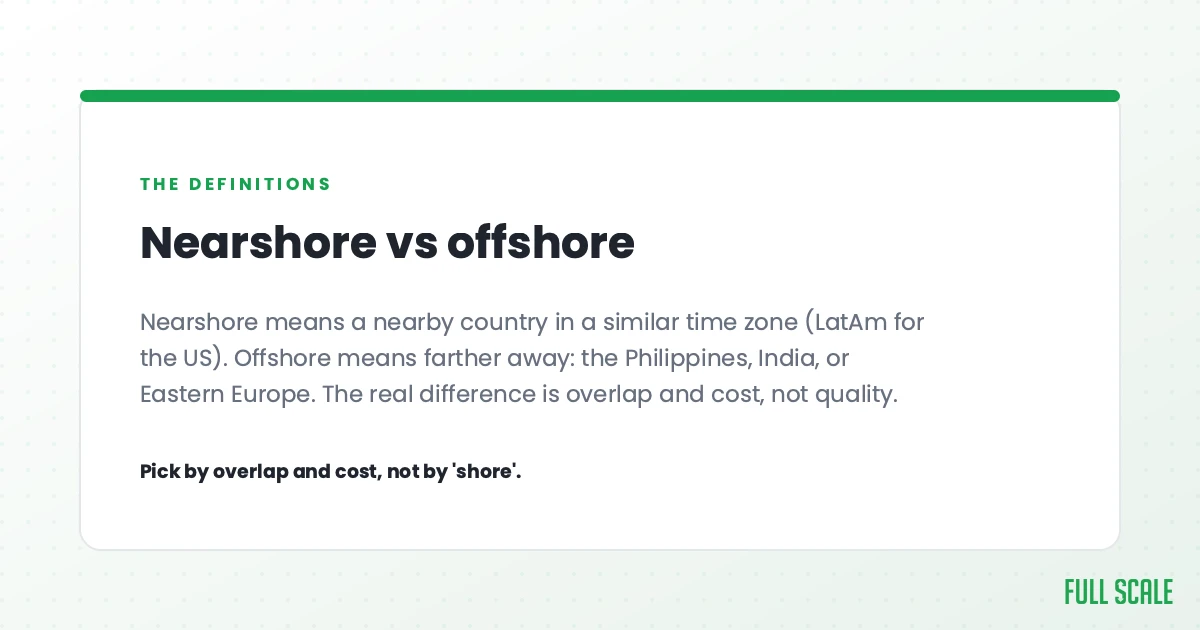
Nearshore vs Offshore: The Definitions
Onshore is hiring developers in the same country as your business. A US team hires US developers, full stop.
Nearshore is hiring developers in a nearby country with heavy time-zone overlap. For US teams, that means Mexico, Costa Rica, Colombia, Argentina, Brazil, Uruguay. The time difference is 1 to 4 hours from US working hours.
Offshore is hiring developers in a country with 5+ hours of time difference. For US teams, the main offshore countries are the Philippines, India, Vietnam, and Eastern Europe (Poland, Romania, Ukraine). The time difference is 8 to 13 hours. Two of those countries get compared head to head a lot, and we break down software developers in vietnam against the Philippines directly, and we've done the same for Eastern Europe against the Philippines. For European teams the time-zone math flips entirely, which is why hiring developers from Europe gets its own breakdown.
Those are the three main engagement models. I’ve hired under all three: nearshore teams in Uruguay and Colombia, offshore teams in Russia and the Philippines, where Full Scale has placed 700+ engineers with US companies since 2018. Most companies pick a model based on time-zone math. That’s the part most posts get wrong.
Nearshore vs Offshore: The Real Comparison
| Factor | Nearshore | Offshore |
|---|---|---|
| Typical locations (for US teams) | Mexico, Costa Rica, Colombia, Argentina, Brazil, Uruguay | Philippines, India, Vietnam, Eastern Europe |
| Time zone overlap with US business hours | 4-8 hours naturally | 1-3 hours naturally, 8+ if devs work a shifted schedule |
| Senior developer rates | $35-$80/hour | $30-$50/hour (Philippines/India), $35-$75/hour (Eastern Europe) |
| English fluency | Generally strong, variable by country | Excellent in the Philippines; variable elsewhere |
| Cultural alignment with US business | High | Variable; the Philippines is high, others differ |
| Travel time from US | 4-8 hour flight | 15-20+ hour flight |
| Talent pool size per country | Smaller | Larger |
| Best fit | Real-time collaboration, frequent travel | Long-term team building, cost-sensitive work |
For the full rate breakdown by country and seniority, see our offshore software development rates guide. For a country-by-country view, see our guide to the best offshore development countries.
The Time Zone Question (Most Posts Get This Wrong)
Most nearshore-vs-offshore comparisons treat time zones as the killer argument for nearshore. The real question is what hours your team works, not where they live.
Someone in the Philippines or India working a US-aligned schedule is the same as someone in Mexico or Colombia working a US schedule. The country is incidental. The hours are what matter.
At Full Scale, we have employees on three schedule patterns:
- Half-day overlap (most common). Filipino engineers work late afternoon Philippine time to midnight, which gives 3 to 4 hours of overlap with US working hours.
- Full US hours (the “graveyard shift”). Some engineers work full US business hours, which is 9 PM to 5 AM in Cebu City. For roles that need real-time customer collaboration or 9-to-5 US coverage, this works fine.
- Their own time zone with async-first communication. Daily standup overlap only. The rest of the workday is independent ship-and-pick-up-the-next-task time.
Most of our customers find that half-day overlap is plenty. They have a daily 1-hour sync, async communication for the rest, and the team ships. The nearshore “we’re in the same time zone” advantage is real but smaller than ranking posts make it look. For most teams, half-day overlap with a strong offshore team beats full overlap with a more expensive nearshore team.
This is the cost-of-living-versus-talent argument applied to time zones. The offshore rate is real, the time-zone gap is fixable with scheduling, and how you structure the team decides whether you actually keep the savings.
When Nearshore Wins
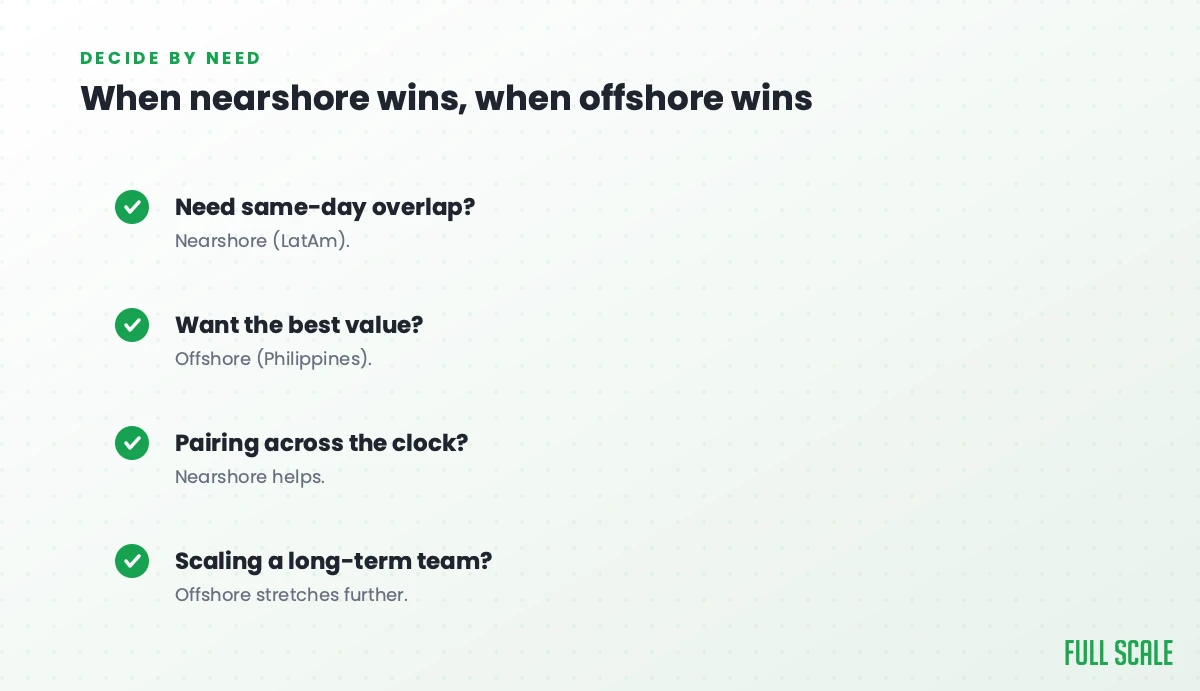
Nearshore is the right answer when one or more of these hold:
- You need frequent in-person travel. A 4-hour flight to Mexico or Costa Rica is dramatically more sustainable than a 20-hour trip to Cebu. Teams that visit the developers quarterly or more often save real time and travel cost going nearshore.
- Real-time stakeholder collaboration is core to the work. Founders writing the product spec live next to the engineer. Live user research feedback. Customer-facing dev where the engineer has to pick up a Zoom call at 2 PM US time and the answer can’t wait.
- Cultural alignment matters more than rate. Latin American developers grow up on American business culture. Their daily rhythms (lunch hours, holidays, the working week) sit even closer to US teams than most offshore countries.
- You’re hiring a small senior team. For 1 to 3 developers where coordination overhead would eat into offshore savings, the nearshore premium often pays back.
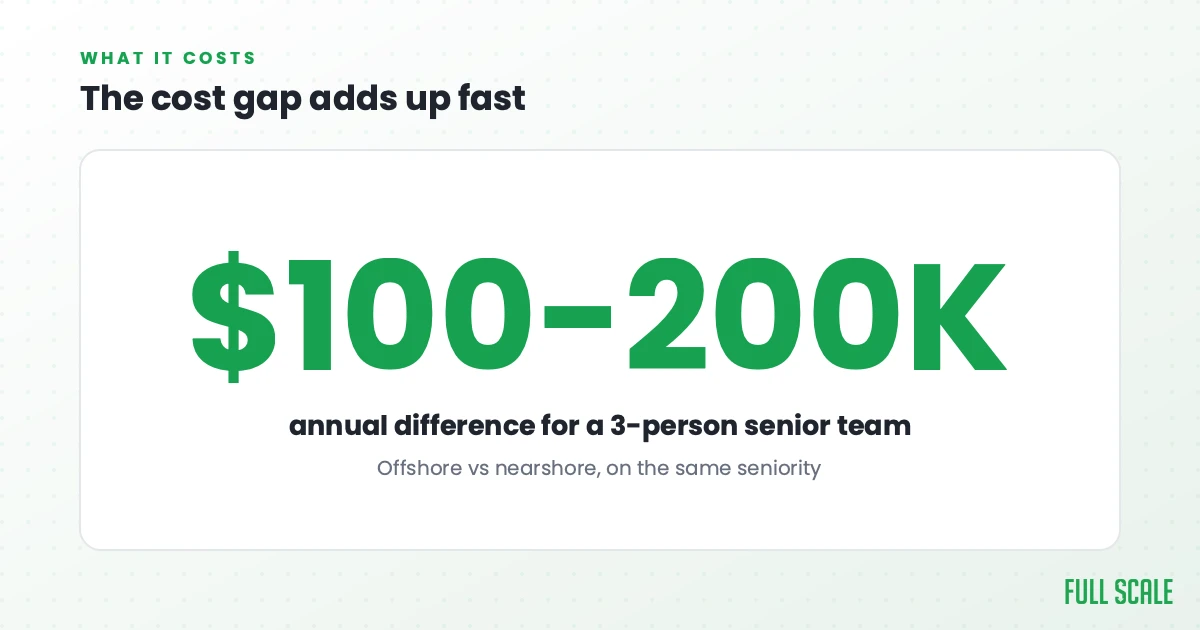
The trade-off is rate. Senior developers in Latin America bill $35 to $80 per hour fully-loaded, depending on country. That runs 30 to 50 percent above Philippines or India rates. For a 3-person senior team, the annual cost difference runs $100K-$200K. For a 15-person team, the difference is closer to $700K-$1.5M. At the high end of that Latin America range, some nearshore staffing platforms, BairesDev included, land close enough to US developer rates that the savings case disappears entirely, which is the math I walk through in our offshore developer rates comparison.
When Offshore Wins
Offshore is the right answer when one or more of these hold:
- You’re building a long-term product team (3+ years). Offshore staff augmentation, structured as a long-term team with high retention, holds the cost savings across years. Full Scale’s developer retention is over 93 percent. The team that started with you in year one is the same team shipping for you in year five.
- You can plan for half-day overlap, or you want US-hour developers. Most product teams ship perfectly well on 3 to 4 hours of overlap. If you need full overlap, offshore partners like Full Scale staff US-hour engineers too.
- The team is bigger than 5 engineers. Offshore savings compound at scale. The cost gap of 50 to 70 percent on a 10-person team is the difference between a $2M annual burn and a $500K one.
- Communication-first hiring matters and the Philippines is on your list. The Philippines is the third-largest English-speaking country in the world, and the local work culture fits remote engineering well. There’s no language barrier with Filipino engineers. Most senior Filipino developers read American technical writing, joke around with US teams, and push back on requirements in fluent English. That fluency is a big reason US companies hire developers in the Philippines.
Across the 200+ tech companies Full Scale has served, the same pattern holds. A long-term team beats project-based work, working directly with developers beats routing everything through a project manager, and high retention is what locks in the savings over time.
For the ROI math on offshore specifically, see our offshore development cost analysis. For the TCO comparison against local hiring, see our in house vs outsourcing breakdown.
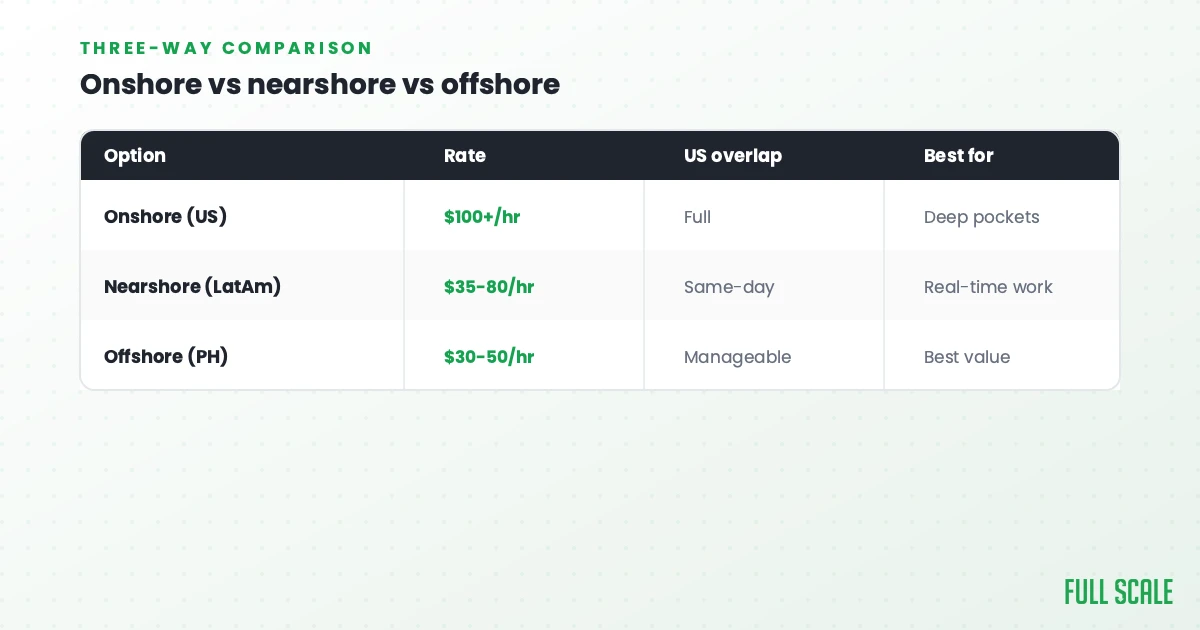
Onshore vs Nearshore vs Offshore: The Three-Way Comparison
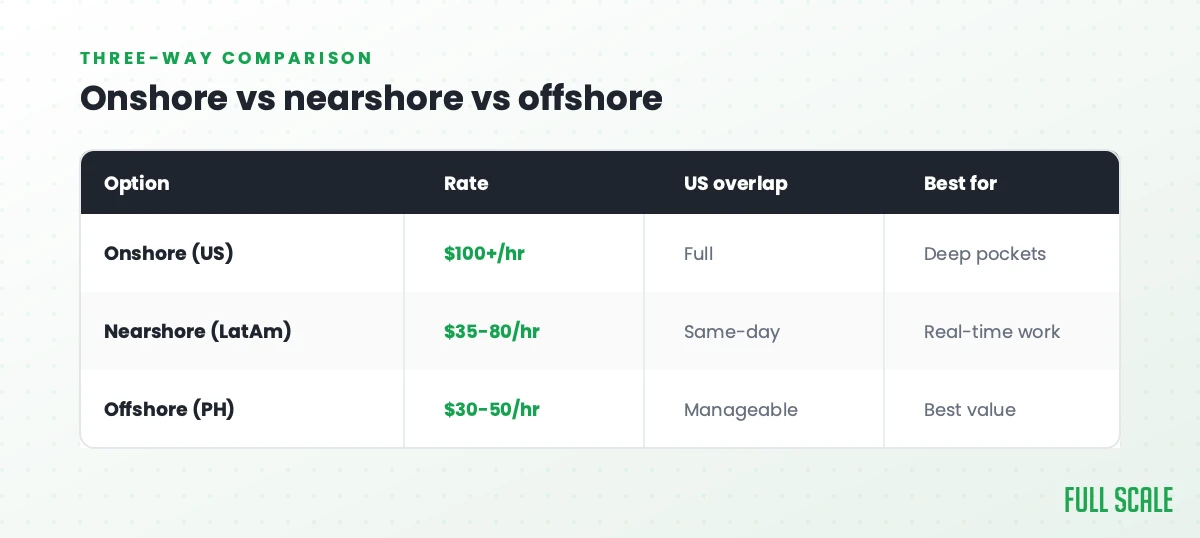
Most cost comparisons stop at nearshore vs offshore. The full picture includes onshore (US developers) as the third option. These ranges match what I’ve paid hiring in four countries and what Full Scale bills US teams today.
| Factor | Onshore (US) | Nearshore (LatAm) | Offshore (PH/EE/India) |
|---|---|---|---|
| Senior fully-loaded annual | $217K-$280K | $130K-$170K | $60K-$80K |
| Time zone overlap | Full | 4-8 hours | 1-3 hours (or US-hour shift) |
| Talent pool | Tight, expensive | Moderate | Massive |
| Cultural alignment | Native | High | Variable (PH high, others differ) |
| Travel time | None | 4-8 hour flight | 15-20+ hour flight |
| Best for | Roles requiring constant stakeholder access | Real-time collaboration, US-time customer work | Long-term product teams, cost-sensitive scaling |
| Typical cost reduction vs onshore | (baseline) | 30-45% | 50-70% |
For most product engineering teams, the right answer is hybrid: onshore engineering leadership plus an offshore development team, with occasional nearshore for time-zone-critical roles. That blend is the onsite-offshore model, and it’s what staff augmentation services are built to deliver. See our writeup on hybrid team cost math for the cost-per-feature breakdown.
Real Examples From Hiring Globally
I’ve personally hired developers in Uruguay, Colombia, Russia, and the Philippines.
Stackify, Uruguay (nearshore, around 2013). A great team that gave us something I’d never had with a vendor before: a proxy product owner who could carry the vision when I couldn’t. We built a whole separate product idea with that team. The product went on the shelf but the team itself was excellent.
Stackify, Colombia (nearshore). A smaller engagement than Uruguay, but useful. Strong technical talent, time-zone-aligned with our Kansas City office, easy to coordinate.
Stackify, Russia, St. Petersburg (offshore, around 2012). My first offshore hire was accidental. A friend ran a Java dev agency and offered to help us build Linux support for Stackify’s monitoring product. We didn’t interview anyone. He vouched for the developers, we trusted him, and the work was excellent.
Stackify, the Philippines (2018, which became Full Scale). When I needed to scale Stackify to support ten new programming languages, US-only headcount was off the table. We set up the office in the Philippines and grew the team to over 20 developers. That team became a big key to Stackify’s exit in 2021. Friends started asking how to get in. That side project became Full Scale.
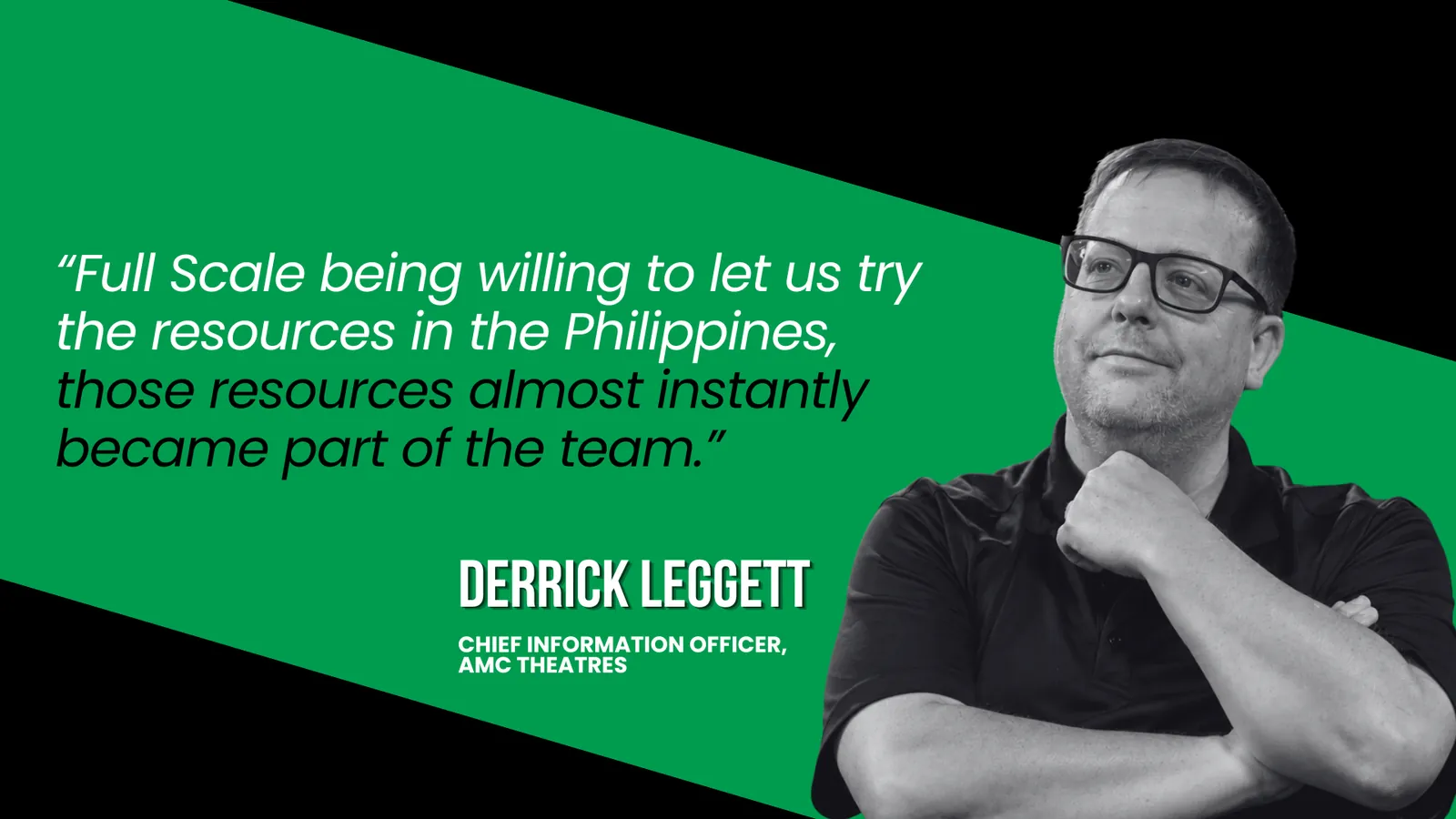
AMC Theatres runs a global engineering organization out of Kansas City under CIO Derrick Leggett. The developers we placed in the Philippines are treated as full AMC engineers, not as contractors. AMC’s Kansas City team flew to our Cebu City office to spend time with the engineers in person. That meant karaoke, the beach, and exploring the city together. The cost reduction runs in the 60 to 70 percent range on backend and QA roles. The structural advantage is simple: AMC’s engineering org ships more product per dollar than orgs three times its size.
LendingStandard processes roughly 30 percent of affordable multifamily property loans nationwide. CEO Andy Kallenbach on working with the team:
Waking up each morning to collaborate with the Full Scale team has become the highlight of my day. Their work ethic, pride in craftsmanship, and the sheer quality of their output have not only met but exceeded our expectations. The most significant impact has been the seamless integration of their team with ours, making every challenge surmountable and every success sweeter.
Read the full LendingStandard case study.
Jason Flowers runs engineering at AG Mednet, and he has hired both. He offshored to India and nearshored to Latin America before he settled on the Philippines, and his QA team there integrated so completely he forgets they are remote:
Other than the fact that they’re not physically here with us, you would think that they’ve always been working with us.
Jason Flowers, Head of Software Engineering and DevOps at AG Mednet, on working with Full Scale
Frequently Asked Questions About Nearshore vs Offshore
What is the difference between nearshore and offshore?
Nearshore developers are in geographically close countries with heavy time-zone overlap (Mexico, Costa Rica, Colombia for US teams). Offshore developers are in countries with 5+ hours of time difference (Philippines, India, Vietnam, Eastern Europe). This is the usual setup for offshore web development services, where the cost gap is widest. The cost difference is 30 to 50 percent because offshore rates run lower due to cost-of-living differences, not skill differences.
Is nearshore better than offshore?
Nearshore is better for teams that need frequent in-person travel or real-time work with stakeholders. It also wins when you are hiring just 1 to 3 senior developers, where coordination overhead would eat into offshore savings. Offshore is better for long-term product teams of 5+ engineers where the cost savings compound and where half-day overlap is sufficient. The time-zone edge of nearshore is real but smaller than most posts make it look. Offshore developers can work US hours when needed.
When should I use nearshore vs offshore?
Use nearshore when you need frequent ad-hoc meetings. It also fits customer-facing work that needs an immediate response, or any engagement where in-person travel is routine. Use offshore for long-term product development with a stable team. It also fits larger teams (5+ engineers) where scale compounds the savings, and cases where communication-first hiring is the priority. That last point makes the Philippines especially strong on English for US clients.
What’s the cost difference between nearshore and offshore?
Senior developers in Latin America bill $35 to $80 per hour. Senior developers in the Philippines and India bill $30 to $50 per hour at Full Scale’s published rates. Senior developers in Eastern Europe bill $35 to $75 per hour. The all-in fully-loaded cost differential is 30 to 50 percent in favor of offshore. For a 10-person engineering team, that gap is $500K to $1M per year.
Which countries are nearshore vs offshore for US teams?
Nearshore for US teams: Mexico, Costa Rica, Colombia, Argentina, Brazil, Uruguay. Offshore for US teams: the Philippines, India, Vietnam, Indonesia, Eastern Europe (Poland, Romania, Ukraine), and occasionally Africa. The boundary is the 5-hour time-zone mark. Anything past that is generally offshore.
Can offshore developers work US business hours?
Yes. At Full Scale, we have employees who work full US business hours from the Philippines. They run a graveyard shift, 9 PM to 5 AM local time. For roles that need real-time customer collaboration or 9-to-5 US coverage, this works fine. Most of our customers find half-day overlap is plenty. That is 3 to 4 hours of shared time between offshore and US teams, with async work for the rest. Once you’ve settled on a region, the real work is learning how to hire offshore developers who fit the schedule you picked.
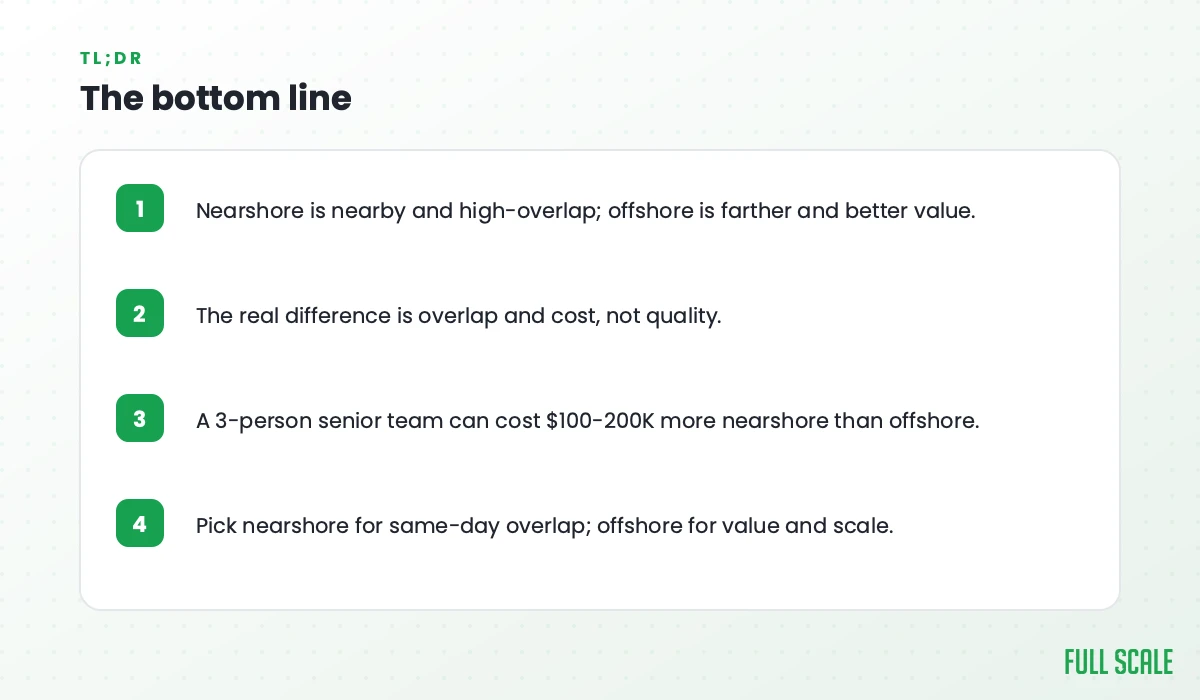
The Bottom Line
Pick the hours first. The country follows.
It’s the rule Full Scale runs on: 300+ engineers in the Philippines, all working US-overlapping hours.