What to Do When Your January 1 Developer Start Date Is Non-Negotiable: How to Hire Developers Fast
Your CEO just told you: “We need developers by January 1. That’s the board presentation date. Non-negotiable.”
It’s December 18. You have 2 weeks.
Traditional hiring says it’s impossible. Traditional hiring takes 3-4 months.
But this isn’t a traditional situation. This is a deadline that can’t move.
Here’s the emergency framework to hire developers fast—even when you’re starting with 14 days or less.
📋 What You'll Learn
- ✅ The 3-week emergency framework that makes January 1 possible
- ✅ Why traditional hiring fails for urgent deadlines (and what works instead)
- ✅ The 7-day onboarding sprint that gets developers productive immediately
- ✅ Quality assurance tactics for fast hiring without compromising standards
- ✅ Real case study: 4 developers hired in 17 days for a hard deadline
The Problem Isn't Speed—It's the Wrong Hiring Model
Everyone will tell you it’s impossible. Your HR team. Your recruiter. Your CTO friends.
They’re wrong.
Not because they’re bad at their jobs. But because they’re using the wrong model for emergency developer hiring.
Traditional recruiting wasn’t built for “we need developers by January 1.” It was built for “we’re planning to expand in Q2.”
Big difference.
LinkedIn’s 2024 hiring data shows the average time-to-hire for software developers is 49 days. That’s just the hiring part—before onboarding.
You don’t have 49 days. You have 14.
Here’s what makes January 1 actually possible: pre-vetted staff augmentation. Not freelancers. Not project outsourcing. Direct integration with developers has already undergone technical assessment.
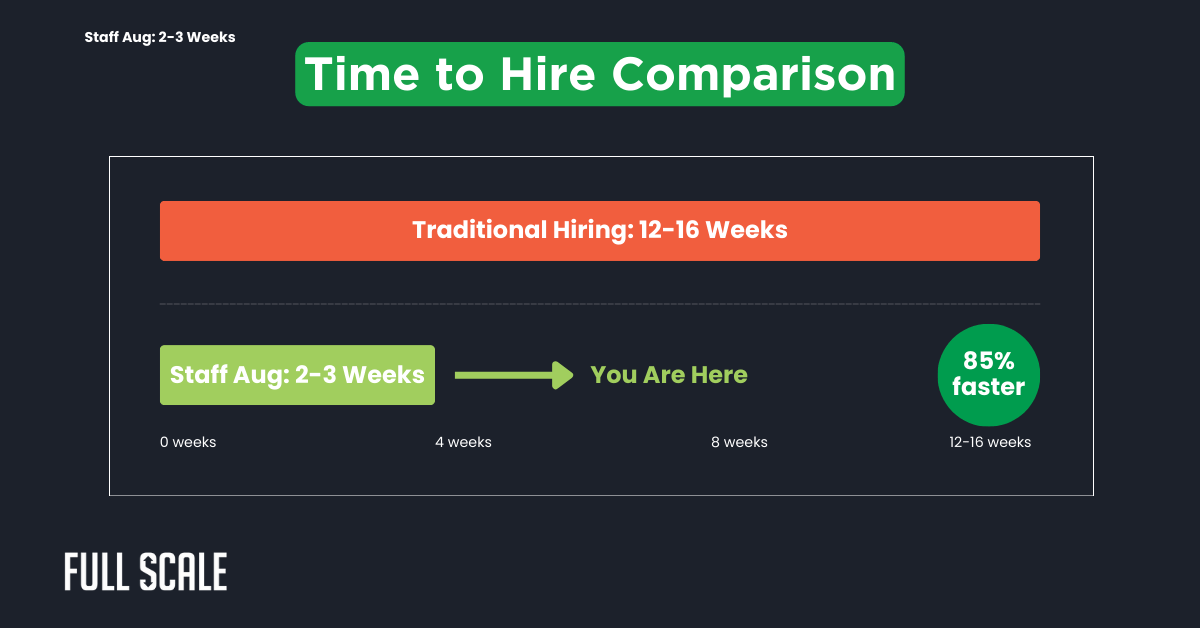
This visual compares traditional hiring timelines against staff augmentation speed. Traditional methods span 12-16 weeks across multiple phases, while staff augmentation compresses the process to 2-3 weeks. The key difference: staff augmentation eliminates the sourcing and screening phases entirely by using pre-vetted developer networks.
I’ve seen companies successfully hire developers fast dozens of times. The ones who fail are trying to speed up a process that can’t be sped up.
The ones who succeed switch processes entirely. Traditional hiring is like trying to book a same-day flight during Christmas.
Sure, the system exists. But it wasn’t built for your emergency.
The 3-Week Emergency Framework to Hire Developers Fast
This framework has worked for 60+ companies facing impossible deadlines. It compresses what normally takes 16 weeks into 21 days.
Here’s exactly how it works. Every phase builds on the previous one.
Week 1 (Days 1-7): The 72-Hour Sprint
Your first 72 hours determine success or failure. Speed matters, but not at the expense of clarity.
This week focuses on rapid selection, not exploration.
Day 1: Define Requirements (Not Job Descriptions)
- List exact technical skills needed (React, Node.js, AWS, etc.)
- Specify experience level (senior only, mid-level acceptable, etc.)
- Identify timezone requirements (overlap hours needed)
Day 2: Choose Your Hiring Model
- Stop traditional recruiting immediately if in progress
- Contact staff augmentation partners with pre-vetted developers
- Verify they can present candidates within 72 hours
Day 3: Kickoff Call
- Share technical requirements with your partner
- Discuss team dynamics and cultural fit needs
- Set interview timeline for Days 4-7
Days 4-5: Review Candidate Profiles
- Receive 4-6 pre-vetted candidate profiles
- Review portfolios and past project work
- Shortlist 3-4 for technical interviews
Days 6-7: Conduct Focused Technical Interviews
- 90-minute technical deep-dives (not 5-round processes)
- Real code review of their actual work
- Architecture discussions and problem-solving assessment
Job postings. Weeks of screening. Endless interview rounds. That's not cutting corners—that's cutting bureaucracy.
Week 2 (Days 8-14): Integration Preparation
Week 2 is about preparation, not more interviewing. Your developers are selected.
Now you set them up for success. This preparation phase ensures Day 1 productivity.
Days 8-9: Finalize Selections
- Make offers to selected developers
- Initiate contracts and paperwork
- Confirm the January 1 start date commitment
Days 10-11: Set Up Tools and Access
- Create Slack accounts, GitHub access, and project management tools
- Prepare development environment setup instructions
- Document security and compliance requirements
Days 12-14: Pre-Onboarding (Async)
- Share documentation, architecture diagrams, and codebase overviews
- Provide recorded demos of key systems
- Send team introductions and communication norms
This async pre-work means your developers arrive on January 1 already familiar with your tech stack. They’re not starting from zero.
Week 3 (Dec 25-Jan 1): Soft Launch
The final week is your secret weapon. Most companies waste the first week of January on orientation.
You won’t. This soft launch transforms Day 1 from “introduction” to “contribution.”
Dec 26-30: Shadow and Observe
- Developers join daily standups (as observers)
- They review code and pull requests
- They ask questions in Slack channels
Dec 31: Final Preparation
- Environment setup verification
- Access confirmation for all tools
- First tasks identified and assigned
Jan 1: Official Start (But They’re Already Integrated)
- Developers begin productive work immediately
- First commits happen on Day 1, not Week 2
- They already know the team, the codebase, and the workflow
| Week | Focus | Key Milestones |
|---|---|---|
| Week 1 | Rapid Selection | Requirements defined, candidates interviewed, selections made |
| Week 2 | Integration Prep | Tools configured, documentation shared, contracts finalized |
| Week 3 | Soft Launch | Async onboarding, shadowing, environment setup |
This breakdown shows each week’s strategic focus and concrete deliverables. Week 1 completes all selection decisions. Week 2 handles logistics and setup. Week 3 integrates developers before their official start date, eliminating traditional first-week orientation time.
Glassdoor’s 2024 research shows companies using structured onboarding see 70% greater new hire productivity. This framework takes that principle and compresses it into three weeks.
Why Traditional Hiring Fails for Urgent Developer Start Dates
Your recruitment process was designed for hiring in 2019. It wasn’t designed for December 18th with a January 1 deadline.
Let’s break down what traditional hiring actually looks like. Each step has valid reasons in normal circumstances.
But you don’t have normal circumstances.
The Real Timeline of Traditional Developer Hiring
Week 1-2: Write job description, get internal approvals, create posting
Week 3-4: Post to job boards (Indeed, LinkedIn, company site)
Week 5-6: Screen 100+ applicants, eliminate 90% immediately
Week 7-8: First round phone screens with remaining 10-15 candidates
Week 9-10: Technical assessments and coding challenges
Week 11-12: Final interview rounds with team and leadership
Week 13: Extend offer, negotiate terms
Week 14-16: Wait for candidate’s notice period at current job
Total timeline: 16+ weeks minimum. You have 2 weeks.
See the problem?
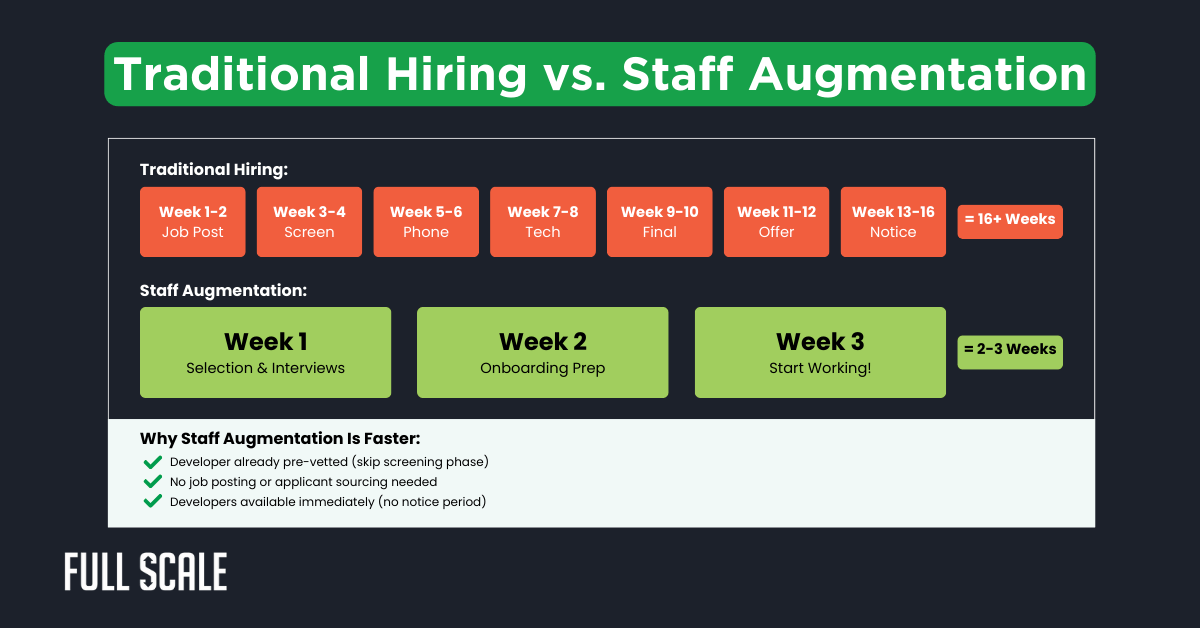
This timeline comparison reveals where traditional hiring creates bottlenecks for urgent deadlines. The traditional model requires seven distinct phases spanning 16+ weeks, with significant waiting periods built into each stage. Staff augmentation collapses this to three action-packed weeks by leveraging pre-vetted talent pools, eliminating the sourcing bottleneck entirely.
Every step in traditional hiring exists for valid reasons during normal hiring. Job postings attract diverse candidates.
Multiple interview rounds reduce hiring mistakes. But those steps were built for hiring when you have time.
When you don’t have time, they become obstacles. Here’s the missing ingredient: pre-vetted talent pools.
Staff augmentation companies maintain networks of developers who’ve already passed technical assessments. You’re not starting from scratch.
You’re selecting from pre-qualified candidates who can start immediately. Deloitte’s 2024 contingent workforce research shows 63% of companies report quality concerns with freelancer platforms.
Staff augmentation sits between freelancers and full-time hiring. You get dedicated developers who work exclusively for you.
How to Maintain Quality When You Hire Developers Fast
Here’s the elephant in the room: “Won’t emergency developer hiring mean bad developers?”
Fair question. Bad answer: No, if you have the right quality gates.
Most companies think thorough hiring equals slow hiring. Not true.
The 3-Gate Quality System for Fast Hiring
Thorough hiring means asking the right questions at the right time. Slow hiring means asking the same questions 5 different ways.
Here’s the dirty secret: “thorough” hiring processes don’t predict quality better than focused, rapid assessment. They just make HR feel better.
Your January 1st deadline doesn’t care about HR’s feelings.
Gate 1: Pre-Vetting (Done by Partner, Not You)
When you work with a staff augmentation partner, developers arrive pre-vetted. This means:
- ✅ Technical skills already assessed through coding tests
- ✅ Portfolio reviews completed by technical experts
- ✅ Reference checks verified from past employers
- ✅ Communication skills evaluated through video interviews
- ✅ Cultural fit pre-screened based on your requirements
You’re not evaluating if they can code. You’re evaluating if they fit your specific needs.
Gate 2: Focused Technical Interview (You Assess Fit, Not Basics)
Your technical interview should be 90 minutes maximum. Here’s what to cover:
- 30 minutes: Architecture discussion about your system
- 30 minutes: Code review of their actual past work
- 30 minutes: Problem-solving scenario relevant to your domain
Those are great when you have 12 weeks. You have 2 weeks.
Gate 3: Rapid Onboarding Trial (First Week Is Working Interview)
Your real quality assessment happens in Week 1. Assign actual tasks immediately:
- Day 1-2: Small bug fix or documentation update
- Day 3-4: Minor feature addition
- Day 5-7: First real task with code review
If quality concerns emerge, you see them in days, not months. With month-to-month staff augmentation contracts, your risk is minimal.
✓ Interactive Quality Assurance Checklist
Track your quality gates as you progress through emergency hiring. Check off each item:
Full Scale’s 95% developer retention rate proves quality isn’t sacrificed. Compare that to the industry average developer turnover of 13.2% annually.
When developers are pre-vetted and integrated directly into your team, retention skyrockets.
Your 24-Hour Action Plan to Hire Developers Fast
You don’t have time to explore options. You have time to execute on THE option.
Pick up the phone in the next hour. Still reading? Stop.
Put this article down. Pick up the phone. While you’re reading this sentence, you’ve lost another hour.
Next 24 Hours (DO THIS NOW)
Hour 1: Stop Traditional Recruiting Immediately
- Cancel any in-progress job postings
- Inform recruiters you’re changing your approach
Hour 2: Define Exact Technical Requirements
- List specific skills needed
- Specify the experience level required
Hour 3: Calculate Your True Budget
- Factor in the cost of missing the deadline
- Compare costs vs. staff augmentation rates
Hours 4-8: Contact Staff Augmentation Partners
- Call Full Scale now
- Verify 72-hour candidate presentation
Hours 8-24: Review First Candidate Profiles
- Evaluate portfolios
- Schedule interviews for Days 2-3
📋 Track Your 24-Hour Action Plan Progress
Click each item as you complete it. Track your momentum:
⚡ Hours 1-3 (Critical First Actions)
🤝 Hours 4-8 (Partner Outreach)
👥 Hours 8-24 (Candidate Review)
Critical Reminder
Every hour you wait reduces your chances of hitting January 1.
December 18: ✅ doable
December 20: ⚠️ very tight
December 22: 🚨 mathematically challenging
Why Partner with Full Scale to Hire Developers Fast
When your January 1 deadline is non-negotiable, you need a partner built for this scenario. We’ve placed 60+ companies facing impossible deadlines.
Why Full Scale Works:
- ✅ Pre-Vetted Developer Network: 300+ senior developers already assessed
- ✅ Proven 2-3 Week Timeline: 17 days average from call to start
- ✅ Direct Integration Model: No middlemen, direct team access
- ✅ 95% Developer Retention: Industry-leading retention proves quality
- ✅ Transparent Pricing: $4,800-$6,600 monthly
- ✅ Built for Urgency: Emergency response team available
- ✅ U.S.-Based Contracts: Full IP protection
🏆 The Full Scale Difference
Other offshore companies: 40-60% turnover, middlemen barriers, juggling clients, hidden fees.
Full Scale: 95% retention, zero middlemen, dedicated developers, transparent pricing.
We don't just place developers. We build your extended team.
Need to Hire Developers Fast by January 1?
We’ve placed 60+ companies with impossible deadlines. We can help you hit yours.
Yes, with pre-vetted developers. Traditional hiring takes 12-16 weeks because you start from scratch. Staff augmentation uses developers who have already been technically assessed. Full Scale’s 95% retention rate proves quality isn’t sacrificed.
Month-to-month contracts minimize risk. Full Scale replaces developers at no cost if fit isn’t right within the first month. The working trial reveals issues in days, not months.
Staff augmentation costs $4,800-$6,600 monthly at Full Scale. Traditional recruiting costs $25K-$50K in fees plus $180K+ salaries. For 4 developers, staff augmentation saves approximately $400K in first-year costs.
Not with the right model. Full Scale’s developers work your timezone with full overlap. They join your standups and Slack directly. Communication issues happen with project outsourcing that uses middlemen.
Tight but achievable with immediate action. You have 14 days. Contact Full Scale today, review candidates by Day 3, interview Days 2-3, prep Days 4-14. Every day you wait reduces the probability.