
Communication Problems in Software Development Are the Real Bottleneck Now

In this article
- Code got cheap. The communication problems got bigger.
- The communication problems that actually sink software projects
- Developers don’t have a talking problem. They have an empathy problem.
- Communication is a leadership job: vision, focus, and clarity
- When AI writes the code, three skills decide who wins
- What good communication actually looks like on a distributed team
- Frequently asked questions
- Build software with a team that communicates
Ask me what software development is really about and I’ll give you the same answer I’ve given for twenty years.
It’s about communication, more than anything else.
I’ve built products, hired engineers in four countries, sold two companies, and watched projects succeed and fail up close. The pattern never changed. The teams that won were the ones that understood the problem and could talk about it clearly. The teams that struggled were almost always struggling to communicate, even when everyone in the room was smart. When a team spans cultures, that breakdown often traces back to Filipino work culture and its high-context communication style rather than to skill.
That was true when writing code was the slow, expensive part of the job. It’s even more true now that it isn’t. AI can write a working feature in the time it takes you to describe it. The typing stopped being the hard part. Now the hard part is being able to say, clearly and completely, what you’re trying to build and why.
Software development moves at the speed of context now.
That’s the whole shift in one sentence, and it’s why the communication problems in software development that teams have always shrugged off are suddenly the thing standing between you and shipping.
Quick Answer: The most common communication problems in software development trace back to missing shared context, not a talking problem: developers building what the ticket says instead of what the business needs, engineers assuming context carried over when it didn't, and a founder's vision staying stuck in their own head. The fix is mostly a leadership job, not a tooling one: give the team a clear why, repeat context weekly instead of as a one-time handoff, cut the layers between developers and the people they build for, and design real-time overlap hours on purpose. Full Scale builds distributed teams around exactly that kind of direct, high-context communication instead of routing everything through a single go-between.
Code got cheap. The communication problems got bigger.
For years, a lot of teams treated communication as the soft stuff around the real work. The real work was the code. Requirements were a thing you got “good enough” so the engineers could start typing, and you fixed the misunderstandings later in QA or in a production fire.
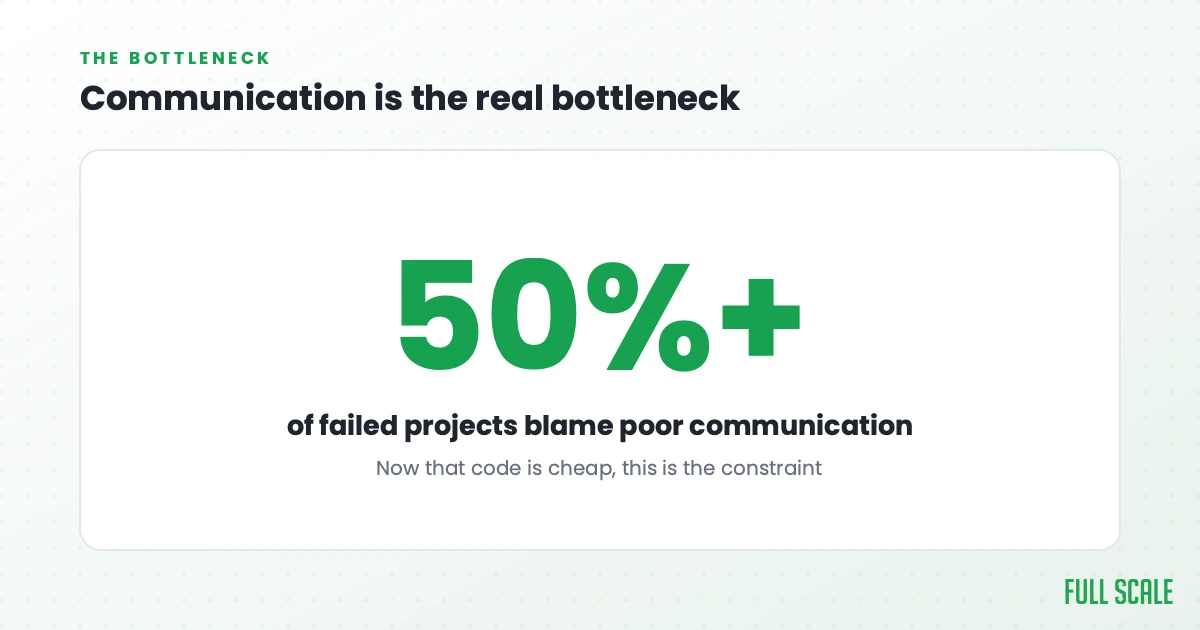
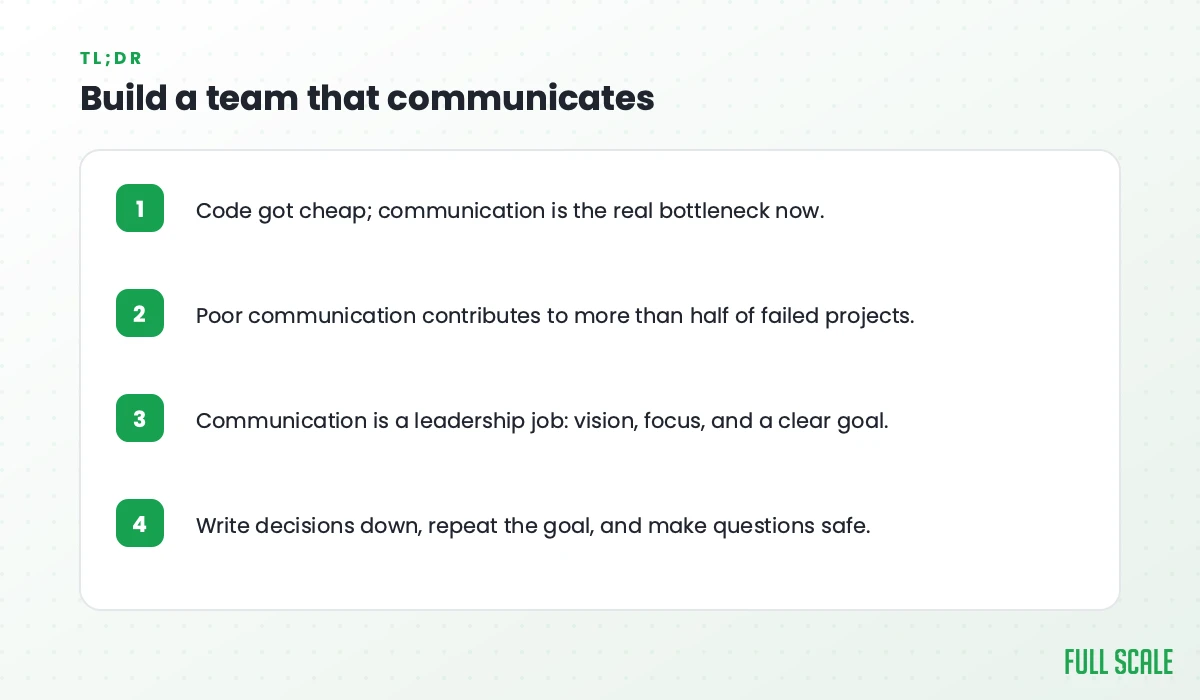
That was always a bad trade. The data has said so for a long time. The Project Management Institute found that ineffective communication is a contributing factor in more than half of failed projects, putting US$75 million at risk for every US$1 billion spent, and ambiguous requirements have topped the “why software projects fail” lists for decades.
Now the trade is just indefensible. About 84% of developers now use or plan to use AI tools, and the good ones move fast. But AI is the fastest junior developer alive, and it still builds exactly what you described, no more and no less. Hand it a vague idea and it will confidently produce the wrong thing in record time.
The constraint moved upstream. It used to sit on the keyboard; now it sits on whether you can give a person, or a model, enough context to build the right thing. The teams pulling ahead aren’t the ones with the cleverest prompts. They’re the ones who are clear about what they want.
The communication problems that actually sink software projects
Most articles on this topic hand you a list of seven problems and a tidy fix for each. That’s not how it breaks in real life. In my experience, communication problems in software development come down to three relationships, and the same root cause runs through all of them: people don’t share enough context with the people who need it.
Developers and the people they build for
This is the biggest gap and the one nobody wants to name. Developers often just don’t talk to users and stakeholders enough. They take a ticket, build what it says, and move to the next one, without ever really understanding the person on the other end.
I lived this at VinSolutions. In the early days I was the lead developer and I talked to car dealers directly, every day. I’d hear a problem in the morning and ship a fix that afternoon. Then we grew. Feedback started filtering through a support person, then two layers of support, then other engineers, until there were four people between me and the customer and I only saw dealers at trade shows.
The work kept moving the whole time. But something felt distant, and the product slowly stopped matching what customers actually needed.
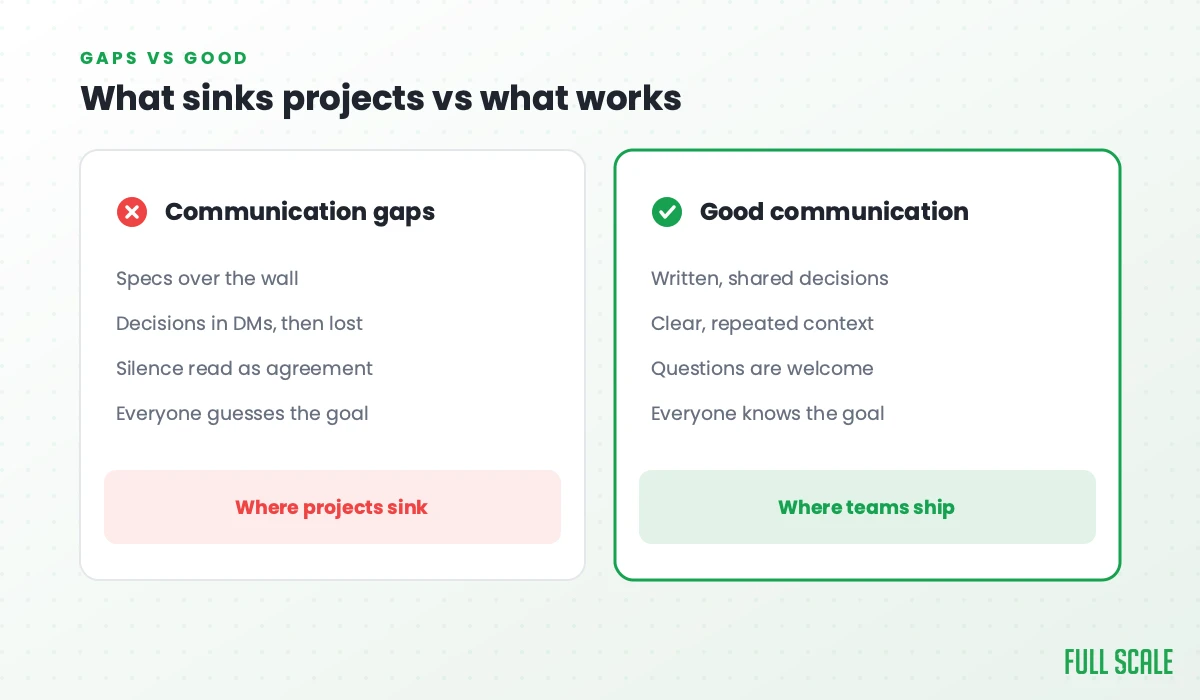
Every layer between your developers and your users is a place where context leaks out. When the people writing the code can’t picture who they’re building for, you get software that’s technically correct and practically useless. Getting clear, well-understood requirements isn’t a phase you finish. It’s a conversation you keep having.
This is exactly what my customer success managers at Full Scale watch for on cross-cultural teams, where the gap runs widest. Christian Arches, one of our CSMs, had an engineer who built a whole feature without confirming the requirement first.
“He implemented it, and it turns out after that, it’s not what it’s supposed to be. So it’s a rework. Once we have this rework, it equates to time, and time equates to money. So it’s additional cost for the client.”
The engineer was good. What was missing was the fifteen-second question up front. Part of why that question goes unasked is cultural: in a lot of high-context cultures, peppering the client with questions can feel like showing off, like being the pabida who always has to speak up, so a developer stays quiet and guesses instead. The habit Christian drills into his team is the cheapest insurance there is, validate the assumption before you write the code.
Developers and each other
The second gap is inside the team. Engineers talk to each other in shorthand and assume the context carried over when it didn’t. Code reviews turn into rubber stamps. The decision behind a chunk of code lives in one person’s head and nowhere else, so the next developer to touch it has to reverse-engineer the intent.
A lot of this is fixable with habits that cost almost nothing. Write down the why, not just the what. Comment the surprising decisions. Make code reviews about understanding, not approval. Even something as small as a bug report a developer can actually act on turns a day of back-and-forth into a quick fix.
The point isn’t more process. It’s more shared context, so the next person doesn’t have to guess.
The founder’s vision, stuck in their own head
The third gap is the one founders feel and rarely solve. You can see the whole product in your head. It’s obvious to you. And it turns out to be incredibly hard to get that picture out of your head and into everyone else’s so they build toward the same thing you’re seeing.
I’ve watched product vision die in silence, not in some dramatic blowup. The team looks aligned, nods in the meeting, and quietly builds five slightly different versions of what they thought you meant. None of that is a coding failure. The context never made it out of your head and into theirs, and closing that gap is almost always the leader’s job. It’s a big part of why I ended up writing Product Driven, my book on building engineering teams that actually understand the why behind their work.
Developers don’t have a talking problem. They have an empathy problem.
Here’s the thing underneath all that under-communication. Most developers can communicate just fine. They simply don’t yet see why it matters, because they haven’t put themselves in the shoes of the person on the other side.
I had a brilliant engineer at Stackify once. Customers kept telling us they struggled with one of his features. When I brought it to him, he said, “It’s all documented. Tell them to read the support documentation.” He wasn’t wrong about the docs existing. He was completely missing the point that a confused customer is your problem to solve, not theirs.
At VinSolutions we had a running joke that we built for a “fifth grader with a hangover.” It sounds harsh, but it came from a place of humility, not contempt. Our users were busy salespeople on a dealership floor, not engineers. If the software wasn’t dead simple for them, that was on us. Keeping that picture in mind changed how we built.
That’s what empathy does for engineering. It turns “I built what the ticket said” into “I built what this person actually needs.” You can’t get there with more status meetings. You get there when developers genuinely care about the human they’re building for, and that care is what makes the communication worth having in the first place.
Communication is a leadership job: vision, focus, and clarity
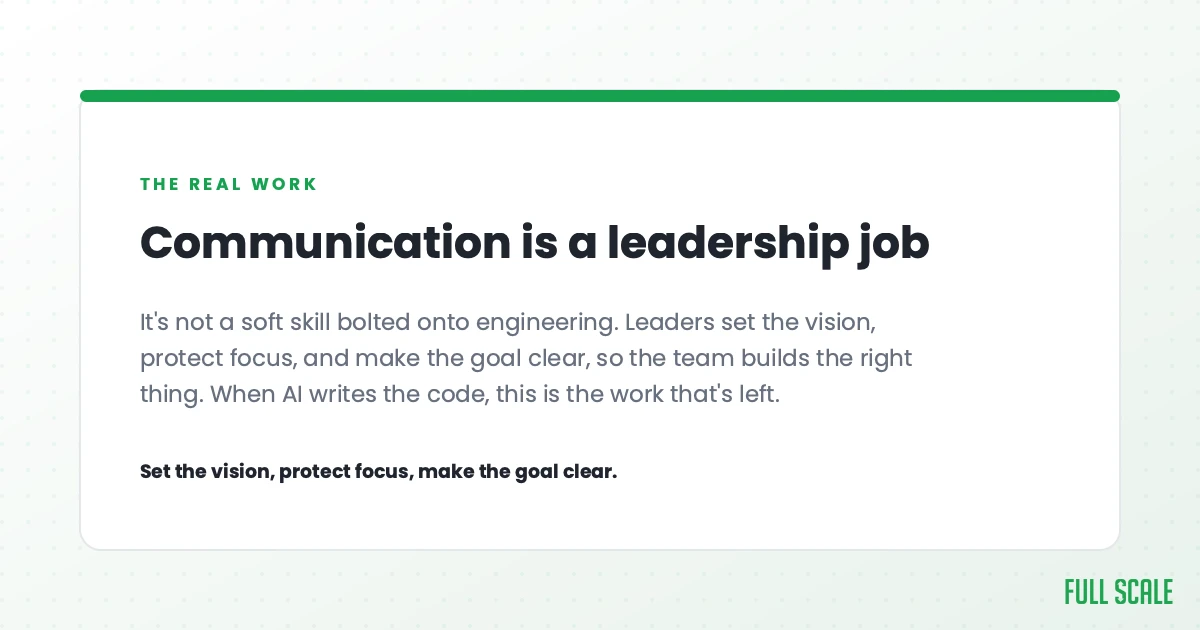
If communication keeps breaking on your team, the fix usually starts with leadership, not with the engineers. Three things are the leader’s responsibility, and when they’re missing, no amount of standups will save you. It’s the same root cause behind most collaboration breakdowns on software teams.
Vision is making sure the team sees the why. Not once in an all-hands, but in the trade-offs and decisions they make when you’re not in the room. Focus is saying no out loud, including no to your own good ideas, so the team knows what actually matters this quarter. And clarity is the daily one.
There are really three kinds of clarity a team needs: product clarity (what we’re building), scope clarity (how much of it), and technical clarity (how it fits together). Miss any one and the team slows down.
The mistake leaders make is treating clarity as a document you hand off once. It isn’t. I once told a team five times, “Whatever you do, don’t spam their API, we cannot get blocked.” That warning wasn’t in the spec anywhere. It lived in the context I had and they didn’t, and it was exactly the kind of thing that decides whether a project survives contact with reality. Clarity is a conversation you keep having, especially as a team grows and scales.
When AI writes the code, three skills decide who wins
I tell the engineers at Full Scale that as the mechanical parts of the job get automated, three human skills are becoming the whole game. I call them the Three C’s, and they’re the spine of how I think about building teams now.
Communication is the one we’ve been talking about. As the job shifts from writing code to understanding problems and working with people, the ability to write clearly, ask good questions, and say “I don’t understand this yet” out loud matters more than raw typing speed ever did.
Curiosity is the survival skill for this moment. The message I give my team is simple: as long as you stay curious, you’ll be fine. Be curious about how AI changes your job and how you can use it. This career has never stopped changing, and the curious people adapt while the ones waiting for it to settle down get left behind.
Courage is the psychological safety that lets an engineer push back, ask why, and say “I think we’re building the wrong thing” before you’ve spent three months building it. When Google went looking for what made its best teams work, the number one factor wasn’t talent or experience. It was psychological safety, whether people felt safe enough to speak up. You can’t demand that. You earn it by how you react when someone tells you something you don’t want to hear. I dig into all three of these at length in Product Driven, because they’re what I believe actually separates teams that thrive from teams that stall.
What good communication actually looks like on a distributed team
Now, here’s where a lot of leaders get nervous. If communication is the whole ballgame, doesn’t a remote or offshore team make it harder?
It’s the first objection I hear, and the honest answer is that bad offshoring absolutely makes it worse. Plenty of shops are built so you only ever talk to one technical project manager while every actual developer hides behind that person, either because of language gaps or a culture about who’s allowed to talk to the client. You lose context at every hop. That’s the version that earned offshoring its reputation.
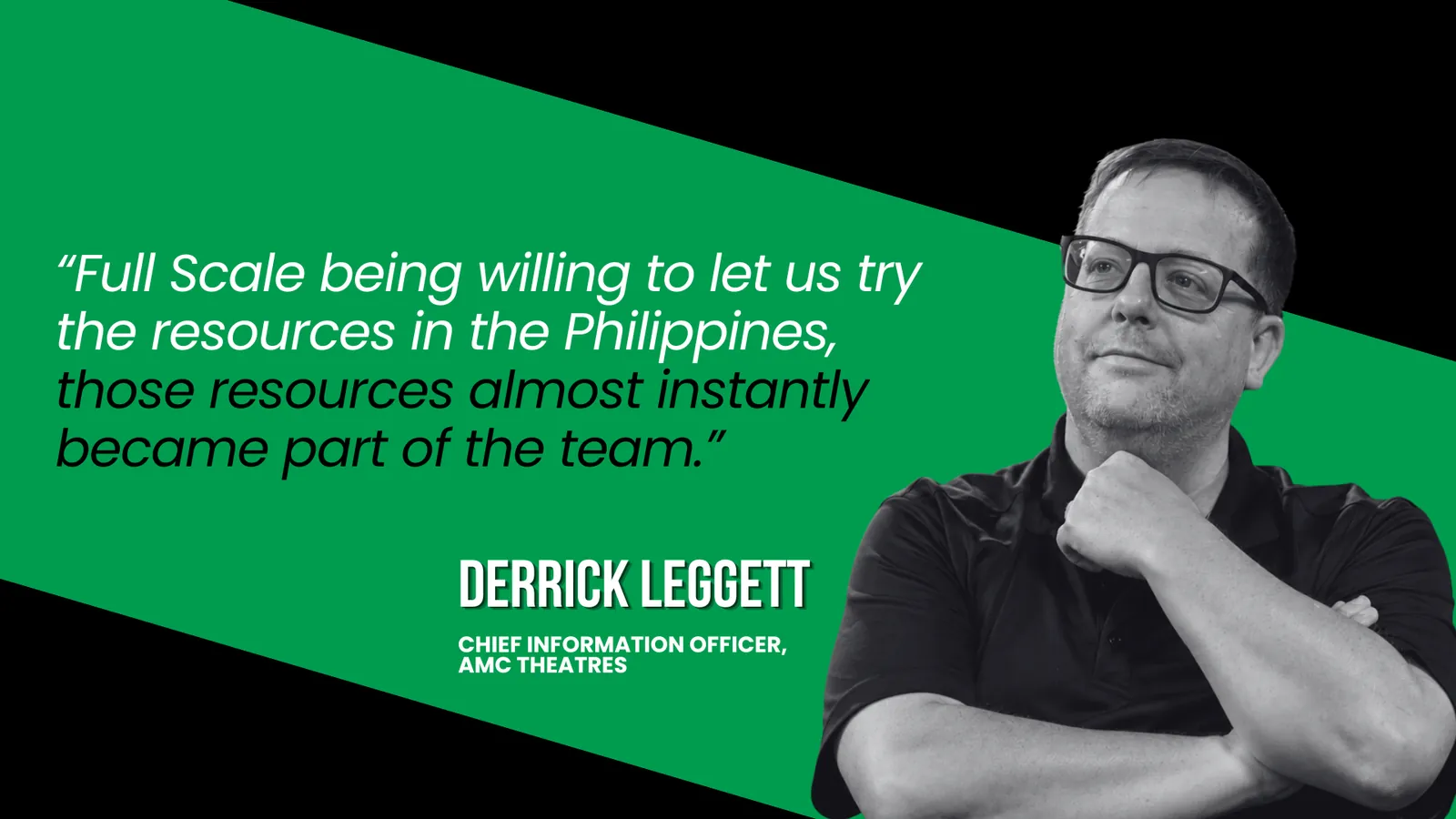
The version that works looks nothing like that. At Full Scale we run an integrated model, where the developers in the Philippines are on your calls, in your Slack, and talking to you directly, the same as any engineer down the hall. The way AMC Theatres puts it about their own global team says it best: it’s one fully integrated team, some of whom happen to live in the Philippines.
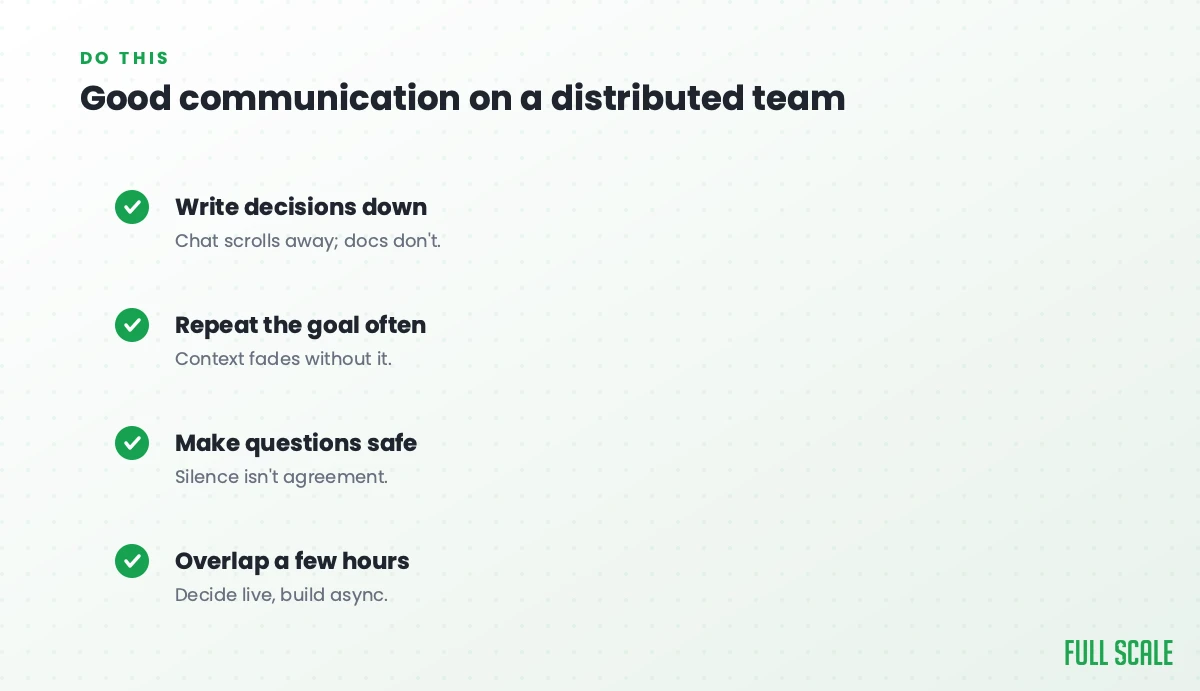
A few things make that possible. The Philippines is the third-largest English-speaking country in the world, so the language barrier that sinks a lot of offshore work mostly isn’t there. It’s one reason we hire developers in the Philippines in the first place. We keep real-time overlap hours so conversations happen live instead of in a 24-hour email relay, which is one of the basics of managing an offshore team well. And video is non-negotiable, because you need to see whether someone actually understood you, not just whether they said yes. Get those right and a distributed team communicates as well as a team in one room, sometimes better, because you’re forced to be deliberate about it.
That’s the real answer to communication problems in software development, whether your team is down the hall or across the world. The tools and the geography were always a distraction. What matters is whether the people building the software understand what they’re building and why, and whether the people who hold that context are willing to share it.
Frequently asked questions
What causes communication problems in software development?
Most communication problems trace back to one root cause: context doesn’t reach the people who need it. That shows up as unclear requirements, developers who don’t talk to users or stakeholders enough, knowledge trapped in one person’s head, and a founder’s vision that never fully makes it out of their head and into the team. Tools and time zones get blamed, but they’re rarely the actual cause.
How do communication gaps between developers and decision-makers hurt a project?
When developers don’t understand what the business is actually trying to achieve, they build what the ticket literally says instead of what the company needs. The result is software that’s technically correct and practically useless, plus expensive rework once everyone realizes the wrong thing got built. Every layer of people between your developers and the real decision-makers is a place where context leaks out.
Does AI reduce communication problems in software development?
No, it raises the stakes on them. AI makes writing code fast and cheap, which moves the bottleneck upstream to whether you can clearly describe what you want and why. A model builds exactly what you tell it, so vague instructions now produce the wrong thing faster than ever. Strong communication is what turns fast code generation into the right software.
How do you keep communication strong on a remote or offshore team?
Work with developers who speak the language well, keep real-time overlap hours so conversations happen live, and make video calls the default so you can confirm people understood you. Most importantly, integrate the team directly into your calls and chat instead of routing everything through a single project manager who becomes a bottleneck and a context filter.
What are the solutions to communication problems in software development?
The fixes are mostly a leadership job, not a tooling one. Give the team a clear why so they make good calls when you’re not in the room, decide out loud what they’re not building, and repeat the context every week instead of treating it as a one-time handoff. Cut the layers between your developers and the people they build for, design real-time overlap hours on purpose, and make it safe to ask the dumb question. Better tools help at the edges, but none of them close a context gap for you.
What are the most common communication barriers on software teams?
They almost always trace back to context that doesn’t reach the people who need it. Developers don’t talk to users or stakeholders enough, so they build what the ticket says instead of what the business needs. Engineers talk to each other in shorthand and assume the context carried over when it didn’t. A founder’s vision stays stuck in their own head. On distributed and offshore teams, routing everything through a single project manager adds another barrier, because context leaks at every hop. Time zones and tools get blamed, but the real barrier is almost always missing shared context.
Build software with a team that communicates
Communication has always been the real work of building software, and AI just made that impossible to ignore. If you want a team that plugs in and communicates like your own engineers, let’s talk about what you’re building.