
How to Choose a Tech Stack in the AI Era

In this article
- What a tech stack actually is
- Pick a stack you can own
- You can be braver about adjacent tech now
- Don’t let AI talk you into the shiny stack
- The 2026 edge: opinionated frameworks win
- Your stack decides who you can hire
- A simple way to actually decide
- If you’re choosing a stack to build an AI product
- Quick notes by industry
- Frequently asked questions
- The bottom line
Quick Answer: Choose a tech stack your team can actually own and maintain, not the one that’s trendiest. AI now makes it safer to stretch into an adjacent stack you don’t know cold, and it works better with mainstream languages and opinionated frameworks like Laravel or .NET than with niche ones. Full Scale has made this call at three companies and staffs mainstream stacks for 200+ client teams, and the stack you pick still decides who you can hire. Keep it simple and boring until you can’t.
I’m a .NET developer. If I started something new tomorrow, I’d probably reach for .NET again, even in 2026, even with AI rewriting how we build software. Not because it’s the trendiest choice, but because I know it well enough to catch the bugs and fix things when they break at two in the morning.
AI has genuinely changed part of the math on how you choose a tech stack, and most of the advice out there hasn’t caught up. Here’s the short version.
The stack you can actually run beats the stack that’s trendy. AI widened how far you can stretch, not which rules you can ignore.
I’ve made this decision at three companies and watched Full Scale build across dozens of stacks for more than 200 client teams. Below is how I’d think it through today.
What a tech stack actually is
A tech stack is just the set of technologies you use to build and run an application. Most stacks have four layers: the frontend (what the user sees), the backend (the logic and services), the database (where the data lives), and the infrastructure (where it all runs). Each of those layers maps to different developer roles, so the stack you pick shapes who you hire. Land on a Python and Django backend, for instance, and the right next move is to build a dedicated Django team rather than lean on backend generalists.
People bundle common combinations into named stacks. A few you’ll hear constantly:
- MERN: MongoDB, Express, React, Node.js. All JavaScript, front to back.
- MEAN: the same, with Angular instead of React.
- LAMP: Linux, Apache, MySQL, PHP. The old workhorse that still runs a huge share of the web.
- .NET: Microsoft’s stack, strong in enterprise and the one I built VinSolutions) on.
- PHP and Laravel: PHP with an opinionated framework on top, which I’ll come back to, because it’s where I’m spending money right now.
Here’s a quick read on what each is good at:
| Stack | Strong fit |
|---|---|
| MERN / MEAN | Single-page apps, real-time features, JavaScript-everywhere teams |
| LAMP / PHP | Content sites, standard web apps, fast and cheap to staff |
| .NET | Enterprise software, regulated industries, large internal systems |
| Python (Django/FastAPI) | Data-heavy products, anything touching machine learning or AI |
| Laravel | Web apps where you want one standard way to do things |
None of these is “best.” The right one depends on you, which is the whole point.
Pick a stack you can own
Whatever you pick, you have to live with it. Someone on your team still reviews the code, debugs the weird production issue, and maintains it for years. AI writes a lot of that code now, but it doesn’t take the pager. Since the pager stays with your team, it pays to keep shipping behind feature flags, so a bad change is a toggle rather than an outage.
You still own every line AI writes for you.
That’s why my .NET instinct holds up. I can sit down with a .NET codebase and know within minutes whether something is wrong. If I picked a stack I’d never touched, I’d be trusting AI output I couldn’t fully judge, and that’s how you ship tomorrow’s problems today. As I’ve said before, vibe coding only works if you’ve been coding long enough to know when the AI is wrong.
Developers feel this too. In Stack Overflow’s 2025 Developer Survey, usage of AI tools kept climbing while the share of developers who trust the output slipped to about 60%. The tools got more popular and less trusted in the same year, and that gap is the whole reason you want to pick a stack you can actually judge.
So the first question is what your team can actually own, before what stack is best. If you and your engineers know a stack cold, that head start is worth more than any feature comparison chart.
You can be braver about adjacent tech now
By 2025, 84% of developers were using or planning to use AI tools, up from 76% a year earlier in that same survey, which is where the old advice falls short. Nearly everyone has these tools now, and that changes one part of the stack decision.
Say you’re a strong backend engineer who hasn’t written real frontend code in years. You’ve never used the current version of React or Angular. A few years ago, picking React for your next project would have been a genuine risk. You’d be slow, you’d make rookie mistakes, and you’d feel it in the schedule.
Today you can lean on AI to carry that ramp. It’ll scaffold the components, explain the patterns, and catch the obvious errors while you get your footing. The thing that used to scare people off trying a new framework is mostly gone.
That means you can stretch further than you used to. If a stack is adjacent to what you already know, AI lowers the cost of learning it on the job enough that it’s worth considering when it wasn’t before.
The key word is adjacent. Stretching from one web framework to another is fine. Jumping into something completely foreign is a different bet.
Don’t let AI talk you into the shiny stack
AI makes it easier to try new things, which is exactly why you have to be careful. “Easier to try” is not the same as “right call.”
I see people reach for Rust or Go on a standard web app because it sounds cool and modern. For most web products, PHP or Node.js is the better tool, and the trendy choice just buys you a harder hiring search and a smaller pool of help. Customers don’t buy cool code. They buy working products.
AI doesn’t fix this either. It’s far better at mainstream, high-training-data languages like JavaScript, Python, and PHP than it is at niche ones, simply because it learned from so much more of that code. JavaScript is still the most-used language by a wide margin in that survey, which is part of why AI assistants are so fluent in it. So an exotic stack costs you twice: a thinner talent pool and weaker AI support on top of it. Keep it simple and boring until you can’t.
The 2026 edge: opinionated frameworks win
At Full Scale Ventures, we’re building new projects on PHP and Laravel, because Laravel is opinionated, and it’s a call I’ve changed my own mind on recently. It has one standard, well-worn way to do most things. That used to feel restrictive. In the AI era, it’s an advantage.
A framework with one right way to do things beats a framework with ten.
It helps in two ways. First, AI is far more reliable when there’s a single correct pattern to follow. Give an AI assistant a Laravel project and it knows the conventions, because everyone’s Laravel project looks roughly the same. Second, onboarding a new developer is faster for the exact same reason. They already know how a Laravel app is laid out before they open it.
Compare that to Node.js. I love Node, but it’s the opposite world. There are countless frameworks and a dozen ways to do any one thing, so two experienced Node developers can show up with completely different habits and assumptions. There’s no shared baseline, which makes both AI help and onboarding messier.
Opinionated versus flexible is a real tradeoff:
- Opinionated (Laravel, Rails, .NET): new hires get productive faster, the code stays consistent, and AI support is stronger, though you give up some freedom.
- Flexible (Node.js, raw JavaScript): you get more control and more options, but every team ends up reinventing its own conventions.
For new work where I want speed and easy hiring, I’m choosing opinionated right now. That wasn’t my answer five years ago.
Your stack decides who you can hire
Your tech stack quietly decides who you can hire, and how fast.
Most stack debates focus on performance and features, but the thing that actually bites you later is people.
Pick a mainstream stack and you get a deep, affordable talent pool, whether you’re hiring locally or building an offshore team. Pick something exotic and every hire gets slower and pricier, everywhere in the world. At Full Scale, we staff PHP, Node.js, React, .NET, and Python teams from the Philippines all the time, because those skills are everywhere and the developers are excellent. The rare stacks are the ones that take months to fill. The same rule now applies outside product engineering, where even marketing runs on enough software that it needs a developer who can own the martech stack.
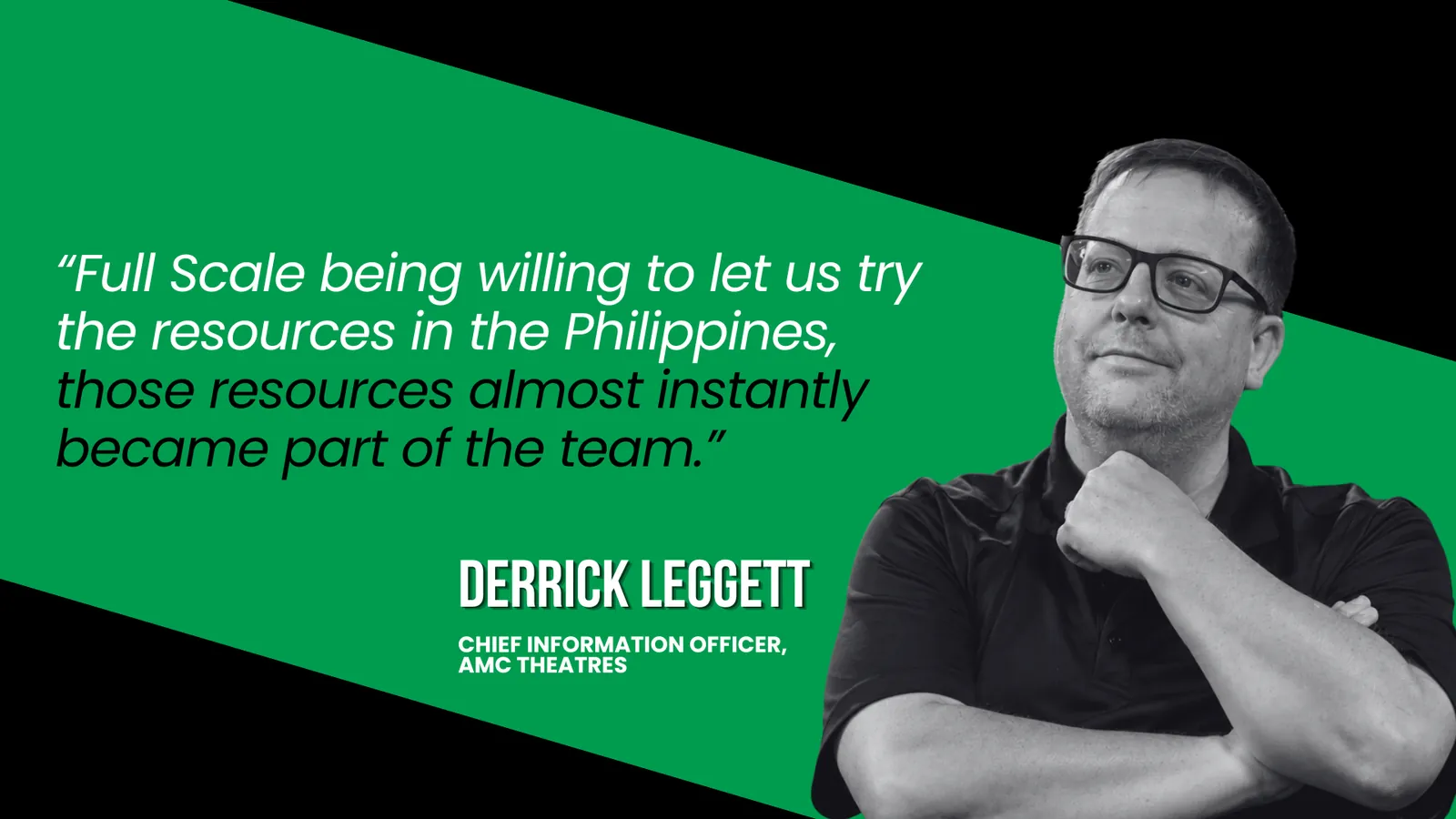
AMC Theatres is a good example of this done right. They run a global engineering team across the US, the Philippines, and beyond on mainstream, well-supported stacks, and they’ve gone AI-first across the whole org. A common stack is what lets a team that spread out share code, review, and standards without friction.
This is the question a lot of technical founders skip, and it’s the one I’d put near the top. A stack you can hire for is a stack you can grow on. If you’re already thinking about an offshore team or augmenting your in-house engineers, it matters even more, because your stack choice sets the size of the pool you’re hiring from.
A simple way to actually decide
Here’s how to choose a tech stack without a made-up scoring matrix. You answer six honest questions:
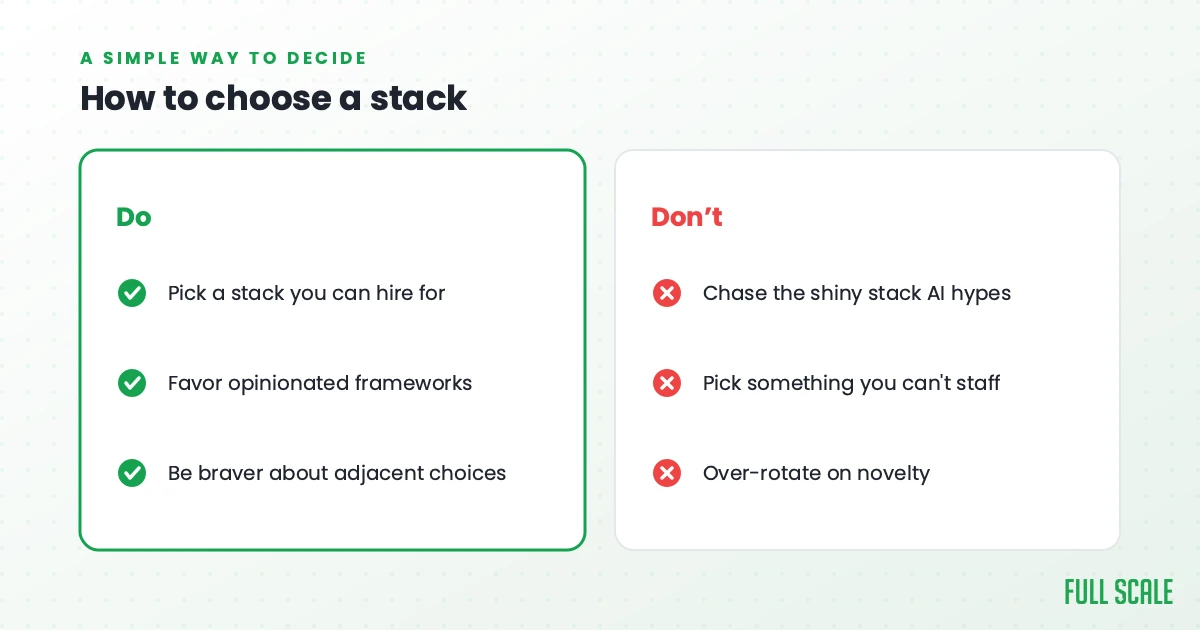
- Can your team own it? Will someone be able to review, debug, and maintain this in two years?
- Is it adjacent enough that AI can carry the stretch? If it’s near what you already know, you can be braver than you used to be.
- Is the framework opinionated or sprawling? One standard way to do things helps both AI and new hires.
- How strong is AI support for it? Mainstream, high-volume languages get far better AI help.
- How deep is the hiring pool? Can you actually staff this, now and as you grow?
- Does it fit the problem? Don’t over-engineer. Match the tool to what you’re building.
Notice that AI shows up in two of the six, but it never overrides the first one. This ties back to what I call the three C’s of software development in my book, Product Driven: communication, curiosity, and courage. The curiosity part is what I tell our engineers all the time. Stay curious about how AI changes your job and how to use it, and you’ll keep up. The tools will change again next year.
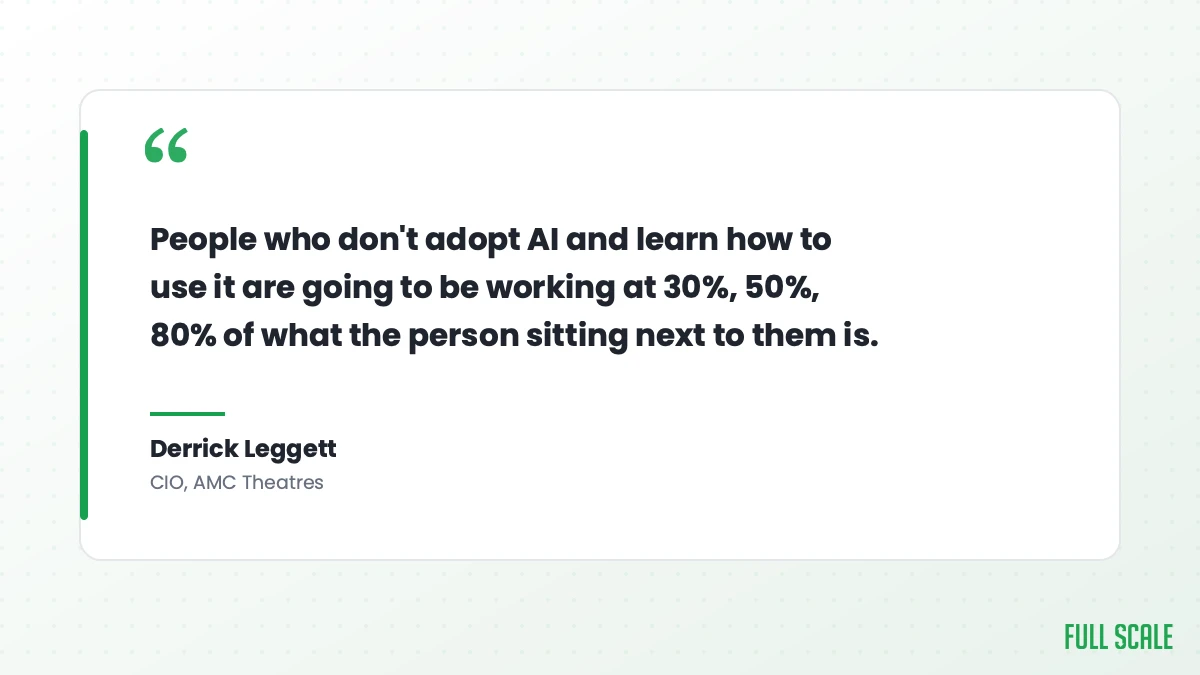
Derrick Leggett, the CIO of AMC Theatres, told me as much: “People who don’t adopt AI and learn how to use it are going to be working at 30%, 50%, 80% of what the person sitting next to them is.” Your stack should make that learning easy, not fight it.
If you’re choosing a stack to build an AI product
If the product itself is AI, you’re picking more than a language, which is a slightly different question that deserves its own deep treatment. You’re choosing a model provider strategy, a vector database (for most teams, pgvector on Postgres is plenty), and a way to evaluate and monitor what the model actually does in production.
Python tends to win here, because the AI tooling grew up in Python. Tools like GitHub Copilot, Cursor, and Claude speed up the coding either way, but the surrounding stack for an AI product is a real architecture decision, not a default. I’ll cover that one separately.
Quick notes by industry
Different kinds of custom software lean toward different stacks. A few patterns worth knowing, without overthinking them:
- Fintech: security and compliance lead. Mature, well-audited stacks (.NET, Java, Python) beat the bleeding edge.
- Healthcare: HIPAA compliance shapes everything. Favor stacks with strong encryption and access-control support and a clear audit trail.
- Ecommerce: traffic spikes hard during sales. Pick a stack and hosting setup that scale cleanly under load, and test it before the holiday rush, not during it.
- Startups: ship on stacks with the biggest hiring pool and the strongest AI-tooling support (TypeScript/Node, Python, React). Speed and cheap iteration matter more than architectural purity this early.
If your current stack is the thing holding you back, that’s a separate project, and modernizing a legacy application is its own careful process. Don’t rewrite just because something newer exists.
Frequently asked questions
What is a tech stack?
A tech stack is the combination of technologies used to build and run an application, usually across four layers: frontend, backend, database, and infrastructure. For example, the MERN stack pairs MongoDB, Express, React, and Node.js. The right stack depends on your team’s experience, the problem you’re solving, and who you can hire.
Is Python a tech stack?
Python is a programming language, not a full stack on its own. It becomes a stack when you pair it with a framework like Django or FastAPI, a database like PostgreSQL, and infrastructure to run it. Python is especially common for data-heavy products and anything involving AI or machine learning, because most AI tooling is built in Python first.
What is an example of a software stack?
The MERN stack is a popular example: MongoDB for the database, Express for the backend framework, React for the frontend, and Node.js as the runtime. It’s all JavaScript, which lets one team work across the whole application. LAMP (Linux, Apache, MySQL, PHP) is another classic that still powers a large share of the web.
Does AI change which tech stack I should choose?
Yes, but less than people think. The core rule still holds: pick a stack your team can own and maintain. What AI changes is that it lowers the cost of learning an adjacent technology, so you can be a bit braver about stretching into something near what you already know. AI also works better with mainstream languages and opinionated frameworks, which is a real point in their favor.
Should I use Laravel or Node.js in 2026?
Laravel, if consistency and fast hiring matter more than flexibility. It’s opinionated, with one standard way to do most things, which makes AI assistance more reliable and new developers faster to onboard. Node.js is more flexible and has a huge community, but that flexibility means teams build very differently from one another. Full Scale Ventures is building new projects on Laravel for exactly that reason.
The bottom line
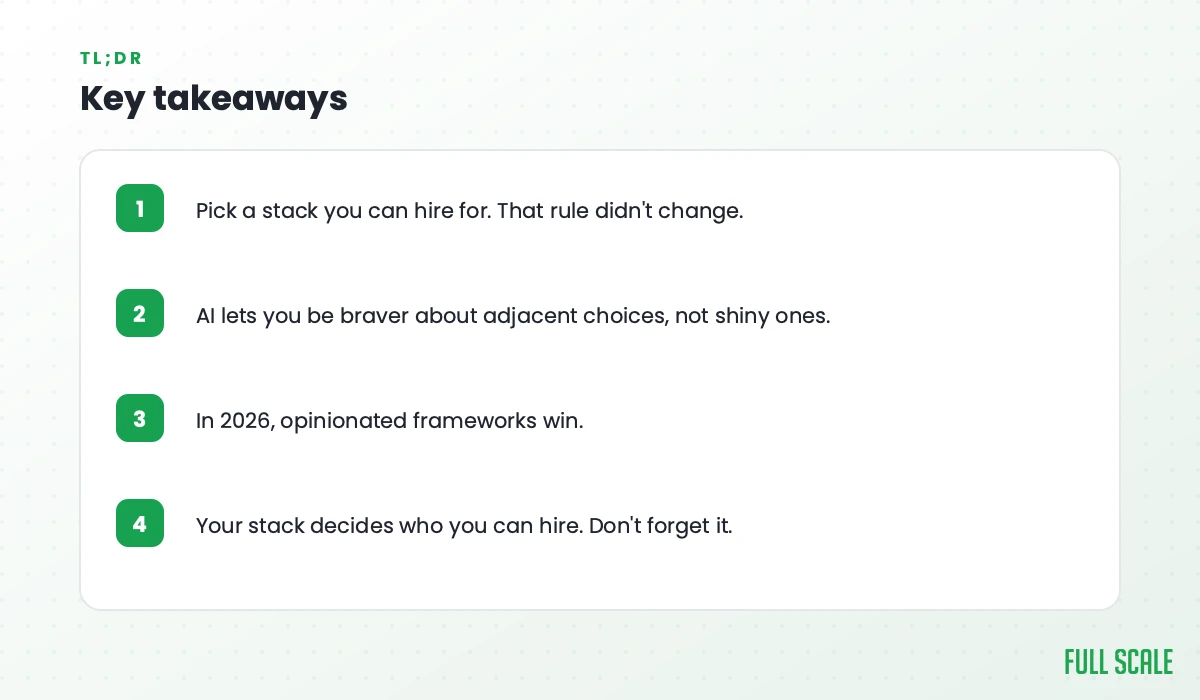
AI changed how brave you can be about your tech stack. It did not change the fact that you have to live with the one you pick. Choose the stack you can own, lean on AI to stretch a little further than you used to, favor frameworks with one clear way to do things, and never forget that your choice decides who you can hire.
Keep it simple and boring until you can’t.
If you want a second opinion on a stack decision, or you need senior engineers in a specific stack faster than local hiring allows, book a quick call with our team.