
Team Capacity Planning Calculator: Complete Guide for Software Development Teams
Team capacity planning for software development determines how much work your team can realistically complete in a sprint. At Full Scale, we’ve refined this process through 8 years of managing distributed teams across 200+ client projects.
According to the 2024 State of Agile Report, 68% of teams struggle with accurate capacity planning, leading to failed sprints.
Atlassian’s research also shows that teams with proper capacity planning deliver 40% more story points per sprint. While McKinsey found that an optimized team utilization rate can reduce software development costs by up to 30% annually.
Let’s Understand the Concept of Team Capacity
Team capacity goes beyond the simple arithmetic of hours and headcount. It requires understanding your team’s true productive potential after accounting for all real-world factors.
Team capacity represents the total productive hours available for development work during a sprint. It’s not just counting heads and multiplying by 40 hours.
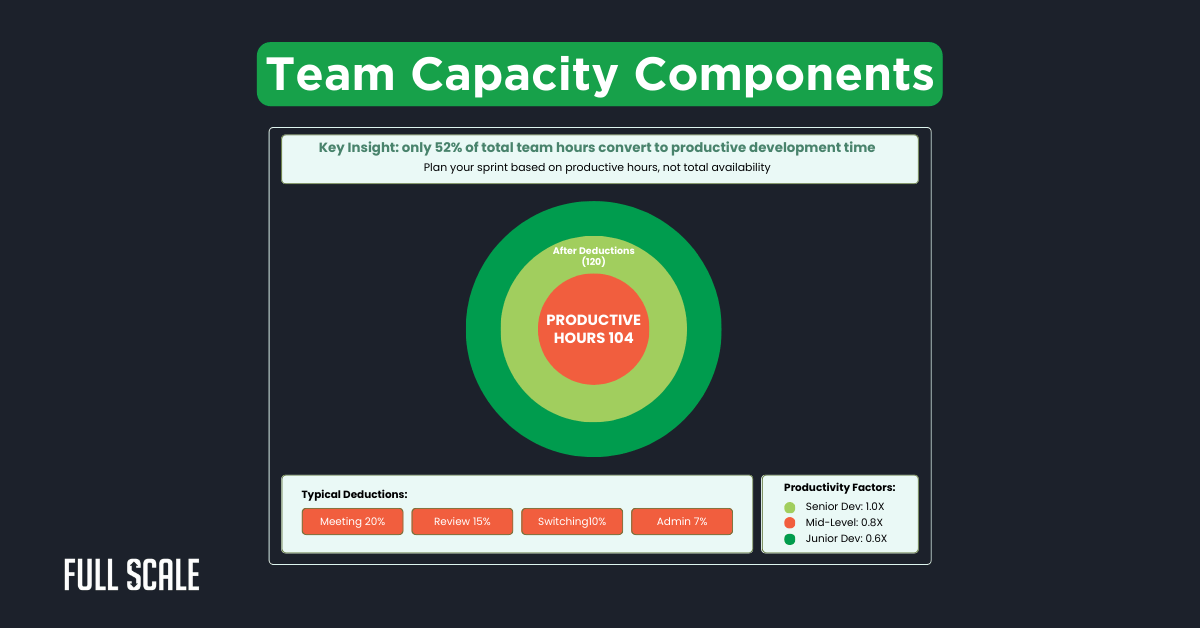
Let’s take a look at one of our clients’ stories. A fintech startup had five developers working 40-hour weeks. They assumed 200 hours of capacity per sprint. Reality showed only 104 productive hours after accounting for meetings, code reviews, and context switching.
Key Components of Team Capacity
- Available Hours: Total working hours minus time off
- Productivity Factor: Skill level multiplier (Junior: 0.6, Mid: 0.8, Senior: 1.0)
- Focus Time: Actual coding hours after deductions
The Full Scale Capacity Planning Methodology
Our proven 8-step process eliminates guesswork from sprint planning. We’ve tested this sprint capacity calculator methodology across 1,000+ sprints with 95% accuracy.
Our 8-step process delivers predictable velocity and prevents team burnout. We developed this methodology after analyzing distributed teams across multiple time zones.
Step 1: Baseline Team Composition
Document each team member’s role, level, and availability. Include contractors and part-time resources.
Step 2: Calculate Raw Capacity
Multiply working days by daily hours for each team member. Account for public holidays and planned time off.
Step 3: Apply Productivity Multipliers
Junior developers contribute 60% of senior developer output. Mid-level developers deliver 80% productivity compared to seniors.
Step 4: Identify Time Deductions
Track non-coding activities that consume developer time. Our data shows 40-50% of time goes to non-development tasks.
Step 5: Factor Remote Work Impact
Time zone differences reduce capacity by 10-25%. Asynchronous communication adds coordination overhead.
Step 6: Calculate Net Productive Hours
Subtract all deductions from raw capacity. This gives realistic available hours for development work.
Step 7: Convert to Story Points
Use historical velocity data to determine story points per hour. Most teams average 0.2-0.3 points per productive hour.
Step 8: Add Risk Buffer
Reserve 15-20% capacity for unknowns. This prevents overcommitment and sprint failures.
Real Client Success Stories
Full Scale’s team capacity planning methodology has transformed how teams deliver software. These case studies show real results from implementing our team capacity planning approach with distributed development teams.
Case Study 1: HealthTech Startup Scaling
Challenge: The team is missing 70% of sprint commitments due to offshore team capacity issues and the lack of a team capacity planning system.
Solution: We implemented our capacity planning formula with proper time zone adjustments. Through asynchronous updates, we reduced meeting time by 30%.
Result: Sprint completion rate improved to 92% within three sprints. Team velocity increased by 40%.
Case Study 2: E-commerce Platform Optimization
Challenge: Unpredictable delivery dates are causing stakeholder frustration. No clear development team velocity metrics.
Solution: Created detailed capacity tracking with our sprint planning capacity formula. Implemented daily capacity snapshots.
Result: Delivery predictions are now accurate within 5%. Customer satisfaction scores increased by 35%.
Case Study 3: FinTech Enterprise Team
Challenge: Cost overruns due to poor engineering capacity planning. Unable to justify team expansion.
Solution: Built comprehensive team capacity vs. velocity tracking. Provided the CFO with cost per story point metrics.
Result: Reduced development costs by 25%. Secured approval for 3 additional developers based on data.
Sprint Capacity CalculatorSprint Capacity Calculator
Team Members
Time Deductions
Team Composition Analysis: How to Build the Right Dev Team
Building the right team mix is crucial for accurate team capacity planning. Understanding productivity multipliers helps set realistic sprint goals and prevents team burnout.
Effective agile team capacity planning starts with understanding your team’s skill matrix. Different skill levels dramatically impact actual output.
Full Scale Productivity Matrix
- Senior Developers (1.0x): Full productivity, mentor others
- Mid-Level Developers (0.8x): Independent work, occasional guidance
- Junior Developers (0.6x): Requires supervision, learning curve
- QA Engineers: Match developer-level multipliers
Skill-Based Capacity Adjustments
New technology adoption reduces productivity by 20-30% initially. Domain expertise increases output by 15-25%.
Onboarding Impact on Story Points Capacity
First month: 40% productivity reduction for new hires.
Mentoring time: 10-15% reduction for senior developers.
Full productivity is typically achieved after 3-4 months.
Time Deductions and Reality Adjustments
Accurate capacity planning requires an honest assessment of non-coding activities. Our data from 200+ teams reveals consistent patterns in time allocation.
Our software team’s productivity metrics show these average time deductions:
Standard Deductions (All Teams)
Effective team capacity planning requires understanding these time losses. In our team capacity planning model, these percentages represent actual time lost to non-development activities.
We’ve validated these numbers across hundreds of sprint retrospectives.
| Activity | Time Impact | Weekly Hours | Notes |
| Daily Standups | 5% | 2.5 hours | 15-30 min daily |
| Sprint Ceremonies | 8% | 3.2 hours | Planning, retro, demo |
| Code Reviews | 10% | 4 hours | Critical for quality |
| Documentation | 8% | 3.2 hours | Often underestimated |
| Context Switching | 7% | 2.8 hours | Between tasks/projects |
| Admin/Email | 7% | 2.8 hours | Unavoidable overhead |
| Total Standard | 45% | 18 hours | From 40-hour week |
Additional Remote Team Deductions
Remote team capacity planning faces unique challenges that impact productive hours. These deductions stack on top of standard deductions. Track your actual numbers after three sprints for accurate team capacity planning.
| Activity | Time Impact | Weekly Hours | Remote-Specific |
| Communication Overhead | 5% | 2 hours | Async coordination |
| Tool/Connection Issues | 3% | 1.2 hours | Technical problems |
| Meeting Scheduling | 5% | 2 hours | Timezone juggling |
| Total Remote | 13% | 5.2 hours | Added to standard |
Remote Team Capacity Considerations
Remote work adds complexity to capacity planning beyond simple timezone math. Our eight years of experience with offshore team capacity shows predictable patterns.
Remote team capacity planning requires special adjustments based on our experience. Time zones significantly impact the calculation of productive hours.
Time Zone Impact on Capacity
- Same Time Zone: No capacity reduction
- 1-4 Hour Difference: 10% capacity reduction
- 5-8 Hour Difference: 20% capacity reduction
- 9+ Hour Difference: 25% capacity reduction
Remote Team Optimization Strategies
Overlap hours become premium capacity for collaboration. Schedule critical discussions during these windows. Use asynchronous work for independent tasks.
Communication Protocols for Remote Teams
Daily async updates reduce meeting time by 40%. Video calls for complex discussions save 2x email time. Written specifications prevent 80% of clarification requests.
Using the Team Capacity Calculator
Our interactive calculator simplifies complex capacity calculations instantly. Follow these steps to get accurate sprint capacity in under 2 minutes.
Our developer capacity calculation tool simplifies sprint planning. Follow these steps for accurate capacity planning:
Capacity Calculator Step-by-Step GuideMaster Your Sprint Capacity Calculator
Follow our 5-step process to accurate capacity planning
Enter Team Details
Start by adding each team member with their role and experience level. This forms the foundation of accurate capacity calculation.
Configure Deductions
Adjust time deductions based on your team’s actual meeting schedule and overhead. Our defaults are based on data from 200+ teams.
Apply Remote Adjustments
Select your team’s timezone configuration. Distributed teams need additional capacity adjustments for coordination overhead.
Review Results
Your calculated capacity shows realistic sprint commitments. Compare this with your historical velocity for validation.
Your Sprint Capacity
Based on 112 productive hours
Recommended Commitment: 24 points (85%)
This leaves buffer for unplanned work
Export Planning Data
Download your capacity report for sprint planning meetings. Share with stakeholders to set realistic expectations.
Your Capacity Report is Ready!
Export formats available:
Step 1: Enter Team Details
Input each team member’s name, role, and level. Add their available days for the sprint.
Step 2: Configure Deductions
Select applicable time deductions from our preset list. Customize percentages based on your team’s history.
Step 3: Apply Remote Adjustments
Choose the time zone configuration for distributed teams. The calculator automatically adjusts capacity.
Step 4: Review Results
See total productive hours and recommended story points. Compare with historical velocity for validation.
Step 5: Export Planning Data
Download capacity report for stakeholder communication. Use data for sprint commitment discussions.
Advanced Capacity Planning Strategies
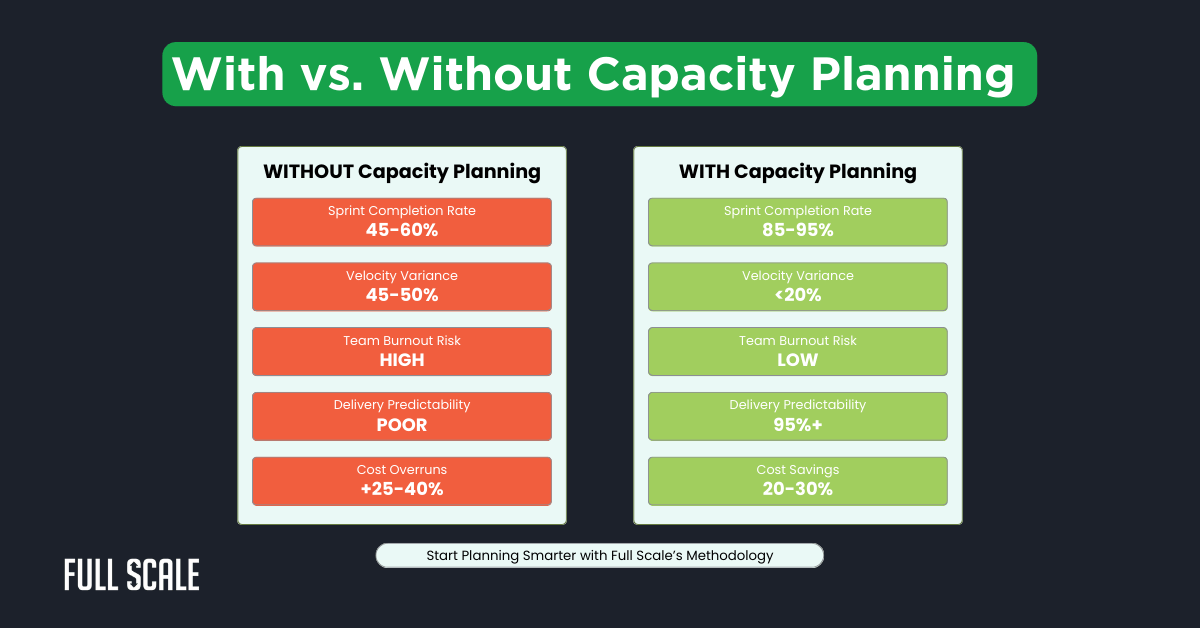
These proven team capacity planning techniques help teams achieve 95%+ planning accuracy. We’ve refined these engineering team capacity planning strategies through thousands of sprint cycles.
Dynamic Capacity Tracking
Update team capacity planning calculations daily based on actual availability. Track unplanned absences and their impact. Use 15-minute daily check-ins for accuracy.
Velocity Trending Analysis
Monitor capacity utilization over multiple sprints. Identify patterns in over or under-commitment. Adjust multipliers quarterly based on data.
Skills-Based Allocation
Match complex tasks to senior developer capacity. Reserve junior capacity for defined, supervised work. Track skill development impact on productivity.
Capacity Reserve Management
Maintain 20% unallocated capacity for urgent issues. Use this buffer for technical debt when unused. Never commit 100% of calculated capacity.
Sprint-Over-Sprint Improvements
Review team capacity planning accuracy in every retrospective. Document reasons for variance over 10%. Refine deduction percentages based on actual team capacity planning data.
Measuring and Improving Capacity Planning
Continuous improvement requires tracking the right metrics. These KPIs help teams optimize their planning accuracy over time.
Track these team capacity optimization metrics for continuous improvement:
Key Performance Indicators
Monitor these metrics weekly to identify trends early. Compare against industry benchmarks quarterly. Use data to justify team expansion or process improvements.
| Metric | Target | Impact |
| Planned vs. Actual Capacity | 90%+ accuracy | Predictable delivery |
| Sprint Completion Rate | 85-95% | Team morale |
| Velocity Stability | <20% variance | Reliable planning |
| Team Utilization | 75-85% | Sustainable pace |
| Story Point Accuracy | ±15% | Stakeholder trust |
Improvement Strategies
Review capacity accuracy after each sprint retrospective. Adjust deduction percentages based on actual data. Refine productivity multipliers quarterly using delivery metrics.
Success Metrics from Full Scale Clients
- Average capacity prediction accuracy: 93%
- Sprint commitment success rate: 89%
- Team burnout reduction: 40%
- Project delivery predictability: 95%
- Cost savings from optimization: 25-30%
Your Capacity Planning Implementation Roadmap
Transform your team’s delivery predictability with Full Scale’s proven methodology. Start seeing results within your first sprint cycle.
Start with our sprint capacity planning template for immediate improvements. Customize deduction percentages after tracking 3 sprints of data.
Week 1: Baseline Assessment
Use our team capacity planning calculator and input current team data. Run calculations for your next sprint planning. Compare results with your typical commitments.
Week 2-3: First Sprint Implementation
Use calculated capacity for sprint commitment. Track actual vs. planned hours daily. Document all deductions and interruptions.
Week 4: Analyze and Adjust
Review sprint completion against predictions. Adjust deduction percentages based on actuals. Share results with stakeholders for buy-in.
Month 2-3: Optimization Phase
Refine productivity multipliers with real team capacity planning data. Implement advanced strategies like skills-based allocation. Achieve 90%+ team capacity planning prediction accuracy.
Why Choose Full Scale for Team Capacity Planning
Full Scale’s team capacity planning expertise comes from managing 200+ distributed development teams. Our proven methodology helps CTOs, Product Managers, and CFOs make data-driven decisions.
Why Full Scale Stands Out
- 8 Years of Remote Team Data: We’ve analyzed over 10,000 sprints across distributed teams, identifying patterns that generic tools miss
- Industry-Specific Expertise: Our capacity models are refined for software development teams, not generic project management
- Proven ROI: Clients achieve 93% capacity prediction accuracy and 25-30% cost savings within three months
Ready to implement capacity planning that actually works? Use our free calculator or schedule a consultation to see how Full Scale can transform your sprint planning process.
Let Us Help You Improve Your Team’s Capacity Planning
FAQs: Team Capacity Planning for Software Development
What’s the difference between capacity and velocity in agile?
Capacity measures available hours for work in a sprint. Velocity tracks completed story points over time. Use capacity for planning, velocity for validation.
How do you calculate story points capacity?
Multiply net productive hours by your team’s points-per-hour rate. Most teams average 0.2-0.3 story points per productive hour. Track your actual rate over 3-5 sprints.
Why is our team capacity planning always wrong?
Common causes include ignoring time deductions, using 100% availability, and not accounting for skill differences. Our calculator addresses all these factors automatically.
Should we plan at 100% capacity?
Never plan at 100% capacity. Reserve 15-20% for unknowns and urgent issues. Teams planning at 85% capacity have 40% higher success rates.
How does remote work affect team capacity?
Remote work typically reduces capacity by 10-25% depending on time zones. Communication overhead and coordination challenges impact productivity. Our calculator includes these adjustments.
What’s the best capacity planning tool for agile teams?
Full Scale’s calculator combines simplicity with accuracy. It accounts for real-world factors most tools miss. Free alternatives often lack remote team adjustments.
How often should we recalculate team capacity?
Recalculate whenever team composition changes or quarterly for accuracy. Track actuals vs. planned to refine your model. Most teams see accuracy improve after 3-4 sprints.