Staff Augmentation Firm: Why December Beats January for 2026 Team Scaling
January 2 is the busiest day of the year for developer hiring.
Every CTO wakes up with the same plan. “This is the year we solve our hiring problem.”
By February, they’re still interviewing.
By March, they’re frustrated. By April, they’re behind.
Here’s what successful CTOs do differently: They start in December, not January.
December isn’t just early. It’s strategic.
Here’s why partnering with a staff augmentation firm in December beats any January hiring plan.
📌 What You'll Learn in This Guide
- Why December developer hiring delivers January 1 productivity while January hiring means March delays
- How to avoid the January hiring traffic jam when every company competes for the same talent
- The exact timeline comparison showing 60 days of lost Q1 productivity from waiting
- How staff augmentation companies help you beat budget season constraints
- Real ROI calculations proving December starts save $50K-$200K per developer
When Should Companies Start Staff Augmentation?
Companies should start staff augmentation 6-8 weeks before they need team productivity. For Q1 2026 goals, December 2025 is optimal timing.
December starts delivering January 1 productivity. January hiring means March productivity—an 8-week delay that destroys Q1 plans.
December also offers 40% better developer availability. Every staff augmentation firm fills its January slots in December.
According to TechTarget's 2025 research, 317,700 computer and IT job openings are projected annually through 2034. However, Robert Half reports that 87% of tech leaders currently face challenges finding skilled workers. The January hiring rush compounds this shortage dramatically.
Why Staff Augmentation Firms Recommend December Over January
The numbers don’t lie. The best time to hire developers isn’t when everyone else is hiring.
It’s when you have a competitive advantage. That’s December, not January.
1. Avoid the January Hiring Traffic Jam
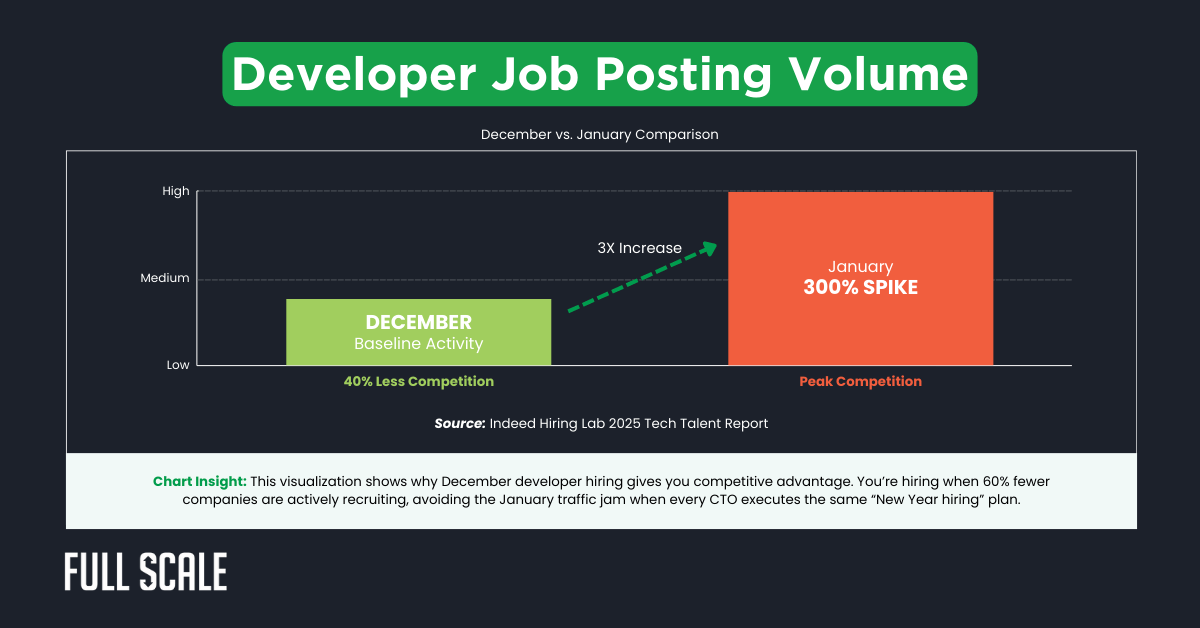
January 2-15 sees a 300% spike in developer job postings. Every CTO has the same “New Year hiring” plan waiting for them.
This creates immediate problems for your Q1 2026 team planning:
- Competition intensity: You’re competing with every other company for the same senior developers
- December reality: 40% fewer companies actively hiring means less competition for top talent
- Developer behavior: Senior developers evaluate opportunities in December, commit in January (you’ve already lost them)
- Agency bandwidth: Recruitment firms and staff augmentation companies are slammed in January-February, responsive in December
2. Get January 1 Productivity (Not March Productivity)
Timeline matters more than you think. An 8-week delay doesn’t just push delivery dates back.
It destroys your entire Q1 plan. Here’s the actual timeline every CTO needs to see:
Timeline Comparison: December vs. January Start
| Start Month | Vetting Period | Onboarding | Competition Delay | Productivity Start | Q1 Days Lost |
|---|---|---|---|---|---|
| December | Weeks 1-2 | Weeks 3-4 | 0 weeks | January 1 | 0 days |
| January | Weeks 1-2 | Weeks 3-4 | 3-4 weeks | March 1 | 60 days |
The Math is Brutal: December starts give you full Q1 productivity (90 days). January starts give you only 30 days of Q1 productivity. That's 3X more output from December timing alone.
The math is brutal. December starts give you full Q1 productivity (90 days).
January starts give you only 30 days of Q1 productivity. That’s 3X more output from December timing alone.
Supporting Data: Job Growth vs. Hiring Challenges
According to Lightcast's 2024 report tracking October 2023 - November 2024, there was a 47% increase in job listings for developers with 0-3 years of experience. However, HackerRank's 2025 research shows 74% of developers still struggle to land jobs due to hiring process inefficiencies.
The Paradox: Job postings are increasing, but hiring process inefficiencies create a bottleneck. Resume filters, slow responses, and irrelevant technical assessments block qualified candidates. This is why the best time to hire developers is when competition is lower—December, not January—giving you access to talent before they're filtered out by January's broken processes.
3. Use The Budget Before It Resets
Most CTOs have a Q4 budget available at this time. Using it strategically for staff augmentation 2026 planning makes financial sense.
Here’s why December timing helps with budget management:
- Current budget availability: Q4 budget often has remaining allocation before year-end reset
- January approval delays: New budget approval processes add 2-4 week delays that push your timeline back further
- Lock in December rates: Start accrual in the current budget, demonstrate Q1 value immediately
- CFO perspective: Show Q1 productivity = justify more Q2 budget allocation based on
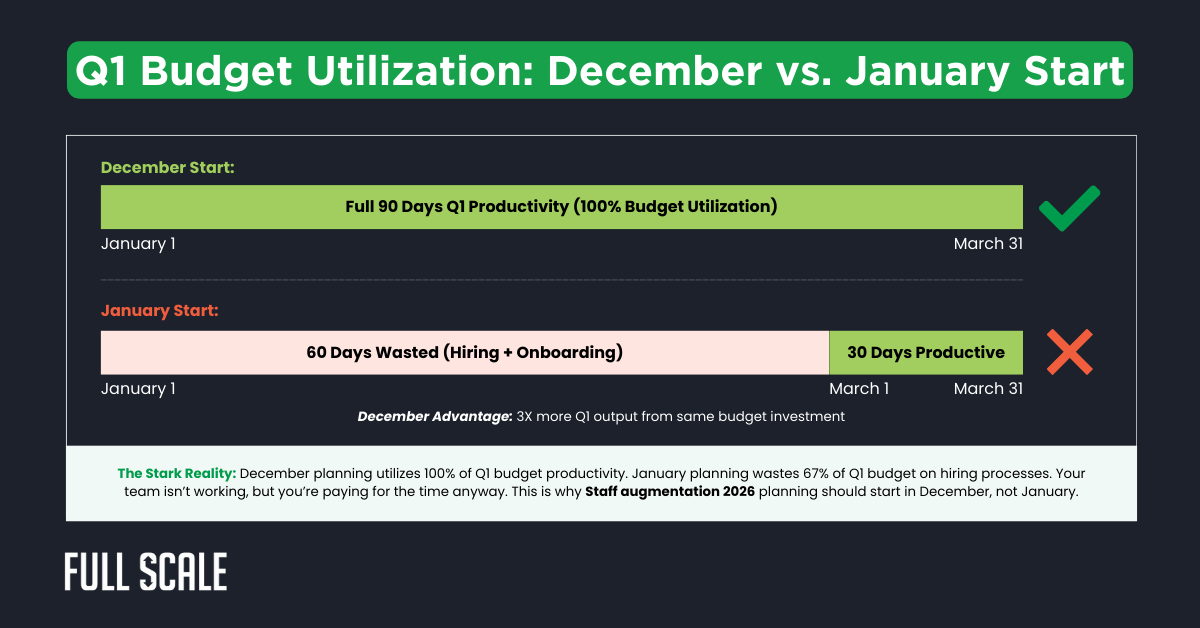
This visualization shows the stark reality. December planning utilizes 100% of the Q1 budget productively.
January planning wastes 67% of Q1 budget on hiring processes. Your team isn’t working, but you’re paying for the time anyway.
Staff Augmentation Vs. Outsourcing: Why The Model Matters For December Timing
Staff augmentation isn’t the same as traditional outsourcing. The difference matters even more when you’re planning for Q1 2026 success.
Here’s what actually separates these models:
| Feature | Staff Augmentation BEST | Project Outsourcing | Freelancer Platforms |
|---|---|---|---|
| Control | Direct Your team, your decisions |
Indirect Through their PM |
Variable Depends on freelancer |
| Integration | Full Integration Slack, standups, your tools |
Separate External team structure |
Minimal Limited coordination |
| Retention | 95%+ Full Scale track record |
~40% Industry average |
Very Low High turnover expected |
| Communication | No Middlemen Direct to developers |
Through PM Layer Added communication delay |
Direct but Inconsistent Timezone & availability issues |
| Commitment | Long-Term Team Building Invested in your success |
Project-Based Ends with deliverable |
Gig-Based Next opportunity focused |
| December Advantage | 2 Weeks to Start FAST Team ready before Q1 |
4-8 Weeks Contract negotiation delays |
Unpredictable Availability varies widely |
For December timing, staff augmentation works because of speed. Traditional outsourcing requires contract negotiations that take a minimum of 4-8 weeks.
By the time contracts are signed, January’s already half over. You’ve lost your window.
Learn more about how staff augmentation differs from outsourcing.
Supporting Data: Retention Rates
According to Merritt Recruitment's 2024 analysis, global turnover rates average 20% across industries. However, leading staff augmentation firms maintain 95%+ retention through proper integration models - a critical advantage for long-term Q1 2026 team planning success.
The Advantage: Staff augmentation's 95%+ retention rate means your December hires become long-term team members, not temporary contractors. This stability allows you to build institutional knowledge and team chemistry that compounds over quarters - essential for sustained Q1 2026 velocity.
The December Staff Augmentation Timeline
Here’s exactly what happens when you start December developer hiring with a quality staff augmentation firm. This isn’t theoretical—it’s the actual timeline that works.
Read our complete CTO Q1 planning guide for more details.
Week 1 (December 2-8): Strategy Call & Requirements
- Book a consultation with staff augmentation companies this week
- Define Q1 2026 team needs (roles, skills, quantity)
- Review pre-vetted developer profiles
- Action item: Schedule calls this week, not next month
Week 2 (December 9-15): Interviews & Selection
- Interview pre-vetted developer candidates
- Technical assessment reviews (already completed by the firm)
- Culture fit evaluation through video calls
- Outcome: Developer selection confirmed before holiday break
Week 3 (December 16-22): Onboarding Prep
- Contracts finalized and signed
- System access provisioned (Slack, GitHub, Jira)
- Onboarding materials prepared and shared
- Before holiday break: Everything is ready for the January 1 start
Week 4-5 (December 23-January 1): Holiday Transition
- Light onboarding starts (if the developer is available)
- Documentation review during downtime
- Team introductions via async channels
- January 1: Developer starts full productivity immediately
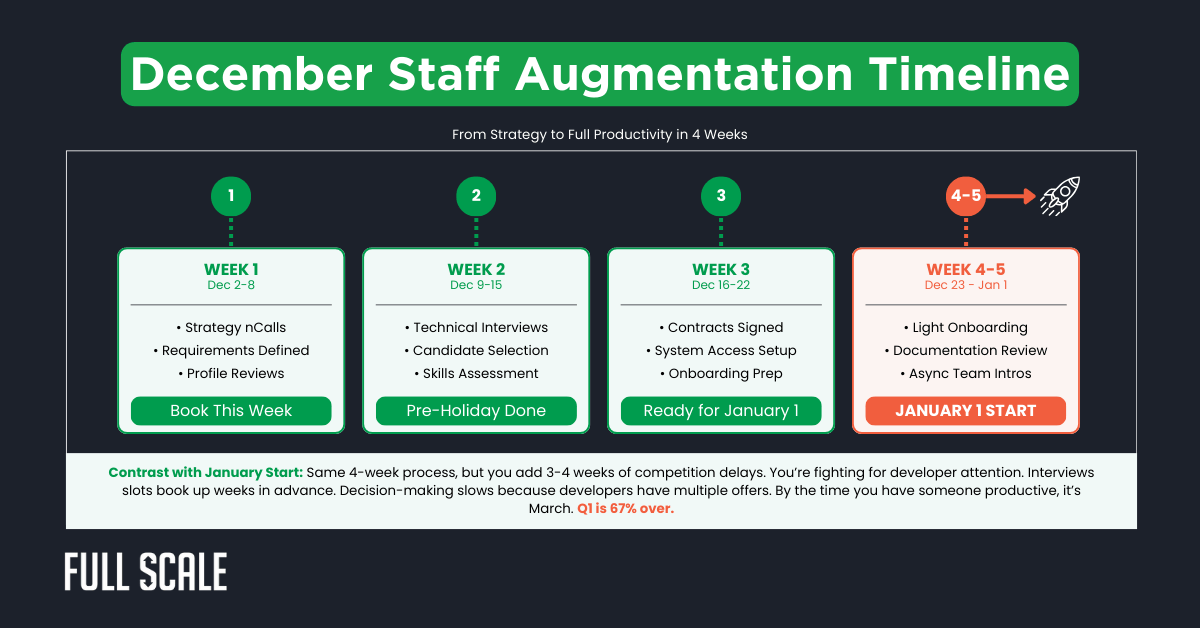
Contrast this with the January start timeline. Same 4-week process, but you add 3-4 weeks of competition delays.
You’re fighting for developer attention. Interview slots book up weeks in advance.
Decision-making slows because developers have multiple offers. By the time you have someone productive, it’s March.
Q1 is 67% over.
Calculate Your December Advantage
Numbers make this real. Use this calculator to see exactly what waiting until January costs your company.
The results show three cost factors: hiring delays, lost productivity, and increased competition costs. Most CTOs underestimate the total by $50K-$150K per developer to hire developers fast.
December vs. January Cost Calculator
See exactly what delaying until January costs in real dollars and lost Q1 productivity.
Your December Advantage
December hiring = Jan 1 start vs. January hiring = March 1 start
• Productivity calculated at 67% of salary for billable work
• Competition costs include 15-20% salary premium for January hires
• Additional 2-3 week hiring delays factored in
• Q1 milestone risk assessed at 25% of project value
This calculator is conservative. It doesn’t include hidden costs like team morale impact, customer delays, or competitive disadvantage from late market entry.
The real cost is often 30-40% higher than calculated. But even conservative numbers show December timing saves $50K-$200K per developer.
Real Results From December Staff Augmentation Starts
Theory matters less than results. Here’s what actually happens when companies start hiring developers in December instead of waiting.
Saas Company: December 2023 Start
The Challenge: Needed 5 senior React developers for the Q1 2024 product launch. Started process December 10, 2023.
The Timeline:
- Week 1-2: Interviews with pre-vetted candidates completed
- Week 3: Contracts signed, onboarding prep finished
- January 2, 2024: All 5 developers are productive on Day 1
The Results:
✅ Hit Q1 launch deadline (would’ve missed with January start)
✅ 100% developer retention after 18 months
✅ Scaled to a 12-person offshore development team by Q3 2024
✅ Saved 60% vs. local hiring costs
Fintech Startup: January 2024 Start (Comparison)
The Challenge: Started hiring process January 5, 2024, after holiday break. Needed the same developer profile.
The Timeline:
- Week 1-3: Scheduled interviews (delayed by January competition)
- Week 4-5: Selection process extended
- Week 6-7: Onboarding and ramp-up
- February 20, 2024: First developer fully productive
The Reality:
❌ Missed Q1 feature launches completely
❌ Had to explain delays to investors
❌ Burned 7 weeks of Q1 budget with zero output
✅ Eventually built a great team (learned to start earlier next year)
Both companies succeeded with staff augmentation. December starts hit Q1 goals.
January starts hit Q2 goals instead. The difference isn’t quality.
It’s timing. December gives you 60 days of competitive advantage.
Common December Objections (Answered)
Isn’t December Too Early For Q1 Hiring?
December is 6-8 weeks before you need productivity. That’s standard lead time for quality hiring, not “too early.”
Too early would be October. December is strategically timed for January 1 delivery.
Our Budget Doesn’t Approve Until January
Most staff augmentation companies structure contracts to start billing on January 1. Even when you commit in December.
Ask about this explicitly. The month-to-month structure eliminates the need for upfront budget approval.
You can begin working with developers while the budget finalizes.
Won’t Developers Be Distracted By Holidays?
Light onboarding during holidays is ideal. Developers review documentation, get system access, and meet team async.
Heavy work starts January 2 when they’re fully ramped. This staged approach actually accelerates integration.
What If We’re Not Ready For Developers On January 1?
If you’re not ready for developers on January 1, you won’t be ready on March 1 either. The question isn’t “Are we ready?”
It’s “When do we need productivity?” Work backwards from that date.
December planning gives you the buffer.
Start Your December Advantage Now
December staff augmentation isn't about being early. It's about being strategic.
The CTOs who hit their Q1 2026 goals won't be scrambling in January. They'll be executing plans made in December.
Book Your December Strategy Call →December slots fill fast. Companies that start this week have developers productive January 1.
Why Partner With Full Scale for Staff Augmentation 2026
Choosing the right staff augmentation firm makes December timing possible. Here’s why Full Scale delivers on December commitments:
- Pre-vetted developer network: Thousands of experienced developers already screened means 2-week delivery timelines instead of 90-day sourcing
- Direct integration model: No project managers between you and developers—they join your Slack, standups, and workflow from Day 1
- 95% retention rate: Industry-leading retention means your December team is still productive 12+ months later
- Month-to-month flexibility: No long-term contracts required—scale up or down based on actual Q1 needs
- U.S.-based legal structure: Contracts and IP protection that satisfy compliance and security requirements
- Transparent, fixed pricing: Know exact monthly costs before commitment—no hidden fees or variable recruitment charges
- Philippines talent advantage: Access senior developers at 50-70% cost savings compared to U.S. hiring without quality compromise
Full Scale has helped 100+ tech companies build their software teams through staff augmentation. Our December starts consistently outperforming January hiring on every metric: speed, cost, quality, and Q1 delivery success.
The difference isn’t just the process. It’s a partnership.
We understand the December timing pressure. We’ve executed it successfully dozens of times.
View our transparent pricing.
Learn more about our staff augmentation services.
Ready to Build Your Q1 2026 Team?
December staff augmentation works when you have the right partner. Start this week.
Here's what happens next:
- 15-minute strategy call: We assess your Q1 needs, timeline, and technical requirements
- Developer profiles within 48 hours: Review pre-vetted candidates matching your exact skillset
- Interviews Week 1-2: Talk directly with developers, evaluate technical fit and culture alignment
- Contracts Week 2-3: Finalize agreements and provision access to your systems
- January 1 productivity: Your new team starts delivering while competitors are still posting job descriptions
December 2025 is optimal for Q1 2026 productivity. Starting in December gives you 2-3 weeks for vetting and onboarding, resulting in January 1 productivity. January starts pushing productivity to March due to competition delays and standard timelines.
Quality staff augmentation firms deliver developers in 2-3 weeks from initial call to Day 1 productivity. This includes pre-vetted candidate interviews (Week 1-2), contract finalization (Week 2-3), and light onboarding (Week 3-4). Traditional hiring takes 90+ days by comparison.
January hiring adds 1a 5-20% salary premium due to competition, plus 60 days of lost productivity. For three developers at $120K average salary, waiting until January costs $150K-$200K in delays, competition premiums, and missed Q1 milestones. December timing eliminates these costs entirely.
Yes. Most staff augmentation companies offer month-to-month contracts that start billing on January 1, even when you commit in December. This flexibility lets you begin developer integration while budget approval is finalizing. No upfront commitment required.
December planning uses holidays strategically. Weeks 1-2 (Dec 2-15) handle strategy calls and interviews. Week 3 (Dec 16-22) finalizes contracts and access. Weeks 4-5 (Dec 23-Jan 1) provide light onboarding—documentation review and async introductions. Full work starts January 2 ,with developers already ramped.