Software Development Approval Process: The Internal Stakeholder Map (Who Approves What and When)
You’ve decided staff augmentation makes sense.
Your CEO says, “Sounds good, but run it by Finance.” Finance says, “Makes sense, but Legal needs to review.” Legal says: “Looks fine, but check with HR.” HR says: “No problem, but does IT Security approve?”
Three weeks later, you’re still collecting signatures. January deadlines slip. Competitors ship features. Your team burns out.
The software development approval process requires five stakeholder approvals: Finance (budget), Legal (contracts), HR (policy), IT Security (data), and CEO (strategy).
Sequential approvals take 23 business days. Parallel engagement compresses this to 5 days by simultaneously providing each stakeholder with targeted information. Cost of delays: $2,043 per developer per day in opportunity cost.
The software development approval process doesn’t have to take weeks. Here’s the stakeholder map showing exactly who approves what, in what order, and how to compress 23 days into 5.
What You'll Learn:
- ✓ The 5 decision-makers who actually matter (and 7 who just slow you down)
- ✓ Parallel approval framework that cuts timelines from 23 days to 5
- ✓ Exact conversation scripts that handle objections before they derail you
- ✓ Real cost calculator: $64,908 opportunity cost per delayed approval cycle
Why Your Software Development Approval Process Costs More Than You Think
Most CTOs think approval delays just cost time. Wrong.
According to Gartner’s 2024 CIO Survey, 64% of IT leaders report that slow software development approval processes directly impact strategic initiatives. Each week spent collecting signatures costs real money. Here’s what you’re actually losing.
Week 1 delay: Senior developers waste 15 hours explaining the same thing to different stakeholders. That’s $3,750 in billable time at $250/hour loaded cost.
Week 2 delay: Your Q1 feature now launches in Q2. Sales miss Q4 targets because the product isn’t ready.
Week 3 delay: The developer you wanted has accepted another offer. You’re back to square one, three weeks behind.
Real Numbers From 60+ Enterprise Implementations:
| Metric | Average Cost |
| Sequential approval timeline | 23 days |
| Opportunity cost per developer/day | $2,043 |
| Total waste (3 developers × 23 days) | $141,159 |
Calculation methodology: $2,043/day = Average senior developer salary ($150K) + 35% benefits/overhead ÷ 240 working days = Daily opportunity cost. Source: Full Scale client data analysis, 2024
The hidden cost nobody mentions? Team morale. Nothing kills engineering culture faster than watching good ideas die in approval purgatory while your CTO planning gets derailed by bureaucracy.
Why Most Software Development Approval Processes Fail
Here’s the uncomfortable truth about getting budget approved for technology hiring decisions. The conventional approach treats every stakeholder as equally important. This is wrong.
You have five stakeholders with veto power. Everyone else is noise.
Most CTOs make three fatal mistakes in their software development approval process:
Mistake #1: Treating information-only stakeholders as decision-makers. This adds weeks of unnecessary “socializing.”
Mistake #2: Providing the same information to everyone. Finance doesn’t need your technical architecture. Legal doesn’t care about sprint velocity.
Mistake #3: Sequential approvals—waiting for each person before starting the next conversation. This multiplies your timeline by 5x.
The fix is counterintuitive. Engage only the five decision-makers. Give each exactly what they need. Run all conversations simultaneously. This transforms your internal approval process technology approach completely.
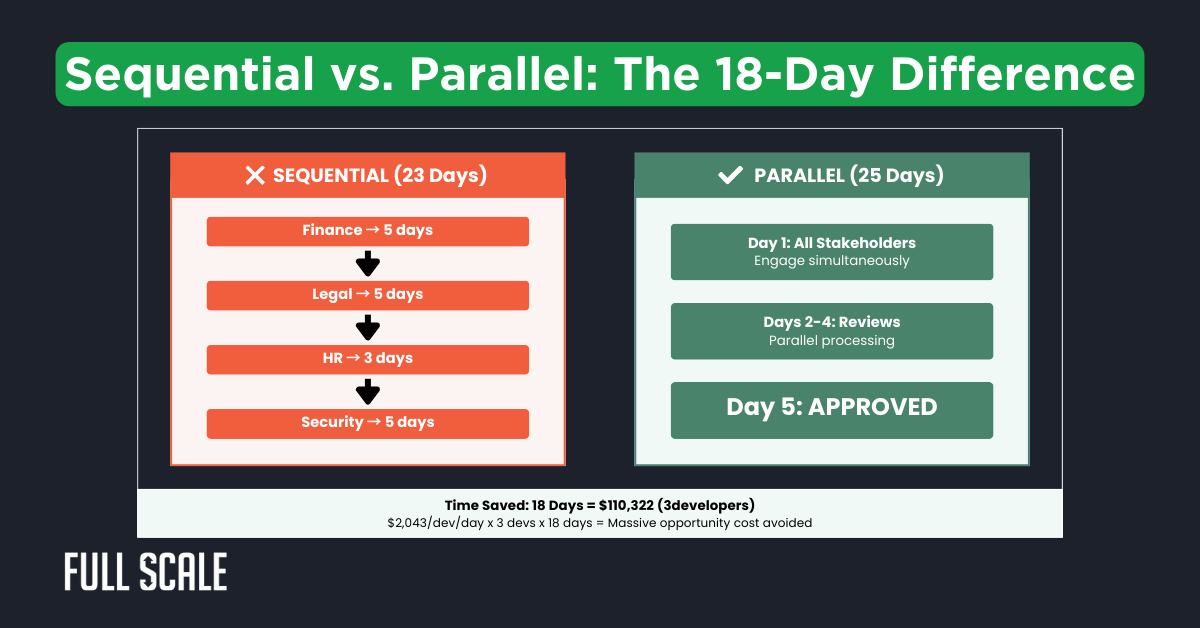
This visual makes the difference obvious. Sequential approvals stack linearly—each delay compounding. Parallel approvals compress exponentially. Your choice determines whether you ship in Q1 or miss the quarter entirely. Learn how strategic CTOs handle budget approvals in a single conversation.
The 5-Gate Stakeholder Approval Framework
So, how do you actually navigate the software development approval process correctly? Start by understanding who controls what. Here’s what nobody tells you about getting budget approved: you don’t have one decision-maker. You have five veto points.
Each stakeholder controls a different gate in your technology hiring approval workflow. Finance controls the budget. Legal controls contracts. HR controls the headcount policy. IT Security controls data access. The CEO controls strategic alignment.
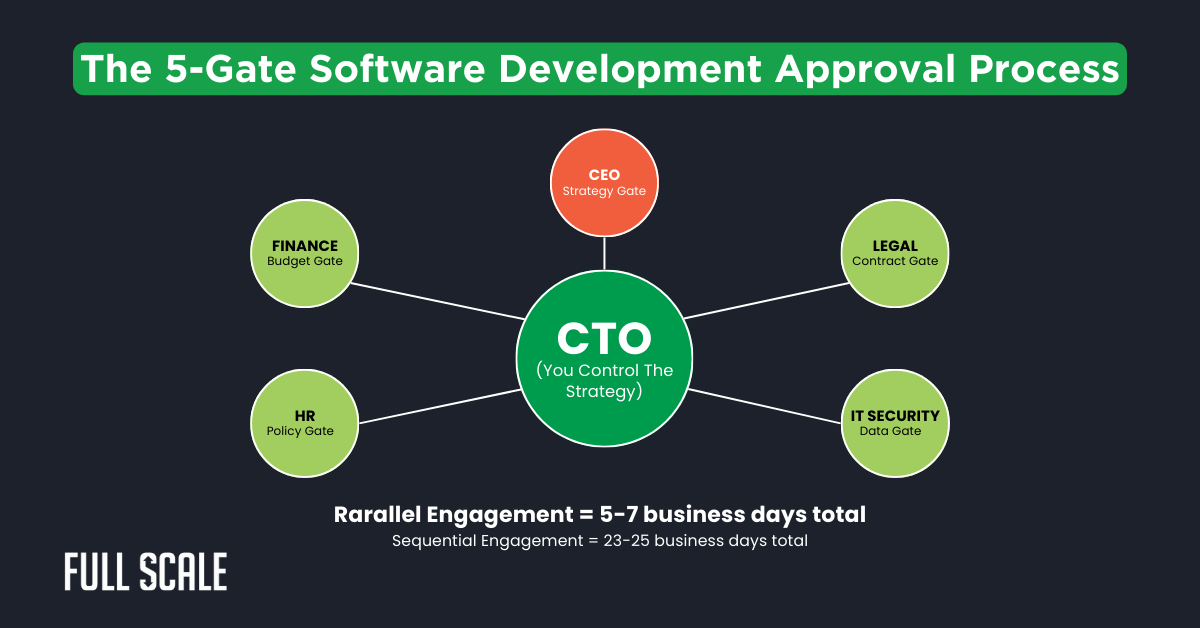
This framework shows why sequential approvals kill timelines in any software development approval process. Engage all five gates simultaneously, and you compress weeks into days. That’s how modern CTOs win.
Now let’s talk about what each stakeholder actually needs to say yes—and how to bypass the seven people who just slow you down.
The 7 Stakeholders Who Slow Your Software Development Approval Process
Not every person who wants approval authority actually needs it in your software development approval process. Here are the stakeholders who create bottlenecks without adding value. These people want to be “in the loop” but don’t have decision authority.
The Procurement Officer: Wants to “evaluate vendors” even though you’ve already chosen one. This is a common blocker when navigating internal approvals and staff augmentation decisions.
Bypass: Get CEO confirmation that this isn’t a formal RFP. Position as Engineering Services, not a technology procurement approval requiring competitive bidding.
The Department Manager: Wants to know how this affects their team, even though they’re not involved.
Bypass: FYI email after approval, not before.
The Compliance Manager: Wants to review everything for “policy alignment.”
Bypass: Route through Legal—Compliance reports to them.
The IT Operations Lead: Wants to “assess infrastructure impact” for remote developers.
Bypass: Include IT Security, not IT Ops.
The Project Manager: Wants timeline impact details.
Bypass: This is your CTO decision, not theirs. Inform after approval.
The Business Unit VP: Claims, “This sets precedent.”
Bypass: Get CEO’s sign-off that this is Engineering’s decision.
The Internal Audit: Wants to review “financial controls.”
Bypass: Finance already approved. Audit reviews after, not during.
Here’s the rule for your enterprise approval process hiring: if someone can’t veto your decision, they don’t get approval authority. They get informed after the fact. This is critical for getting sign-off for offshore developers quickly.
Your Technology Hiring Approval Workflow: Gate-by-Gate Breakdown
You know who to bypass. Now here’s exactly what the five real decision-makers need from you. Most CTOs waste time showing everyone everything. Finance doesn’t need technical architecture. Legal doesn’t care about sprint velocity.
Finance: What They Actually Review
Finance controls one thing in the software development approval process: money. They want three specific answers only.
What Finance needs to approve:
- Total annual cost (not monthly rates)
- Budget source (which line item)
- ROI justification (saves or makes money)
Their approval timeline: 2-3 days with a one-page breakdown.
Finance Approval One-Pager Template
| Item | Annual Cost | Budget Source |
|---|---|---|
| Senior Developers (3) | $237,600 | Engineering OpEx |
| vs. Local Hiring Cost | $450,000 | Same budget line |
| Annual Savings | $212,400 | 47% cost reduction |
Source: Full Scale transparent pricing at $6,600/month per senior developer vs. $12,500/month local average (including benefits, overhead, and recruiting costs)
Finance approves in 48 hours when you show savings while increasing capacity. This is exactly how smart CTOs structure their development budget planning to get quick approval.
Legal: IP Protection and Contract Terms
Legal exists to protect the company from liability in the software development approval process. They want contracts minimizing risk, not perfect contracts. The software vendor approval process typically takes 3-5 days with pre-negotiated enterprise contracts versus 15-30 days for custom agreements.
What Legal reviews:
- IP ownership clauses (who owns the code)
- Data protection terms (GDPR, security)
- Liability limitations (cap on damages)
- Termination conditions (easy exit)
Their timeline: 3-5 days for standard agreements, 15+ for custom negotiations.
The trick? Use vendors with pre-negotiated enterprise agreements for your internal approval process technology decisions. Full Scale’s contracts include U.S.-based IP protection and month-to-month terms. Legal reviews in one business day. According to Deloitte’s 2024 CFO Signals Survey, 71% of CFOs increased scrutiny on Q4 technology spending, making pre-approved contracts critical for fast approvals.
HR: Headcount Policy Compliance
HR worries about one thing: Is this disguised full-time hiring? They need contractor classification clarity per IRS worker classification guidelines.
What HR approves:
- Classification (contractor vs. employee)
- Headcount impact (budget count?)
- Onboarding process details
- Exit procedures
Their timeline: 1-2 days with proper framing.
The magic phrase: “This is staff augmentation, not headcount. These developers are vendor employees working as team extensions. Zero headcount budget impact.”
IT Security: Data Access Protocols
Security has one job in the software development approval process: protect company data. They want system access protocols documented with proper certifications.
What Security reviews:
- System access levels needed
- Data handling procedures
- Security certifications (SOC 2)
- Incident response protocols
Their timeline: 2-3 days with proper certifications, 10+ without.
Security moves fast when vendors already meet compliance standards. SOC 2 Type II certification, defined by AICPA standards, is the gold standard for vendor security. Choose partners who handle this upfront—it eliminates weeks from your software development approval process timeline.
CEO: Strategic Alignment Sign-Off
Your CEO cares about one thing: Does this help us win? They want strategic fit confirmation, not tactical details.
What CEO approves:
- Strategic fit (why this, why now)
- Competitive impact (market position)
- Risk mitigation (failure planning)
Their timeline: One 15-minute meeting with proper setup.
Here’s the CEO script that works:
“We’re three developers short for Q1 priorities. Local hiring: 4 months, $450K. Staff augmentation: 2 weeks, $238K. Same skills, faster delivery, lower risk. Need your sign-off to proceed.”
Done. CEOs approve strategic decisions, not tactical details. Learn more about justifying offshore development to executives.
The 5-Day Parallel Software Development Approval Process
Now you know what each stakeholder needs in your software development approval process. Here’s how to engage all five simultaneously—the core of any effective stakeholder approval framework.
Conventional wisdom says get Finance approval first, then Legal, then HR, then Security, then CEO. This takes an average of 23 days.
Smart approach: engage everyone Day 1 with targeted information. This takes 5-7 days total.
Day 1 (Monday): Send customized packets to all five stakeholders. Each contains only what that person needs to decide.
Day 2 (Tuesday): Follow up with Finance and HR (fastest approvers). These typically sign off the same day.
Day 3 (Wednesday): Legal and Security review contracts and certifications. Answer clarifying questions.
Day 4 (Thursday): Schedule a 15-minute CEO conversation. Finance/Legal/HR/Security already approved. You’re getting the final strategic sign-off.
Day 5 (Friday): All approvals complete. Start onboarding developers on Monday. This is how modern staff augmentation playbook strategies compress timelines.
The Approval Acceleration Formula
Calculation: $2,043/developer/day opportunity cost × 3 developers × 18 days saved with parallel engagement
What is the difference between 5 days and 25 days? Parallel engagement with tailored information. Stop treating approvals like a relay race where everyone waits their turn.
The Objection Framework: Handle Pushback Before It Derails You
Even with parallel approvals in your software development approval process, stakeholders raise objections. Here’s how to handle the most common ones before they become delays.
When Finance Says: “This isn’t in our budget.”
Your response: “You’re right—but here’s what is budgeted. We allocated $450K for three local developers. I’m proposing $238K for the same three through staff augmentation. That’s $212K in savings or capacity for two additional mid-levels.”
Why this works: You’re not requesting new money. You’re showing better allocation of existing budget.
When Legal Says: “We need to modify contract terms.”
Your response: “I chose a vendor with U.S.-based contracts and explicit IP assignment clauses. Here’s their standard agreement, approved by 60+ enterprise legal teams. What specific concerns remain?”
Why this works: You de-risked contracts upfront. Legal isn’t starting from scratch. This is why choosing the right IT staff augmentation services matters for approval speed.
When HR Says: “This circumvents our headcount freeze.”
Your response: “Actually, it respects the freeze. These aren’t employees—they’re augmented staff from an external vendor. No headcount budget impact, no benefits load. This is exactly what staff augmentation solves: capacity without headcount.”
When Security Says: “External developers can’t access our systems.”
Your response: “That’s why I chose SOC 2 Type II certified vendors with background checks and NDAs. Here’s their security documentation. What additional safeguards do you need?”
When the CEO Says: “Why can’t we just hire locally?”
Your response: “We can. Takes 4 months, costs $450K for three developers. Or augment in 2 weeks for $238K. Same skills, faster market delivery, lower risk. If they don’t work out, we’re not stuck. Which timeline fits our Q1 priorities?”
Why this works: You frame this as a strategic choice, not cost-cutting. CEOs approve strategies that help them win. Understanding why offshore outsourcing works better with staff augmentation helps frame this conversation.
Calculate Your Actual Software Development Approval Process Cost
Use this calculator to see exactly what your current approach costs in real time and money. Enter your details and watch the numbers.
Software Development Approval Process Timeline Calculator
Your Approval Timeline:
Financial Impact:
This calculator shows your exact timeline and cost. Sequential approvals typically add 18-20 days compared to parallel engagement. That’s a full sprint cycle wasted on paperwork instead of shipping. This is exactly why flexible development budget strategies matter for competitive advantage.
Real Examples: CTOs Who Mastered The Software Development Approval Process
Here are three real scenarios where CTOs transformed their software development approval process from a 23-day bottleneck to a 5-day greenlight. Names changed, numbers real.
Case 1: FinTech CTO Cut 22 Days (Q2 2024)
Challenge: Needed five developers for regulatory reporting. The CEO is nervous about offshore. Legal concerns about data security. Finance wanted cost proof.
What worked: Created three one-pagers. Finance got a cost comparison ($396K saved annually). Legal got security docs. The CEO got a strategic brief showing competitor’s advantage.
Result: All five stakeholders approved in six business days. Developers started on Monday.
Case 2: SaaS VP Bypassed Procurement (Q3 2024)
Challenge: Needed eight developers for AI integration. Procurement insisted on a 60-day vendor evaluation.
What she did: Positioned as “professional services” under the Engineering budget, not “staffing” under Procurement. Got CEO confirmation, Engineering controls technical partners.
Result: Procurement informed, not consulted. Approval took nine days instead of 60. This is how understanding top staff augmentation companies speeds decisions.
Case 3: Healthcare CTO Parallelized Everything (Q4 2024)
Challenge: Healthcare startup needed 12 developers for patient portal rebuild. HIPAA compliance required. Multiple nervous stakeholders.
What he did: Created approval packets for each stakeholder on Day 1. Finance: cost analysis. Legal: HIPAA docs. Security: SOC 2 certification. CEO: Competitive timeline.
Result: Twelve stakeholders, five business days, complete approval.
Why Freelancer Platforms Fail The Software Development Approval Process
Most CTOs consider freelancer platforms like Toptal, Upwork, or Turing before staff augmentation companies. Here’s why they fail enterprise approvals:
No Enterprise Contracts = Legal Rejects
Freelancer platforms use individual contractor agreements. Legal can’t approve 12 separate contractor relationships. They need one master services agreement. Full Scale provides enterprise contracts approved by 60+ legal teams.
No Security Certifications = IT Security Rejects
Individual freelancers don’t have SOC 2 Type II certification. They can’t prove background checks. Security teams reject on first review. Full Scale maintains SOC 2 certification and vets all developers before engagement.
High Turnover (40%+) = CEO Rejects
Freelancer platforms average 40% annual turnover. Projects stall when freelancers move to higher-paying gigs. Full Scale’s 95% retention rate means developers stay for years, not months.
Month-to-Month Contracts = Finance Approves
Full Scale built our model specifically to pass enterprise approvals on first review. Every common objection (Legal, Security, Retention) was solved before we signed our first client.
Why Partner With Full Scale For Your Software Development Approval Process
Getting approvals isn’t just about good answers in your software development approval process. It’s about choosing vendors who make the approval process easy. Full Scale’s approach was designed to eliminate common stakeholder objections.
Why Finance approves Full Scale:
- Transparent pricing: $4,800-$6,600/month per developer (no hidden fees)
- 47% cost savings vs. local hiring for senior developers
- Month-to-month terms mean no long-term budget commitments
- Clear ROI: senior developers at mid-level U.S. prices
Why Legal approves Full Scale:
- U.S.-based contracts with explicit IP assignment
- Pre-negotiated terms approved by 60+ enterprise legal teams
- No unusual liability language triggering negotiations
- Month-to-month terms mean easy exit
Why HR approves Full Scale:
- Developers are our employees—zero headcount impact for you
- No benefits administration or payroll complexity
- No immigration or visa sponsorship needed
- Clear contractor classification eliminates co-employment risk
Why Security approves Full Scale:
- SOC 2 Type II certified infrastructure
- Background checks on all developers before engagement
- Standard NDAs and security protocols
- Dedicated Philippines facility with controlled access
Why CEOs approve Full Scale:
- 95% developer retention vs. 68% industry average
- Developers start in two weeks, not four months
- The Philippine time zone enables daily standup overlap
- 500+ developers placed across 60+ companies—proven model
We built an approval-friendly business model. Every objection your stakeholders raise, we’ve already solved in our software development approval process design.
Start Your Parallel Approval Process This Week
You now have the complete software development approval process stakeholder map. You know who approves what, in what order, with what information. The framework is clear. The choice is yours.
Will you use sequential approvals and wait 25 days? Or parallel approvals and start in five days?
Your competitors aren’t waiting for perfect consensus. They’re using parallel engagement frameworks to ship faster. According to Gartner’s 2024 research, 43% of CIOs report talent shortages as the biggest barrier to emerging technologies. Your software development approval process determines whether you solve that in one week or one quarter.
Monday morning action plan:
Create five approval packets (Finance, Legal, HR, Security, and CEO). Send all five simultaneously with the subject: “Need approval by Friday for Q1 staffing.”
Tuesday-Thursday: Answer questions, schedule brief calls as needed.
Friday: Get final CEO sign-off after confirming other approvals are complete.
Following Monday: Start onboarding developers.
That’s your entire software development approval process. Five days from decision to execution. Stop waiting for approvals to find you. Go get them in parallel. Learn how year-end budget planning can accelerate your timeline even more.
Stop Collecting Signatures. Start Shipping Code.
Full Scale handles compliance, contracts, and headcount questions. You handle technical decisions. We’ve compressed the software development approval process for 60+ tech companies.
Five stakeholders control technology hiring approval:
Finance – Budget allocation approval
Legal – Contract and IP terms review
HR – Headcount policy compliance
IT Security – Data access protocols
CEO – Strategic alignment sign-off
Everyone else receives information after approval, not during the software development approval process.
Sequential approvals in a typical software development approval process take 23-25 business days (one stakeholder at a time). Parallel engagement with all five decision-makers simultaneously compresses this to 5-7 business days. Time saved: 18 days average equals $110,322 opportunity cost for a 3-developer team.
Finance requires three specific items in the software development approval process: total annual cost, budget source identification (which line item), and ROI justification showing savings or revenue impact. They don’t need technical architecture or staffing methodology. When you show Finance they’re saving money ($212K annually for three developers vs. local hiring) using existing budget, they typically approve in 48 hours.
Legal approval timelines depend entirely on contract complexity in your software development approval process. Standard pre-negotiated agreements take 1-2 days. Custom negotiations take 15+ days minimum. Choose vendors with enterprise-grade contracts already approved by multiple companies. Legal verifies IP clauses, data protection terms, liability limitations, and termination conditions. Standard terms mean immediate sign-off.
Sequential approvals mean getting Finance approval, then Legal, then HR, then Security, then CEO—each waiting for the previous completion. This takes 5 days per stakeholder equals 25 days total in your software development approval process. Parallel approvals engage all five stakeholders simultaneously on Day 1 with customized information packets. Each reviews independently. Total time: 5-7 days because you eliminate sequential wait times. Savings: 18 days equals $110,322 opportunity cost for three developers.