Offshore Developer Onboarding: Your Week 2-3 Game Plan (Daily Priorities That Prevent 6-Month Failures)
Week 2 with your offshore developers is when the magic happens. Or when everything starts to crack.
Most CTOs obsess over velocity metrics in week 2. They’re measuring the wrong things.
What actually matters: relationship patterns forming RIGHT NOW. If you’re in week 2-3 with your offshore team and thinking “this feels slower than I expected”—you’re not alone.
You’re past the excitement of day 1. You’re not yet hitting stride.
Here’s what most don’t tell you: these patterns—forming right now, this week—determine whether you’re celebrating at month 3 or scrambling to fix communication breakdowns at month 6.
According to GitLab’s Remote Work Guide, 67% of offshore integration failures happen in the first 30 days. Not because of skill gaps.
Because of integration gaps that solidify in weeks 2-3.
Here’s the offshore developer onboarding playbook that actually works. From 60+ companies that got it right.
📗 What You'll Learn in This Offshore Developer Onboarding Guide
- The 4 Cs Framework that separates successful integrations from struggling ones
- Day-by-day priorities for weeks 2-3 with specific actions, not vague advice
- Diagnostic checklist to know if you're on track or quietly going sideways
- Red flags to address immediately before they become 6-month problems
- Recovery plan if you're already behind schedule in offshore developer onboarding
📍 Quick Navigation - Jump to Your Biggest Need:
Core integration methodology 📅 Day-by-Day Actions
What to do each day ✅ Am I On Track?
Self-assessment checklist 🚩 Red Flags
Warning signs to fix now 🆘 Behind Schedule?
Recovery plan 📊 Real Success Story
From crisis to integration
Estimated read time: 8 minutes | 2-3 minutes per section
Why Week 2-3 Is the Make-or-Break Phase for Offshore Team Integration
Here’s what happens in most companies during offshore developer onboarding:
Week 1 is white-glove treatment. Daily check-ins. Detailed explanations.
Everyone’s excited.
Week 2 hits. The novelty wears off.
The CTO gets busy with other priorities.
And quietly, patterns form:
- Your offshore developers only communicate with one tech lead (bottleneck forming)
- Standups become status reports where offshore devs just listen
- Your local team starts working around them instead of with them
By week 4, you’re wondering why this isn’t working. By month 3, you’re dealing with turnover or performance issues.
The brutal truth: Week 2-3 offshore developer onboarding patterns become month 2-3 habits. What you ignore now costs you 10x time later.
Understanding the differences between staff augmentation and traditional outsourcing helps explain why integration matters more in the augmentation model.
What Should I Focus On in Offshore Developer Onboarding Week 2-3?
The 4 critical priorities for offshore developer onboarding weeks 2-3:
- CONNECT (35% of effort): Build relationships through 2-3 weekly pair programming sessions and informal Slack channels
- CLARIFY (25% of effort): Document communication norms, decision-making processes, and create RACI charts
- CONTRIBUTE (25% of effort): Assign well-scoped tasks that create early wins without time pressure
- COURSE-CORRECT (15% of effort): Conduct 30-minute 1-on-1s in weeks 2 and 3 to identify integration gaps
Success indicator:
By day 19, offshore developers should be pulling work independently, contributing strategic opinions in meetings, and scoring 7+ out of 10 on "feeling part of team" assessments.
Source: Analysis of 60+ offshore developer onboarding integrations, GitLab research shows 67% of failures happen in first 30 days.
What You’re Probably Experiencing Right Now
Let me guess what your week 2 offshore developer onboarding looks like:
- Your developers are still asking basic questions you thought were covered
- Standups feel one-sided, with offshore team mostly listening
- Code review comments feel surface-level (“LGTM”), not strategic
- Your local team is polite but hasn’t really bonded with offshore folks
Here’s what I want you to know: This is all completely normal.
But it does require intentional action THIS WEEK to move past it.
I’ve watched 60+ tech companies go through this exact offshore developer onboarding phase. The ones who get it right by month 2?
They all did the same things in weeks 2-3.
The ones who struggle at month 6? They skipped these offshore team integration steps.
They thought they’d “catch up later.” They never did.
Here’s what works.
The 4 Cs Framework for Week 2-3 Offshore Developer Onboarding Success
After watching 60+ companies go through remote developer onboarding, we’ve identified the 4 critical priorities. These separate successful integrations from struggling ones.
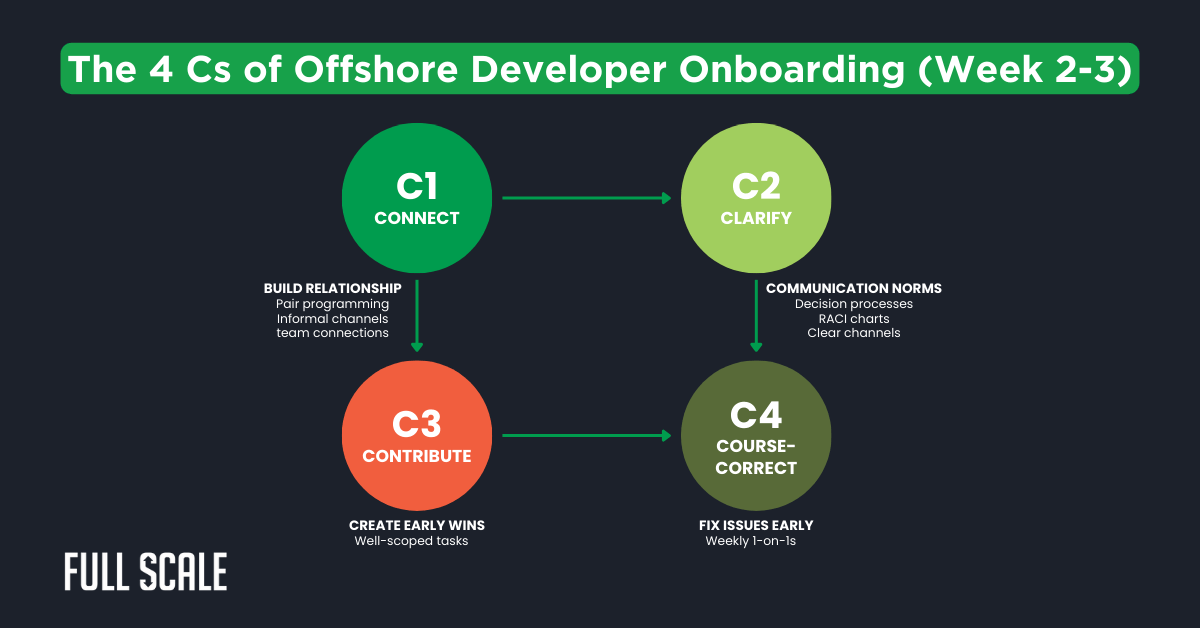
We call it the 4 Cs of Week 2-3 Offshore Developer Onboarding:
C1 – CONNECT: Build Relationship Capital First
According to Gallup’s 2024 State of the Global Workplace report, employees with strong workplace relationships are 50% more engaged.
For distributed teams in offshore developer onboarding, this compound connection isn’t just nice to have; it’s the foundation.
Developers who feel part of the team stay (our retention: 95% vs. industry average: 60%). Psychological safety enables better questions and contributions.
Research from Harvard Business Review shows that intentional relationship-building in the first month of remote team integration reduces turnover by up to 40%.
How to Build Connection in Week 2-3:
Daily Touchpoints:
- Morning standup (but make it conversational, not just status updates)
- Async check-ins via Slack (casual, not formal)
- End-of-day “wins & blockers” thread
2-3x Weekly:
- Pair programming sessions (local + offshore mixed pairs)
- Collaborative code reviews (not just approval stamps)
- Knowledge-sharing sessions (rotate who presents)
Create Informal Channels:
- Slack channel for non-work chat (#random, #watercooler)
- Virtual coffee chats (optional but encouraged)
- Include offshore in ALL team communications
📅 DAY 8 ACTION: Schedule Your First Pair Programming Session
Pair your strongest LOCAL developer with an offshore developer on a non-critical task.
Goal: Not perfect code. Goal: Build rapport.
What to look for: Are they comfortable asking "dumb questions"? Are they laughing together? That's offshore team integration working.
Common Mistake: ❌ “We have a daily standup, which should be enough for connection.”
✅ Formal meetings create performance anxiety, not psychological safety. Integration happens in the margins—casual Slack messages, pair programming, informal check-ins.
Learn proven strategies for managing remote development teams effectively and discover how to retain offshore developers long-term.
C2 – CLARIFY: Establish Communication Norms
Why Communication Clarity Matters in Offshore Developer Onboarding:
Prevents “assumption debt” from compounding. Reduces friction in decision-making.
Creates clarity about who to ask for what.
Offshore developers hate wasting people’s time. Give them clear channels and explicit permissions.
How to Establish Communication Norms:
Document Decision-Making Process:
- Who has final say on architecture decisions?
- Who approves PRs?
- Who can answer domain-specific questions?
Define Terminology:
- What’s a “blocker” vs. a “question”?
- What’s “urgent” vs. “important”?
- What response time should they expect?
Establish Communication Preferences:
- When to use Slack vs. email vs. Jira comments
- When to schedule a meeting vs. async discussion
- When to escalate vs. work through it
📅 DAY 10 ACTION: Clarify Communication Channels in Standup
Say this out loud:
"If you're blocked, tag @tech-lead in #dev-chat immediately. If you have questions about requirements, tag @PM in #product. If you're unsure which channel, ask in #dev-chat—someone will help or redirect you."
Then: Write it down. Pin it in Slack. Reference it when people get confused.
In our analysis of 60+ integrations during offshore developer onboarding, teams with documented communication norms by week 3 had 40% fewer escalations at month 2.
Connection alone isn’t enough. Your offshore developers also need clarity about how things work.
Now it’s time to build confidence through contribution.
C3 – CONTRIBUTE: Create Early Wins
Confidence builds competence. Small wins create momentum.
Contribution creates ownership and investment during offshore developer onboarding.
How to Create Early Wins:
Assign Well-Scoped Tasks:
- Meaningful but not critical
- Clear acceptance criteria
- Not time-sensitive (removes pressure)
- Complexity is slightly above their current level
Set Up for Success:
- Provide context: WHY this task matters
- Make requirements crystal clear
- Be available for questions (but don’t hover)
- Pair them with a buddy for the first solo task
Celebrate Completion Publicly:
- Shout-out in team Slack channel
- Mention in standup
- Positive code review feedback (specific, not generic)
📅 DAY 11 ACTION: Assign First "Solo" Task
Requirements for successful offshore developer onboarding:
- ✅ Meaningful (real feature, not busy work)
- ✅ Well-scoped (completable in 2-3 days)
- ✅ Clear success criteria
- ✅ Not blocking anything critical
When complete, celebrate publicly:
"Great work @offshore-dev on shipping [feature]. Clean implementation and good test coverage. This unblocks [thing]."
Common Mistake: ❌ Either too easy (busy work) or too hard (set up for failure)
✅ Find the Goldilocks zone: challenging enough to feel meaningful, scoped enough to succeed. Discover more offshore software development best practices.
With relationships forming and norms established, confidence-building through contribution is working. Even with all this in place, issues will emerge.
The key is catching them early.
C4 – COURSE-CORRECT: Fix Issues Before They Stick
Week 2-3 offshore developer onboarding patterns become month 2-3 habits. Early correction is 10x easier than later.
How to Course-Correct Effectively:
Schedule Explicit 1-on-1s:
- Week 2: 30 minutes with each offshore developer
- Week 3: Another 30 minutes
- Focus on feelings and integration, not just task status
Ask Better Questions:
- “On a scale of 1-10, how connected do you feel to the team?”
- “What’s still confusing after 2 weeks?”
- “What would make this feel like YOUR team, not just a job?”
- “What’s working? What’s not?”
Address Issues Immediately:
- Don’t let communication breakdowns fester
- If the local team is excluding them, call it out
- If expectations are unclear, clarify NOW
📅 DAY 14 ACTION: 1-on-1 with Each Offshore Developer (30 min)
Your offshore developer onboarding script:
"I want to check in on how integration is going. Not task status—how you're feeling about being part of the team. On a scale of 1-10, how connected do you feel? What would make it a 10? What's been confusing? What could I do better?"
Then: LISTEN more than you talk. Take notes. ACT on what you hear within 48 hours.
Common Mistake: ❌ “I’ll do 1-on-1s once they’re fully ramped up.”
✅ By then, bad patterns are cemented. One hour now prevents 10 hours of fixing issues in month 3.
Personal Story from 2012:
I hired my first offshore team at Stackify. By week 2 of offshore developer onboarding, I was panicking.
“Why are they so slow? Why do they need so much handholding?”
Turns out, I was measuring the wrong things. I was optimizing for output when I should have been optimizing for integration.
Once I shifted my focus—from daily standups to relationship building, ticket completion to communication quality—everything changed. By week 4, my offshore team was outperforming my local team.
Not because they were “better” developers. Because they felt like PART of the team.
Connection. Clarity. Contribution. Course-correction.
Those are your four offshore developer onboarding priorities.
But how do you actually apply them day-to-day? Here’s your tactical playbook.
Your Day-by-Day Offshore Developer Onboarding Priority Guide
Here’s exactly what to focus on each day of weeks 2-3 during offshore developer onboarding. Hitting 70-80% of these priorities will set you up for success.
| Day | Focus | Action | Success Metric |
|---|---|---|---|
| DAY 8 Mon | Review & Relationships | Morning: Review week 1 retro Action: Schedule 2-3 pair programming sessions | Offshore devs speaking up in standup? Tip: Call on them directly if silent |
| DAY 9 Tue | Hands-On Collaboration | Morning: First pair programming session Action: "Question of the day" in Slack | Questions in PUBLIC channels vs. DMs? Tip: Answer publicly even if asked privately |
| DAY 10 Wed | Clarity & Independence | Morning: Clarify decision-making norms Action: Assign first "solo" task | How long before first question? Tip: Check in if no questions within 2 hours |
| DAY 11 Thu | Contribution & Voice | Morning: Code review session Action: Offshore dev presents approach | Explaining THINKING or just code? Tip: Ask "Why this approach?" |
| DAY 12 Fri | Reflection & Celebration | Morning: Week 2 retro on communication Action: Celebrate wins publicly | "Feeling part of team" score (1-10)? Tip: Below 7 = course-correction needed |
| 🎯 Week 2 Checkpoint: Offshore devs asking questions publicly • At least one codebase contribution • Connections forming with 2+ team members |
📱 Scroll horizontally to view full table on mobile
| Day | Focus | Action | Success Metric |
|---|---|---|---|
| DAY 15 Mon | Increasing Ownership | Morning: Review week 2 themes Action: Increase task complexity | Pulling work from backlog independently? Tip: Give explicit permission to pull work |
| DAY 17 Wed | Deep Check-In | Morning: 30-min 1-on-1s Action: Focus on feelings, not tasks | Still asking logistical questions? Tip: Logistical questions at day 17 = gap |
| DAY 19 Fri | Autonomy Assessment | Morning: Week 3 retro on autonomy Action: Plan week 4 increased ownership | How many independent decisions this week? Tip: Zero = you're hand-holding too much |
| 🎯 Week 3 Checkpoint: Questions evolving to "Should we?" • Proactive suggestions in planning • Work pulled independently • Connection score 7+/10 |
📱 Scroll horizontally to view full table on mobile
These day-by-day priorities are based on offshore development team best practices we’ve refined across 500+ developer placements.
Diagnostic Checklist: Is Your Offshore Developer Onboarding On Track?
Here’s how to know if your offshore team integration is working—or if you need to course-correct NOW during offshore developer onboarding.
✅ Signs Offshore Developer Onboarding Is Working (By End of Week 3)
COMMUNICATION QUALITY
TEAM PARTICIPATION
AUTONOMY INDICATORS
ENGAGEMENT SIGNALS
SCORING YOUR OFFSHORE DEVELOPER ONBOARDING:
12+ out of 16: You're on track. Keep going. 8-11: You're okay, but prioritize the missing areas. <8: Course-correct immediately. Read Red Flags section.
🚩 Red Flags to Address Immediately in Offshore Developer Onboarding
If you see 2+ of these by the end of week 3 during offshore developer onboarding, don’t ignore them. These patterns will calcify if not addressed this week.
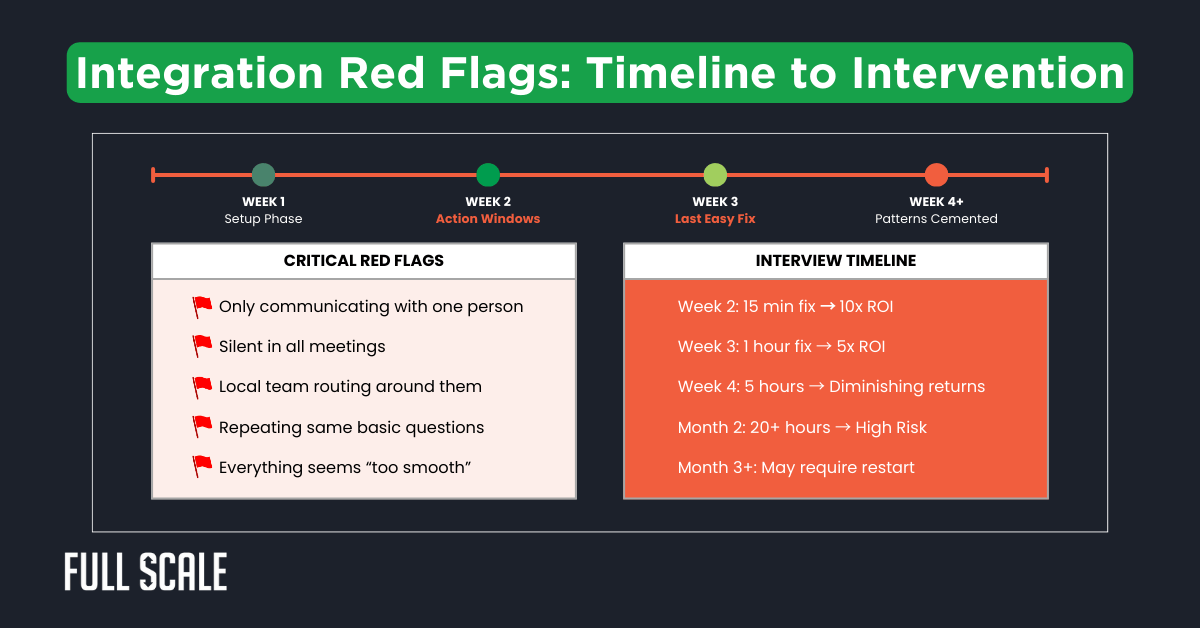
Most Dangerous Red Flags in Offshore Developer Onboarding:
🚩 ONLY COMMUNICATING WITH ONE PERSON
Still routing all questions through one tech lead or manager during offshore developer onboarding.
→ IMMEDIATE FIX: Explicitly assign different team members for different question types. “Ask Sarah about frontend, John about backend, Maria about requirements.” Force connection diversification starting tomorrow.
🚩 SILENT IN MEETINGS
Only speaking when directly asked a question, otherwise silent.
→ IMMEDIATE FIX: In the next standup, call on them by name. “Hey [name], I’d love your thoughts on this approach.” Make it safe to contribute.
🚩 LOCAL TEAM ROUTING AROUND THEM
Local team actively excluding offshore devs from discussions or decisions.
→ IMMEDIATE FIX: Address this directly in the team meeting. “I’ve noticed the offshore team isn’t being tagged in architecture discussions. That needs to change. They’re not contractors—they’re team members.”
🚩 CODE REVIEWS = “LGTM” ONLY
Code reviews consist only of approval, never suggestions.
→ IMMEDIATE FIX: Before their next review, say explicitly: “I want your honest technical opinion. What would you do differently?”
⚠️ THE WORST RED FLAG: Everything Seems “Fine”
No questions. No blockers. No friction.
This usually means:
- They’ve stopped asking because they’re not getting helpful answers
- They’re not invested enough to care about getting it right
- They’re just going through the motions
Real offshore developer onboarding is messy for a few weeks. Questions are good.
Silence is concerning.
Learn about common offshore outsourcing mistakes to avoid.
Real Client Story: From "This Isn't Working" to Full Offshore Team Integration
📊 CASE STUDY: Offshore Developer Onboarding Success
THE CLIENT:
- 50-person B2B SaaS company in FinTech
- Hired 3 offshore React developers through Full Scale
- CTO: Sarah Chen (name changed, story real)
THE WEEK 2 OFFSHORE DEVELOPER ONBOARDING CHALLENGE:
By day 10, Sarah was worried. Her offshore developers were:
- Only communicating with one tech lead (bottleneck forming)
- Not participating in planning meetings (just listening silently)
- Velocity was ~40% of what she expected
- Local team starting to work around them
Her exact words on our check-in call: "I think I made a mistake. This feels like it's going sideways."
THE DIAGNOSIS:
"How often are your offshore devs in the same conversations as your local team?"
Sarah's answer: "Just standup and code reviews when it's their code."
Problem identified: They weren't part of TEAM conversations. They were only included in WORK conversations.
They felt like external contractors, not team members.
THE FIX (Days 11-14 of Offshore Developer Onboarding):
We helped Sarah implement 4 changes:
- Added offshore devs to #engineering-random Slack channel (casual space)
- Scheduled 2x weekly pair programming (mixed local/offshore pairs, rotating)
- Explicitly invited them to "local only" architecture discussions
- Forced direct communication between local and offshore devs (no more bottleneck)
THE TRANSFORMATION (Week 3):
By day 18, everything shifted:
- ✅ Offshore devs proactively suggesting improvements in planning meetings
- ✅ One offshore developer identified critical security vulnerability local team missed
- ✅ Velocity nearly doubled from week 2
- ✅ Local team: "I honestly forgot they were offshore—they just feel like part of the team"
SARAH'S REFLECTION:
"I was measuring tickets closed. I should have been measuring relationship quality. Once we fixed that, everything else fixed itself. The offshore team didn't change. Our approach to integration changed."
6-MONTH UPDATE:
- All 3 original offshore developers still with company (95% retention)
- Sarah has since scaled to 8 offshore developers
- Uses same offshore developer onboarding playbook for every new hire
- Offshore team now training incoming local developers
THE LESSON:
Week 2 problems are almost always communication/integration problems during offshore developer onboarding, not skill problems. Fix the integration, fix the performance.
Read more success stories about scaling development teams with offshore talent.
What To Do If You're Already Behind Schedule in Offshore Developer Onboarding
Maybe you’re reading this and thinking: “It’s day 18 and we haven’t done ANY of this.”
Don’t panic. You can still course-correct your offshore developer onboarding.
I’ve seen companies turn around integrations at week 4, even week 6. It’s harder—but not impossible.
Your 5-Step Recovery Plan:
STEP 1: Acknowledge Reality
In your next team meeting, say explicitly: “I think our offshore developer onboarding could be stronger. I missed some things in weeks 1-3. Here’s what we’re going to change starting this week.”
Vulnerability builds trust.
STEP 2: Have Honest 1-on-1s This Week
Ask each offshore developer:
- “How are you really feeling about being part of this team? 1-10?”
- “What would make you feel more integrated?”
- “What’s still confusing that shouldn’t be?”
Listen. Don’t defend.
ACT on what you hear within 48 hours.
STEP 3: Pick ONE Thing to Change Tomorrow
Don’t try to fix everything at once. Pick the biggest friction point.
Examples:
- “Starting tomorrow, all architecture discussions include the offshore team in Slack thread.”
- “This week, every offshore dev pairs with a local dev twice.”
- “We’re adding a #random channel for casual conversation—everyone join it.”
One change, executed well, is better than five changes executed poorly.
STEP 4: Measure Week-Over-Week Improvement
Don’t compare to where you “should” be. Compare THIS week to LAST week:
- Are questions getting better?
- Is participation increasing?
- Are relationships forming?
Progress, not perfection.
STEP 5: Get Help If You’re Stuck
If you’re a Full Scale client, reach out to our offshore team integration support. If you’re NOT a Full Scale client and struggling, book a free 15-minute diagnostic call.
We help even if you’re not working with us. Seriously.
Your Week 4 Preview: What Successful Offshore Developer Onboarding Looks Like
If you nail weeks 2-3 of offshore developer onboarding, here’s what week 4 looks like:
✅ Your offshore developers are pulling work from the backlog independently
✅ They’re contributing strategic opinions in planning, not just executing
✅ Your local team forgets to distinguish between “local” and “offshore”
✅ Velocity is climbing toward 70-80% of local team baseline (and accelerating)
✅ Questions are decreasing in frequency but increasing in sophistication
✅ They’re identifying problems AND proposing solutions
✅ You’re thinking about scaling (adding more offshore developers)
But you only get this version of week 4 if you invest in weeks 2-3. The choice you make this week determines your trajectory for the next 6 months.
Explore how to build an offshore development team that scales.
Not sure where you stand right now? Take 2 minutes to find out.
Interactive Offshore Developer Onboarding Health Assessment
Use this tool to evaluate your current offshore team integration health during offshore developer onboarding.
📊 Week 2-3 Integration Health Check
The Window Is Closing. Don't Waste It.
Here’s the truth: Week 2-3 offshore developer onboarding will feel slow. It will feel like you’re over-investing in relationship building when you “should” be shipping features.
But here’s what’s NOT fuzzy:
→ Companies with 95% offshore retention rates? They all do this.
→ Can companies scale from 2 to 20 offshore developers seamlessly? They all do this.
→ Companies where offshore teams outperform local teams by month 3? They all do this.
The companies struggling at month 6 with communication issues, turnover, and “offshore doesn’t work for us” stories?
They skipped weeks 2-3 of the offshore developer onboarding. They thought they’d “make up for it later.”
They never did.
You’re in the window right now. The patterns forming this week during offshore developer onboarding—how your offshore developers ask questions, who they build relationships with, whether they feel like team members or external contractors—will either accelerate or sabotage everything that comes next.
Don’t waste it.
📗 Is Your Offshore Developer Onboarding On Track?
Book a free 15-minute integration diagnostic with our team.
We’ve guided 60+ companies through offshore developer onboarding weeks 2-3. We know what “on track” looks like—and what “quietly going sideways” looks like.
We’ll review:
✅ Where you are vs. where you should be in offshore developer onboarding
✅ Your biggest integration bottleneck (and how to fix it)
✅ One concrete action to take tomorrow morning
Even if you’re not a Full Scale client, we’ll help you course-correct. No sales pitch. Just helpful advice from people who’ve seen offshore developer onboarding 500+ times.
You’ve learned the playbook. Here’s why Full Scale is uniquely positioned to execute it with you.
Why Partner with Full Scale for Your Offshore Developer Onboarding?
At Full Scale, we’ve spent 8 years perfecting offshore developer onboarding and integration. Here’s what makes us different:
🟢 We Fix What’s Broken in Traditional Offshore Models
- No project managers as middlemen—developers work directly with you
- U.S.-based contracts and IP protection (Kansas City-based company)
- Month-to-month flexibility with no long-term lock-in required
🟢 Industry-Leading Retention That Proves Integration Works
- 95% developer retention rate vs. industry average of 60-70%
- Developers are our full-time W-2 employees with benefits
- We treat developers as long-term team members, not disposable contractors
🟢 Proven Offshore Developer Onboarding Methodology
- Structured onboarding process refined across 60+ client relationships
- Dedicated integration support team throughout your first 90 days
- Week-by-week playbook for companies from 10-500 employees
🟢 Transparent, Competitive Pricing
- Senior developers: $4,800-$6,600/month all-inclusive
- Equivalent to $30-45/hour with no recruiter fees
- Save 50-70% vs. U.S. salaries while maintaining senior-level quality
🟢 Fast, Flexible Scaling When You Need It
- Start interviewing vetted candidates within days
- Scale from 1 to 10+ developers without recruitment bottlenecks
- Ramp up or down based on project needs
🟢 Technical Expertise Across Modern Tech Stacks
- React, Node.js, Python, .NET, PHP, mobile development, and more
- Senior developers with 5-10+ years of experience
- Experience with SaaS, FinTech, HealthTech, and enterprise applications
Learn more about staff augmentation vs. outsourcing and why our model works.
Ready to start? Read our comprehensive guide on how to hire offshore developers from evaluation to integration.
This usually signals one of two issues during offshore developer onboarding: your documentation is insufficient, or they don’t know where to find answers.
Schedule a 30-minute screen share walking through your docs, wiki, and Confluence. Add them to all relevant Slack channels.
If questions are truly basic (things that should have been covered), it means your week 1 onboarding missed critical context. Don’t blame them—fix your onboarding process for the next hire.
Low productivity in weeks 2-3 of offshore developer onboarding is completely normal IF you’re seeing improvement week-over-week.
Compare week 2 to week 1, and week 3 to week 2—velocity should be trending upward, questions should be getting more sophisticated, and participation should be increasing.
Red flag territory: if velocity or engagement is DECLINING, or if they’re making no progress at all. That signals integration problems that need immediate intervention during offshore developer onboarding.
Daily check-ins in weeks 2-3 are NOT micromanaging—they’re essential for offshore developer onboarding.
But there’s a difference between “checking in” and “checking up.” Daily standup plus one async check-in (“How’s it going? Any blockers?”) is appropriate.
By week 4, you should be reducing frequency naturally as they gain autonomy. If you’re still doing daily check-ins at week 6, something went wrong in the offshore team integration process.
Address it directly and publicly in your next team meeting during offshore developer onboarding.
Say: “I’ve noticed the offshore team isn’t being tagged in architecture discussions. That needs to change starting now. They’re not contractors—they’re team members. If you’re making a technical decision, they should be in the conversation.”
Your local team takes cues from YOU. If you treat offshore as second-class, they will too. Model inclusive behavior and call out exclusion when you see it.
By the end of week 2 of offshore developer onboarding, they should be making their first meaningful contribution to production (even if it’s a small feature or bug fix).
By the end of week 3, they should be working on production code regularly with appropriate oversight through code reviews.
If they’re not touching production by week 4, you’re either over-scaffolding or they lack confidence. Either way, address it immediately.
Read more about offshore development best practices for production code.