How Should You Build Products Users Actually Want? Here’s An MVP Development Strategy You Should Know
The technology industry hemorrhages $1.2 trillion annually on failed products. Seven out of ten digital products fail within twelve months. According to CB Insights (2023), 42% of startups fail because they build products without market need. McKinsey reports that companies using a structured MVP development strategy reduce failure rates by 60%.
This guide reveals a proven MVP development strategy framework for success. CTOs learn cost-effective validation techniques for engineering teams, and product managers discover how to build MVPs that users want. The guide also covers team structure, execution, and risk mitigation.
A strategic MVP development strategy reduces failure rates by 60%. Using this approach, teams launch products 40% faster. Development costs decrease by up to 50%. Most importantly, teams build products with actual market demand.
The guide explores minimum viable product development methodology from conception to scale. Learn MVP development best practices that separate successful products from failures. Discover how long MVP development takes and the optimal team structures. Master the complete development lifecycle for sustainable growth.
What is an MVP Development Strategy?
MVP development strategy is a systematic approach to building and validating product ideas with minimal resources.
It focuses on creating the simplest version that delivers core value to users. The strategy provides maximum learning about market demand and user behavior. Teams validate assumptions before investing significant resources.
The approach differs from traditional product development in fundamental ways. Traditional development often involves extensive planning and full feature implementation.
MVP strategy emphasizes rapid experimentation and learning. This lean startup methodology reduces waste and accelerates market entry.
A successful MVP development strategy incorporates continuous user validation throughout the process. Teams gather customer feedback at every stage of development. This iterative development approach ensures products evolve based on real user needs.
The result is higher adoption rates and better product-market fit.
MVP vs. Prototype vs. Proof of Concept
Understanding the differences helps teams choose the right MVP development strategy. Each approach serves distinct purposes in product development. Choosing incorrectly wastes valuable time and resources. Clear distinctions guide better decision-making.
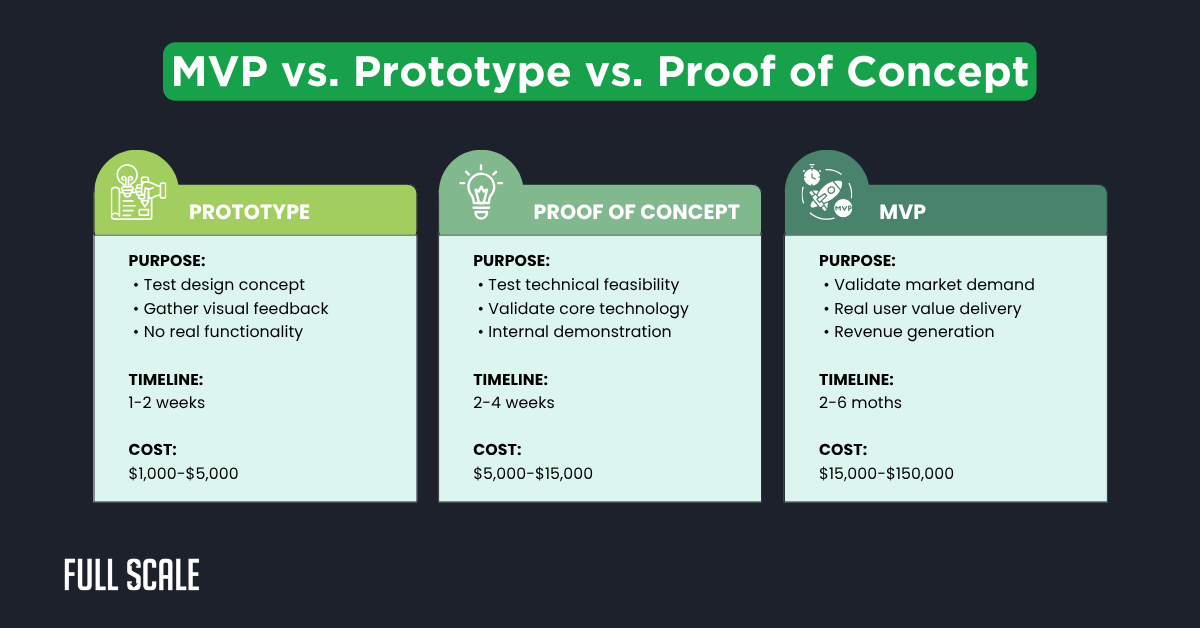
An effective MVP development strategy validates product-market fit and MVP efficiently. Teams test core assumptions with real users. This minimum viable product development approach saves resources. The distinction prevents costly mistakes in the early stages.
Prototype development focuses on visual representation without functional implementation. Design teams use prototypes to communicate concepts and gather feedback. These tools excel at stakeholder alignment and user testing. However, prototypes cannot validate actual market demand.
Proof of concept demonstrates technical feasibility for specific features or integrations. Engineering teams build these to test complex algorithms or architectures. They prove that solutions are technically possible. Yet they don’t validate whether users want these solutions.
MVPs combine functional implementation with market validation in one approach. They deliver real value while testing business assumptions. This dual purpose makes MVPs essential for startup success. The MVP development guide shows how to balance both objectives.
The VALIDATE Framework: Your MVP Development Process
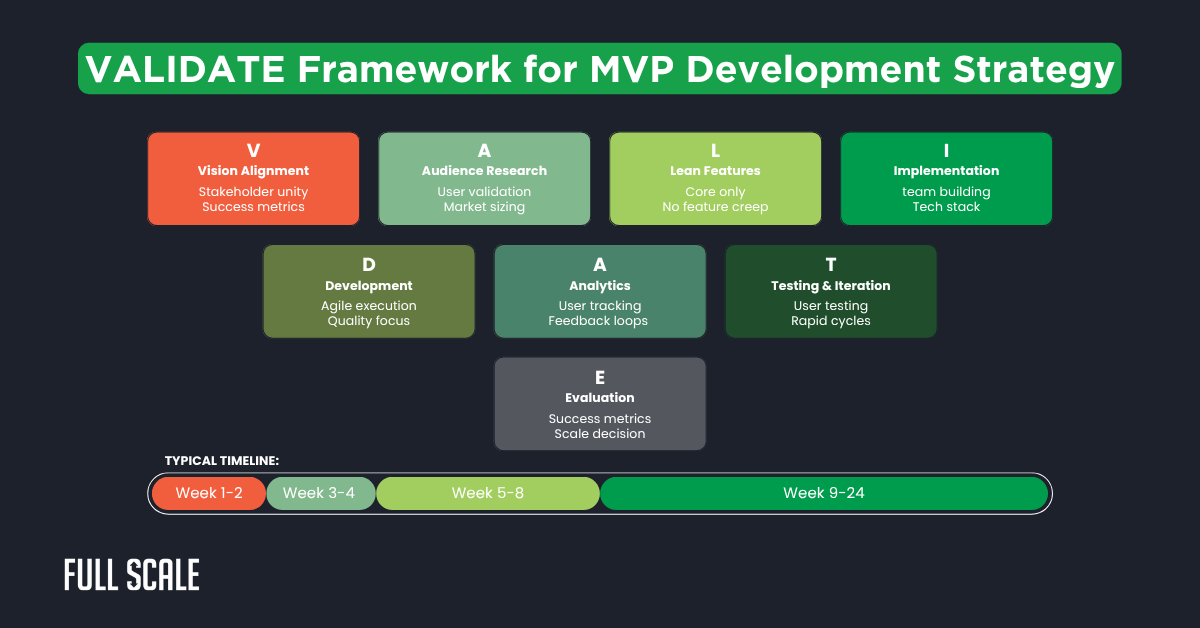
The MVP development strategy framework guides teams systematically. VALIDATE represents seven critical phases for success. Each phase builds on previous learnings. This MVP development process ensures market validation.
The framework emerged from analyzing hundreds of successful MVP launches. Common patterns revealed optimal sequences for validation and development. Teams following this structure avoid typical pitfalls. Success rates improve dramatically with systematic approaches.
Phase-by-Phase MVP Development Process
Your MVP development strategy follows these validated steps:
1. Vision Alignment (Week 1-2)
- Define clear problem statements
- Establish success metrics
- Align all stakeholders
- Document the MVP objectives
Vision alignment prevents costly misunderstandings throughout development. All stakeholders must agree on the core problems being solved. Success metrics need quantifiable definitions from the start. Documentation ensures consistency as teams grow.
2. Audience Research (Week 3-4)
- Conduct user interviews
- Validate market demand
- Analyze competition
- Create user personas
Market research reveals actual user needs versus assumed requirements. Direct interviews uncover pain points teams never considered. Competitive analysis identifies gaps and opportunities in the market. User personas guide all subsequent development decisions.
3. Lean Feature Selection (Week 5-6)
- Prioritize core features
- Eliminate nice-to-haves
- Technical feasibility check
- Create a feature roadmap
The MVP feature prioritization framework focuses resources on essential functionality. Teams resist adding features that don’t solve core problems. Technical feasibility prevents committing to impossible timelines. Roadmaps show future development paths without current commitments.
4. Implementation Planning (Week 7-8)
- Choose a technology stack
- Design system architecture
- Plan team structure
- Set the development timeline
Careful planning prevents technical debt accumulation during rushed development. Architecture decisions impact scalability for years to come. Team structure determines communication patterns and development velocity. Realistic timelines prevent burnout and quality compromises.
This MVP development process for engineering teams ensures systematic progress. Teams avoid common pitfalls through structured execution using lean startup methodology and agile development practices. The framework adapts to different industries while maintaining core principles.
Building Your MVP Development Team
The right MVP development team structure determines project success. Offshore MVP development teams provide cost advantages. Here’s how to build an MVP development team effectively. Team composition impacts everything from development speed to product quality.
Successful MVP development requires diverse skills working in harmony. Technical expertise alone doesn’t guarantee success without proper management. Design thinking must balance engineering constraints. Quality assurance prevents embarrassing launches that damage credibility.
The hiring process for MVP teams differs from traditional recruitment. Speed matters but not at the expense of quality. Cultural fit becomes crucial in small teams. Remote collaboration skills are now essential requirements.
Essential Roles Comparison
Teams need specific expertise for a successful MVP development strategy execution:
| Role | Responsibilities | In-House Cost | Offshore Cost | Impact on MVP |
| Product Manager | Vision, prioritization, stakeholder management | $120-180/hr | $40-60/hr | Critical for direction |
| Technical Lead | Architecture, tech decisions, mentoring | $150-200/hr | $50-80/hr | Ensures scalability |
| UX/UI Designer | User experience, interface design | $100-150/hr | $30-50/hr | Drives adoption |
| Frontend Developer | User interface implementation | $100-150/hr | $25-45/hr | User perception |
| Backend Developer | Server, database, APIs | $110-160/hr | $30-50/hr | System reliability |
| QA Engineer | Testing, quality assurance | $80-120/hr | $20-35/hr | Prevents issues |
Building an MVP with offshore development teams reduces costs significantly. The MVP development strategy for CTOs often includes hybrid teams. This offshore team integration MVP approach balances cost and control while maintaining quality. Smart talent acquisition for MVP development considers global talent pools.
Hiring developers for MVP projects requires evaluating both technical skills and adaptability. MVP environments demand flexibility as requirements evolve. Developers must be comfortable with ambiguity and rapid changes. Communication skills matter as much as coding ability.
The MVP development team’s roles and responsibilities must be clearly defined. Overlapping responsibilities cause confusion and delays. Clear ownership accelerates decision-making. Regular role reviews ensure alignment as projects evolve.
Managing global MVP development teams presents unique challenges and opportunities. Time zone differences can enable 24-hour development cycles.
Cultural diversity brings fresh perspectives to problem-solving. Proper MVP development team collaboration tools become essential infrastructure.
MVP Development Cost Analysis
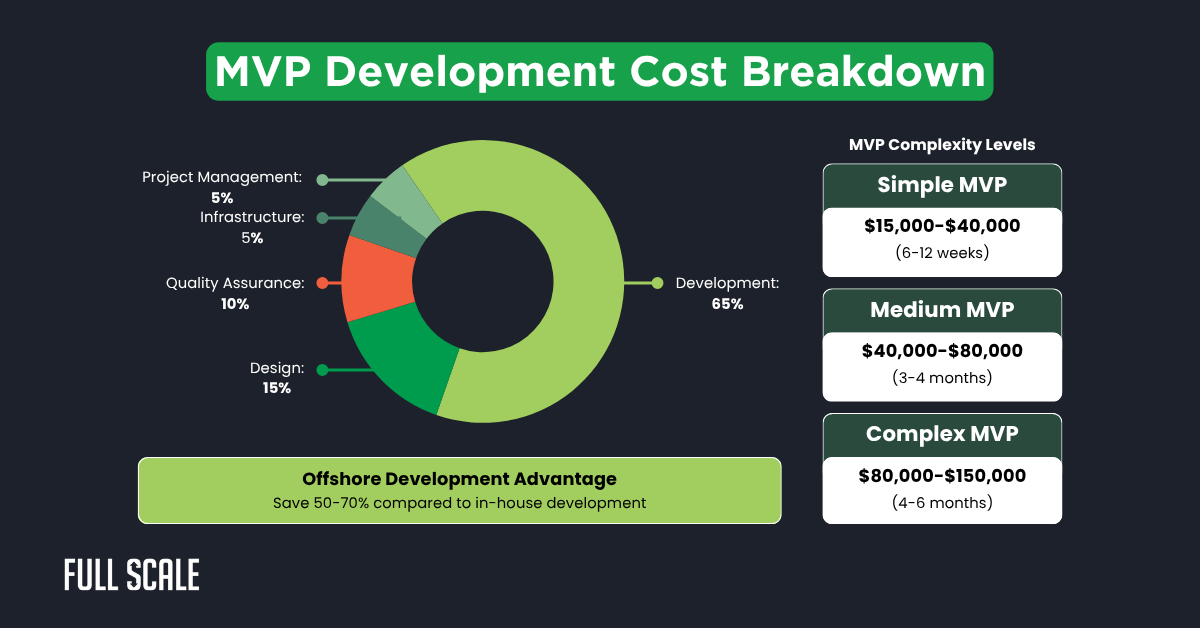
Understanding the cost of MVP development helps with budget planning. Your MVP development strategy must balance features with budget.
Here’s a comprehensive MVP development cost analysis based on 2024 market data. Smart financial planning enables sustainable development.
The MVP development pricing models vary significantly across providers and regions. Fixed-price contracts provide budget certainty but limit flexibility.
Time-and-materials agreements adapt to changing requirements. Hybrid models balance predictability with adaptability needs.
Cost-Effective MVP Development Strategies
Your MVP development strategy should optimize costs through:
- Phased development approach using iterative development
- Offshore team integration for talent acquisition
- Lean feature prioritization following the MVP feature prioritization framework
- Agile development methodology for rapid iterations
- Cloud infrastructure usage for scalability
The MVP development budget planning process requires careful allocation. A successful MVP development ROI calculation shows 3-10x returns. Cost reduction strategies for MVP development include offshore teams and smart technology choices. The minimum viable product cost calculator helps estimate the total investment.
Budget allocation for MVP development projects follows the 60-20-20 rule. Development, including coding and architecture, consumes 60% of budgets. Design and user experience require 20% for professional quality. Testing and infrastructure share the remaining 20% equally.
How much does MVP development cost for startups depend on multiple factors. Location dramatically impacts developer rates and total costs. Feature complexity drives development hours exponentially. Third-party integrations add both time and licensing costs.
The MVP development cost vs. risk analysis reveals interesting patterns. Higher initial investment often reduces long-term technical debt. Cutting corners on architecture creates expensive problems later. Balanced approaches optimize both immediate and future costs.
Technical Architecture Best Practices
Technical MVP development best practices ensure scalability. Your MVP development strategy must prevent technical debt. Here’s how to build a scalable MVP architecture using proven MVP architecture design patterns. Smart technical decisions enable rapid growth.
The MVP technical requirements documentation serves as the development bible. Clear specifications prevent misunderstandings and scope creep. Technical constraints must be documented and communicated. Architecture decisions need explicit justification for future reference.
How to choose MVP features without technical debt requires discipline. Each feature must justify its complexity cost. Simple solutions often outperform elaborate architectures. Technical elegance matters less than user value delivery.
MVP Architecture Patterns
Choose an architecture supporting your MVP development strategy goals:
1. Monolithic Architecture
- Pros: Simple, fast initial development
- Cons: Scaling challenges later
- Best for: Simple MVPs, quick validation
Monolithic architectures excel at rapid initial development for simple products. All components exist within a single codebase. Deployment remains straightforward with fewer moving parts. This pattern suits MVPs with unclear scaling requirements.
2. Microservices Architecture
- Pros: Scalable, flexible, independent services
- Cons: Complex initial setup
- Best for: Complex MVPs, multiple teams
Microservices enable the independent scaling of different system components. Teams can work on services without affecting others. Technology choices can vary between services. This flexibility comes with increased operational complexity.
3. Serverless Architecture
- Pros: Cost-effective, auto-scaling
- Cons: Vendor lock-in risk
- Best for: Variable load MVPs
Serverless architectures eliminate infrastructure management overhead. Automatic scaling effortlessly handles traffic spikes. Pay-per-use pricing models benefit low-traffic MVPs. However, vendor lock-in poses long-term strategic risks.
Technology Stack Selection Guide
Your MVP tech stack selection guide impacts long-term success:
| Component | Recommended Options | Considerations |
| Frontend | React, Vue.js, Next.js | Team expertise, SEO needs |
| Backend | Node.js, Python/Django, Ruby on Rails | Performance, ecosystem |
| Database | PostgreSQL, MongoDB | Data structure, scaling |
| Cloud | AWS, Google Cloud, Azure | Cost, features, support |
| Mobile | React Native, Flutter | Platform coverage, performance |
Technical debt in MVP development accumulates without proper planning. The scalable MVP development approach prevents future problems while enabling rapid prototype development. Regular refactoring sessions maintain code quality. Technical reviews catch problems before they compound.
Technical validation strategies for MVP development include automated testing suites. Continuous integration catches bugs before deployment. Performance monitoring alerts teams to degradation. Security scanning prevents vulnerabilities from reaching production.
User Validation Techniques
Effective MVP validation strategy confirms market demand. Your MVP development strategy must include continuous validation. Here’s how to validate MVP with users using proven MVP validation techniques. Real user feedback drives successful products.
The lean product development with the MVP philosophy emphasizes learning over perfection. Every feature release tests specific hypotheses. User behavior data confirms or refutes assumptions. This scientific approach reduces product failure rates.
Validating product ideas with an MVP requires a systematic approach. Initial validation happens before any code is written. Continuous validation throughout development prevents drift from user needs. Post-launch validation guides iteration priorities effectively.
MVP User Testing and Feedback Collection
Your MVP development strategy needs systematic validation:
Pre-Launch Validation
- Problem interviews (20-30 users) for user validation
- Solution mockup testing using market research
- Landing page conversion tests
- Pre-order campaigns for demand validation
Problem validation interviews reveal whether issues truly matter to users. Structured questions uncover pain point intensity and frequency. Financial impact quantification justifies development investment. Document all findings for team alignment.
Post-Launch Validation
- User behavior analytics tracking
- In-app feedback tools for customer feedback
- Regular user interviews for insights
- A/B testing framework for optimization
Product-market fit validation through MVP requires continuous iteration. User feedback collection for MVP drives improvements. MVP validation techniques for product managers ensure building user-centered MVP successfully. These methods reveal how to build MVP that users actually want.
The MVP user testing and feedback collection process creates learning loops. Each iteration systematically incorporates previous learnings. User feedback naturally shapes product evolution. Success metrics track progress toward product-market fit.
From MVP to Scale: Success Indicators
Your MVP development strategy must plan for scaling. Successful MVP to product roadmap planning requires clear metrics. Here’s when and how to scale using data-driven decisions. Growth requires different approaches than initial development.
The minimum viable product roadmap planning extends beyond launch. Initial success creates new challenges and opportunities. Scaling decisions impact the company trajectory for years. Poor timing wastes resources or misses opportunities.
Product management MVP best practices emphasize metrics over opinions. Data reveals true user behavior patterns. Vanity metrics mislead teams into poor decisions. Focus on metrics that indicate sustainable growth.
Key Success Metrics
Monitor these indicators for your MVP development strategy:
User Engagement Metrics
- Daily/Monthly Active Users (DAU/MAU)
- User retention rate (target: 40%+)
- Feature adoption rates
- Session duration trends
User engagement metrics reveal product stickiness and value delivery. High DAU/MAU ratios indicate habitual usage patterns. Feature adoption shows which investments provide value. Session duration suggests user satisfaction levels.
Business Metrics
- Customer Acquisition Cost (CAC)
- Lifetime Value (LTV)
- Monthly Recurring Revenue (MRR)
- Conversion rate optimization
Business metrics validate the economic model underlying your MVP. CAC must decrease as marketing improves and word-of-mouth grows. LTV increases through better retention and upselling. Positive unit economics enable sustainable scaling.
Technical Metrics
- Page load times (<3 seconds)
- System uptime (99.9%+)
- Error rates (<1%)
- API response times
Technical metrics ensure infrastructure supports business growth. Poor performance directly impacts user satisfaction and retention. System reliability builds user trust over time. API performance affects third-party integrations and mobile apps.
Scaling Decision Framework
Your product strategy for MVP development and scaling follows this framework:
| Indicator | Not Ready to Scale | Ready to Scale |
| User Retention | <20% monthly | >40% monthly |
| Product-Market Fit Score | <40% very disappointed | >40% very disappointed |
| Unit Economics | CAC > LTV | LTV > 3x CAC |
| Technical Performance | Frequent outages | 99.9% uptime |
| Team Readiness | Struggling with the current load | Processes documented |
This data-driven approach ensures sustainable growth using proven MVP development methodology and user experience design principles.
The MVP development timeline for product launches extends through scaling phases. MVP development must balance speed with sustainability for faster time to market.
Common MVP Development Mistakes to Avoid
Learning from failures improves your MVP development strategy. Avoid these pitfalls in your minimum viable product development methodology to ensure MVP development for faster time to market. Experience teaches valuable lessons about what not to do.
The best MVP development companies learn from industry-wide mistakes. Pattern recognition prevents repeating costly errors. Smart teams study failures as much as successes. Prevention costs far less than correction.
The Top 5 MVP Failures
1. Skipping Validation
- Building without user research
- Assuming market demand exists
- Ignoring competitive analysis
Skipping validation wastes months building unwanted products. Teams fall in love with solutions before confirming problems. Market assumptions prove wrong more often than right. Validation prevents expensive pivots or failures.
2. Feature Overload
- Adding every requested feature
- Perfectionism over launching
- Scope creep acceptance
Feature overload delays launches and confuses users. Core value gets lost in complexity. Development costs spiral out of control. Simple products often outperform feature-rich alternatives.
3. Wrong Team Structure
- Missing critical roles
- Poor communication setup
- No quality assurance
Wrong team structures create systemic problems throughout development. Missing roles leave critical gaps in capabilities. Poor communication multiplies mistakes and misunderstandings. Quality suffers without dedicated oversight.
4. Technical Shortcuts
- Accumulating technical debt
- No scalability planning
- Security as afterthought
Technical shortcuts create expensive problems later. Quick fixes become permanent technical debt. Scaling becomes impossible without major rewrites. Security breaches destroy user trust instantly.
5. Metric Confusion
- Tracking vanity metrics
- No feedback systems
- Ignoring user behavior
Metric confusion leads teams astray from real progress. Vanity metrics create false confidence in failing products. Missing feedback systems blind teams to problems. User behavior reveals the truth beyond stated preferences.
MVP Development Strategy Action Plan
Your MVP development strategy implementation starts now. Follow this proven MVP development guide for 2025 for success using the development lifecycle best practices. Action beats planning when building successful products.
The talent strategy for MVP development projects begins with an honest assessment. Current team capabilities determine starting points. Skill gaps highlight hiring or training needs. Realistic planning prevents overcommitment and burnout.
MVP project management for distributed teams requires adapted approaches. Traditional management fails with remote teams. Asynchronous communication becomes essential. Trust replaces micromanagement for productivity.
Your 5-Step Implementation Roadmap
Step 1: Validate Your Idea (Week 1-2)
- Interview 20-30 potential users
- Quantify the problem urgency
- Analyze existing solutions
- Document validation findings
Start validation immediately before investing significant resources. User interviews reveal surprising insights about assumed problems. Quantification separates nice-to-have from must-have solutions. Documentation creates team alignment from day one.
Step 2: Define Your MVP (Week 3-4)
- List all possible features
- Prioritize using the value/effort matrix
- Select core features only
- Create a development roadmap
Feature definition requires ruthless prioritization for MVP success. Value/effort matrices visualize optimal feature selection objectively. Core features solve primary problems without extras. Roadmaps show future possibilities without current commitments.
Step 3: Build Your Team (Week 5-6)
- Assess required skills
- Evaluate in-house capabilities
- Consider offshore developers
- Set up communication tools
Team building determines execution quality and speed. Skills assessment reveals gaps requiring external help. Offshore developers provide cost-effective expertise quickly. Communication infrastructure prevents future coordination problems.
Step 4: Develop Your MVP (Week 7-20)
- Follow the agile development process
- Implement analytics from the start
- Conduct weekly progress reviews
- Test continuously with users
Development execution brings plans to life systematically. Agile processes adapt to learning during development. Analytics implementation enables data-driven decisions immediately. Continuous testing prevents late-stage surprises.
Step 5: Launch and Iterate (Week 21+)
- Deploy to beta users first
- Collect systematic feedback
- Iterate based on data
- Plan a scaling strategy
Launch marks the beginning, not the end, of MVP development. Beta users provide safe testing environments. Systematic feedback collection drives improvement priorities. Scaling plans prepare for success.
Your MVP Success Starts Now
Strategic MVP development strategy transforms failure rates into success stories. Teams using this approach launch faster, spend less, and build products users love. The VALIDATE framework provides your roadmap to success. Implementation separates successful products from failed attempts.
Key takeaways for your MVP development strategy:
- Validate before building anything
- Focus on core value propositions
- Build the right team structure
- Use data-driven iteration
- Plan for scaling from day one
The journey from idea to successful product requires systematic execution. Each phase builds on previous learnings and validation. Success comes from disciplined implementation, not perfect planning. Start with small steps toward big goals.
Ready to implement your MVP development strategy with experienced developers? Full Scale provides expert remote teams skilled in modern MVP development methodology. Our proven process reduces costs by 60% while accelerating your time to market. Hire MVP developers who understand startup dynamics.
Start Your MVP Development Strategy with Full Scale
FAQs: MVP Development Strategy
What is the MVP approach to development?
The MVP approach validates ideas with minimal investment before scaling. Teams build the smallest viable version, testing core assumptions. User feedback guides iterative improvements toward product-market fit. This reduces failure risk significantly.
What are MVP development best practices?
MVP development best practices include continuous user validation throughout development. Teams should focus on core features and solving primary problems. Implement analytics tracking from day one for data-driven decisions. Use proven technology stacks, avoiding technical debt accumulation.
How long does MVP development take?
MVP development timelines vary: simple MVPs take 6-12 weeks, medium complexity requires 3-4 months, and complex MVPs with advanced features need 4-6 months. The timeline depends on team size, feature scope, and validation requirements.
What’s the best MVP development strategy?
The best MVP development strategy validates problems before building solutions. It uses the VALIDATE framework for systematic execution. It combines in-house expertise with offshore development teams. It also focuses on rapid iteration based on user feedback.
How to build MVP that users actually want?
Build products users want by validating problems through direct interviews. Involve users throughout the development process continuously. Focus exclusively on solving their primary pain points. Iterate quickly based on behavioral data, not assumptions.
How do I build an MVP for my startup?
Build an MVP for your startup by starting with problem validation. Interview potential customers about their current solutions and frustrations. Create the simplest version solving their core problem. Launch quickly and iterate based on real usage data.
What are the 3 elements of MVP?
The three essential MVP elements are minimum features, viable solution, and product learning. Minimum features solve core problems without extras. Viable solutions provide real value to users. Product learning validates assumptions for future development.
What does MVP stand for in development?
MVP stands for Minimum Viable Product in software development. It represents the simplest version delivering core user value. MVPs test product hypotheses with minimal resource investment. This approach accelerates learning and reduces risk.