
Microservices vs. Monolithic Architecture: A Decision Framework with Real-World Examples
Choosing between microservices vs. monolithic architecture determines your application’s scalability, development speed, and operational complexity.
According to a 2024 O’Reilly survey, 61% of enterprises have adopted microservices, yet 29% returned to monolithic architectures due to complexity.
Additionally, Gartner reports that organizations using the wrong architecture experience 40% higher development costs and 60% longer time-to-market. The microservices vs. monolithic architecture comparison shows distinct trade-offs in every aspect.
What is the difference between microservices and monolithic architecture?
Monolithic architecture combines all application components into a single deployable unit with a shared database. Microservices architecture breaks applications into multiple independent services with separate databases.
The key decision factors include team size, system complexity, and scaling requirements.
This guide provides a proven decision framework for choosing between microservices vs. monolithic architecture. You’ll discover real cost comparisons, implementation strategies, and performance metrics to make data-driven architectural decisions.
Architecture Fundamentals
Understanding microservices vs. monolithic architecture requires examining their core characteristics and trade-offs. Each architecture offers distinct advantages depending on your organization’s needs.
Let’s explore the fundamental differences between these approaches. When should you use microservices vs. monolithic? The answer depends on multiple factors we’ll examine.
Monolithic Architecture
Key Characteristics
- Single codebase and deployment unit
- Shared database for all components
- Direct function calls between modules
- Centralized logging and monitoring
Microservices Architecture
Key Characteristics
- Multiple independent services
- Service-specific databases
- Network-based communication
- Distributed logging and tracing
Visual Architecture Comparison
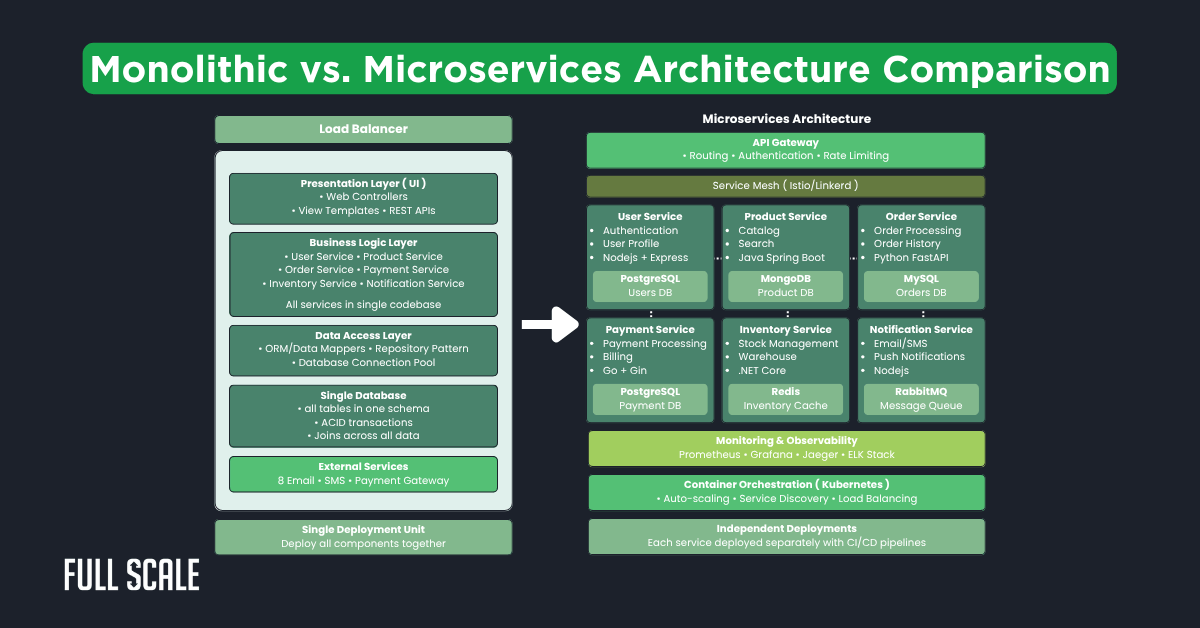
The diagram below illustrates the structural differences between monolithic and microservices architectures. Notice how the monolithic approach consolidates all components while microservices distribute them.
This fundamental difference impacts every aspect of development and operations.
Performance Comparison Table
This table compares key performance metrics between the two architectures. Response times differ significantly due to network overhead in microservices. Infrastructure costs increase with microservices due to service duplication and orchestration needs.
| Metric | Monolithic | Microservices |
| Response Time | 50-100ms | 100-300ms |
| Deployment Frequency | Weekly | Daily per service |
| Scaling | Vertical | Horizontal per service |
| Debugging Complexity | Low | High |
| Infrastructure Cost | Base cost | 50-100% higher |
When to Use Microservices vs. Monolithic: The Decision Framework
Choosing between microservices vs. monolithic architecture depends on four critical factors. This framework helps evaluate your specific situation objectively.
Consider each factor carefully before making your architectural decision. Understanding the pros and cons of microservices vs. monolith enables informed choices.
1. Team Size and Structure
Team composition significantly influences architectural success in microservices vs. monolithic architecture decisions. Conway’s Law states that systems mirror organizational communication structures.
Your team structure should align with your chosen architecture. The monolithic development team structure differs fundamentally from a microservices organization.
Choose Monolithic Architecture When:
- Team size < 50 developers
- Single product domain
- Centralized decision-making
- Limited DevOps expertise
Choose Microservices When:
- Multiple teams (3+ teams of 8-10 developers)
- Clear domain boundaries
- Decentralized decision-making
- Strong DevOps/SRE capabilities
2. Scaling Requirements
Different components often require different scaling strategies. The table below helps identify which architecture matches your scaling needs. Consider both current and future scaling requirements.
| Scaling Need | Monolithic | Microservices |
| Uniform scaling | ✓ Optimal | ✗ Wasteful |
| Component-specific scaling | ✗ Limited | ✓ Optimal |
| Traffic patterns | Predictable | Variable |
| Cost priority | ✓ Lower cost | ✗ Higher cost |
3. Development Velocity
The microservices decision framework shows clear patterns for development speed. Initial development differs from long-term velocity. Choose based on your timeline and growth projections.
Monolithic Advantages
- Faster initial development
- Simpler testing strategies
- Quick prototyping
- Shared code reuse
Microservices Advantages
- Independent deployments
- Parallel development
- Technology diversity
- Fault isolation
4. Operational Maturity
Operational capabilities determine sustainable architecture choices. This comparison shows the different requirements for each approach. Honestly assess your team’s current capabilities.
| Capability | Monolithic | Microservices |
| Monitoring Tools | Basic APM | Distributed tracing |
| Team Skills | Traditional dev | Distributed systems |
| Deployment Pipeline | Single | Multiple + orchestration |
| Incident Response | Simple | Complex |
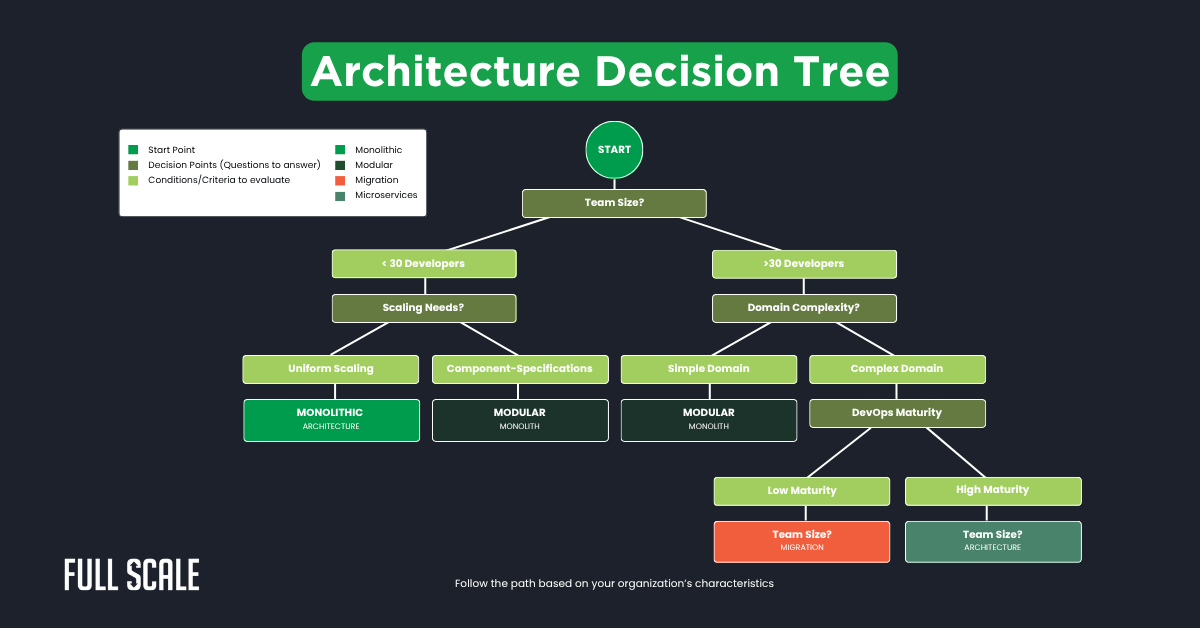
Architecture Decision Tree
This decision tree guides you through the selection process systematically. Start at the top and follow the path based on your organization’s characteristics. Each branch leads to an appropriate architectural choice.
Microservices Architecture Pros and Cons
Understanding the microservices architecture pros and cons helps make informed decisions about microservices vs. monolithic architecture.
Each advantage comes with corresponding trade-offs. Evaluate these factors against your specific requirements.
The complete microservices vs. monolithic architecture comparison reveals complex considerations.
Advantages of Microservices
- Independent Scaling: Scale specific services based on demand
- Technology Flexibility: Use optimal technology per service
- Fault Isolation: Service failures don’t cascade
- Team Autonomy: Independent development and deployment
- Faster Innovation: Parallel feature development
Disadvantages of Microservices
- Operational Complexity: Requires sophisticated monitoring
- Network Latency: Inter-service communication overhead
- Data Consistency: Distributed transaction challenges
- Higher Costs: 50-100% infrastructure increase
- Debugging Difficulty: Complex distributed tracing
Monolithic vs. Microservices Performance Analysis
Performance differs significantly between monolithic vs. microservices performance scenarios in microservices vs. monolithic architecture comparisons.
Network communication adds latency in microservices architectures. Understanding these differences helps set realistic performance expectations when choosing microservices vs. monolithic architecture.
Response Time Breakdown
Monolithic Performance
- Direct function calls: 0.1-1ms
- Database queries: 10-50ms
- Total request: 50-150ms
Microservices Performance
- Inter-service calls: 5-20ms each
- Serialization overhead: 2-5ms
- Total request (3 services): 100-300ms
When Performance Matters Most
Choose Monolithic for:
- Low-latency requirements (< 100ms)
- High-frequency trading systems
- Real-time gaming applications
- Simple CRUD operations
Choose Microservices for:
- Complex business workflows
- Variable scaling needs
- Fault tolerance requirements
- Multi-region deployments
Real-World Cost Analysis: Microservices vs. Monolith Cost
Financial implications often drive architectural decisions in microservices vs. monolithic architecture choices.
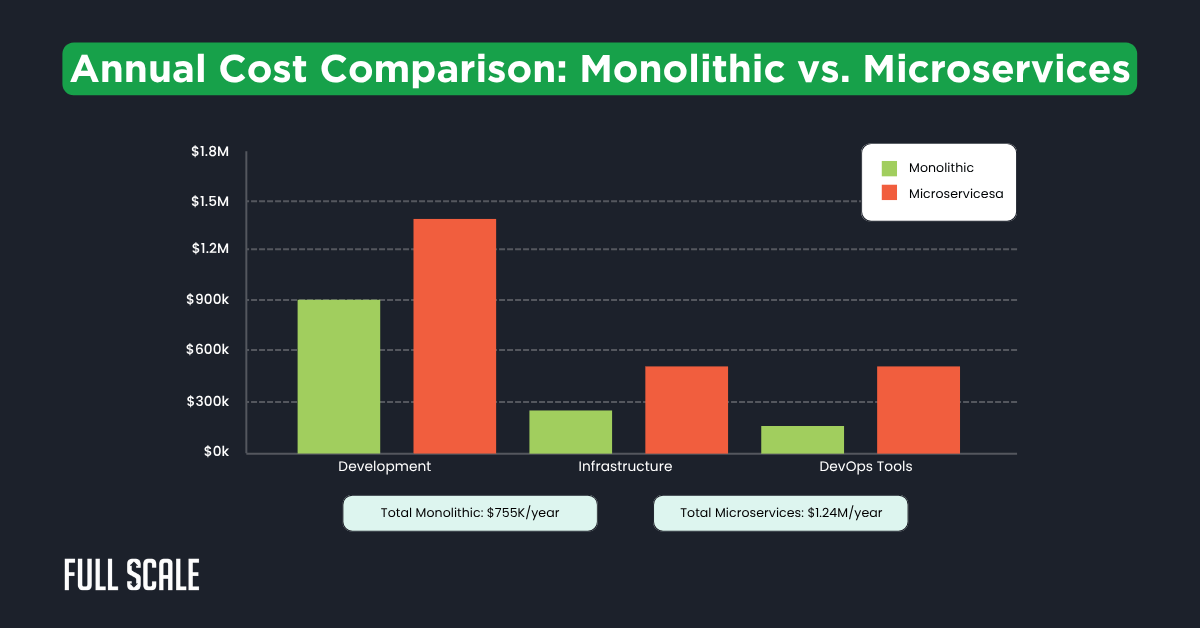
The chart below visualizes annual cost differences between architectures. These figures represent typical mid-sized technology companies evaluating microservices vs. monolithic architecture.
Comprehensive Cost Breakdown
This detailed breakdown shows costs across multiple categories. Infrastructure and tooling costs increase significantly with microservices. Training costs reflect the need for specialized skills.
| Cost Category | Monolithic | Microservices | Difference |
| Development | $500-800K/year | $800K-1.2M/year | +60% |
| Infrastructure | $50-100K/year | $75-200K/year | +50-100% |
| DevOps Tools | $20-40K/year | $50-150K/year | +150-275% |
| Training | $15-30K/year | $50-100K/year | +233% |
| Total | $585-970K | $975K-1.65M | +67% |
Case Study: E-commerce Platform Migration
A 200-employee e-commerce company faced the microservices vs. monolith decision in their microservices vs. monolithic architecture evaluation. Their journey illustrates real-world trade-offs and outcomes. The results justified their architectural choice despite the higher costs of microservices vs. monolithic architecture.
Challenge: Catalog, inventory, and payments needed independent scaling
Solution: Migrated to microservices over 18 months
Results:
- Migration cost: $1.2M
- Development velocity: +60%
- Infrastructure costs: +35%
- Revenue per user: +40%
Implementation Strategies
Successfully implementing microservices vs. monolithic architecture requires careful planning. The right strategy depends on your current situation and goals. These proven approaches minimize risk during transitions.
Microservices Migration Strategy
This phased approach reduces risk during migration. Each phase builds on previous foundations. Start small and expand gradually.
Phase 1: Foundation (0-6 months)
- Set up Kubernetes orchestration
- Implement service mesh (Istio/Linkerd)
- Deploy monitoring (Prometheus/Grafana)
- Extract the authentication service first
Phase 2: Core Services (6-12 months)
- Extract 2-3 business services
- Implement distributed tracing
- Establish service ownership
- Deploy the API gateway
Phase 3: Complete Migration (12-18 months)
- Extract remaining services
- Decommission monolith
- Optimize performance
- Implement chaos engineering
Monolithic Optimization Strategy
Teams choosing monolithic architecture can still achieve scalability. These optimization strategies address common monolithic limitations. Implement these practices for long-term success.
- Modular Architecture: Implement clear boundaries
- Caching Strategy: Redis/Memcached for performance
- Database Optimization: Read replicas, query optimization
- Horizontal Scaling: Load balancing, stateless design
Team Structure and Skills
Architectural choices directly impact team organization and skill requirements in microservices vs. monolithic architecture decisions. Different architectures demand different expertise levels and team structures. Understanding these requirements helps plan hiring and training strategies effectively. The monolithic development team structure contrasts sharply with microservices teams.
Microservices Team Structure Requirements
Successful microservices implementations require specific organizational structures. Each role supports different aspects of the architecture. Plan for these positions before migration.
Essential Roles:
- Service teams (2-8 developers per service)
- Platform engineering team (3-5 engineers)
- SRE team for operations
- Architecture team for standards
Skills Comparison
This comparison highlights the different skill requirements. Training investments vary significantly between architectures. Consider these when calculating total migration costs.
| Skill Area | Monolithic | Microservices |
| Core Development | Traditional web dev | Distributed systems |
| Database | RDBMS, SQL | NoSQL, eventual consistency |
| DevOps | Basic CI/CD | Kubernetes, service mesh |
| Monitoring | APM tools | Distributed tracing |
| Time to Productivity | 2-4 weeks | 6-12 weeks |
Decision Matrix: How to Choose Between Microservices and Monolithic Architecture
Use this microservices vs. monolith decision matrix to guide your microservices vs. monolithic architecture choice. Check the boxes that apply to your situation. The architecture with more checks likely suits your needs better in the microservices vs. monolithic architecture comparison.
Quick Decision Checklist
Choose Monolithic Architecture if:
- Team size < 50 developers
- Simple domain model
- Uniform scaling needs
- Limited DevOps expertise
- Cost optimization priority
- Rapid prototyping needed
Choose Microservices if:
- Multiple autonomous teams
- Complex, bounded contexts
- Variable scaling requirements
- Strong DevOps capabilities
- Independent service needs
- Fault isolation critical
Common Pitfalls and Solutions
Both architectures present predictable challenges that teams must navigate in microservices vs. monolithic architecture implementations. Early recognition of these patterns prevents costly failures. These solutions address the most common issues organizations face when choosing microservices vs. monolithic architecture.
Microservices Implementation Challenges
These common failures occur during microservices adoption. Understanding these patterns helps avoid costly mistakes. Implement prevention strategies from the start.
1. Distributed Monolith: Services are too tightly coupled
- Solution: Domain-driven design, clear boundaries
2. Operational Overwhelm: Too many services to manage
- Solution: Start with 3-5 services maximum
3. Data Consistency: Distributed transaction issues
- Solution: Saga patterns, eventual consistency
Monolithic Architecture Drawbacks
Monolithic systems face predictable challenges as they grow. These solutions address common scaling issues. Regular refactoring prevents technical debt accumulation.
1. Scaling Bottlenecks: Database becomes a limitation
- Solution: Read replicas, caching, CDN
2. Development Bottlenecks: Team coordination issues
- Solution: Modular architecture, feature flags
3. Technology Lock-in: Difficult to adopt new tech
- Solution: Hexagonal architecture, clear interfaces
Industry-Specific Considerations
Different industries have unique requirements affecting architectural choices in microservices vs. monolithic architecture decisions. These recommendations consider regulatory and operational constraints. Adapt these guidelines to your specific industry needs when evaluating microservices vs. monolithic architecture.
Microservices vs. Monolith for Fintech
Fintech Requirements:
- ACID transactions critical
- Regulatory compliance
- Audit trails required
Recommendation: Hybrid approach with core banking monolith and microservices for auxiliary features
E-commerce Microservices Architecture Benefits
E-commerce Needs:
- Catalog scaling
- Payment isolation
- Inventory management
Recommendation: Microservices for large catalogs (>10K products)
Healthcare Microservices vs. Monolithic Systems
Healthcare Constraints:
- HIPAA compliance
- Data privacy
- Integration complexity
Recommendation: Monolithic for patient data, microservices for integrations
Get Expert Architectural Guidance with Full Scale
Making the right choice between microservices vs. monolithic architecture shapes your company’s technical future. Full Scale’s experienced remote developers have successfully implemented both architectures across various industries. Our expertise covers the complete microservices vs. monolithic architecture spectrum.
Our teams bring expertise in:
- Monolithic to microservices migration strategies
- Modern microservices architecture patterns
- Distributed systems architecture patterns
- Cloud-native development
Whether you’re optimizing monolithic architecture performance benefits or implementing microservices scalability benefits, we provide the skilled developers you need.
Contact Full Scale today to build your remote development team with experts in both monolithic and microservices architectures. We understand the complete microservices vs. monolithic architecture landscape.
Build Your Remote Development Team Today
FAQs: Microservices vs. Monolithic Architecture
When should you migrate from a monolith to microservices?
Migrate when you have 3+ development teams, clear domain boundaries, and strong DevOps capabilities. The monolithic to microservices migration considerations include current performance limitations and the business value of independent scaling.
What are the main disadvantages of microservices?
Microservices deployment complexity includes 30-50% higher costs, network latency, and microservices communication overhead. Teams face distributed architecture vs. monolithic debugging challenges and data consistency issues.
When should you not use microservices?
Avoid microservices for small teams (<30 developers), simple domains, or when facing monolithic system limitations that can be solved through optimization. Monolithic architecture vs. microservices for startups typically favors monoliths.
What team size is needed for microservices?
Microservices team size requirements include 50+ developers across 3+ teams. Each service needs 2-8 developers, plus platform engineering support for microservices development team organization.
How to decide between microservices and monolithic architecture?
Use the decision framework considering team size, scaling needs, and operational maturity. Best practices for choosing microservices or monolith include evaluating microservices architecture decision criteria and microservices organizational complexity.
What is the performance difference between architectures?
Microservices latency compared to monolith shows 2-3x higher response times. Microservices performance overhead vs. monolithic includes network calls and serialization. However, monolithic application scaling limitations affect high-traffic scenarios.
Which architecture is better for enterprises?
Enterprise microservices vs. monolith decisions depend on organizational maturity. Microservices vs. monolithic for enterprise typically requires strong DevOps capabilities and microservices architecture complexity management.
How much does microservices cost compared to monolithic?
Microservices vs. monolith cost analysis shows 50-100% higher total ownership. This includes infrastructure, tooling, and training for distributed systems vs. monolithic systems.
What about security considerations?
Microservices vs. monolith security involves different approaches. Microservices offer better isolation but require complex authentication. Monolithic application modernization can address security through module boundaries.
How does maintenance differ between architectures?
Microservices vs. monolith maintenance shows microservices require more operational overhead but enable independent updates. Monolithic application advantages include simpler debugging and centralized monitoring.