
Honest Pros and Cons of Outsourcing Software Development (After Years of Hiring Engineers Abroad)

In this article
- What outsourcing software development actually means
- The real benefits of outsourcing software development
- The cons that actually sink projects
- When you should not outsource software development
- Advantages and disadvantages of outsourcing software development at a glance
- How to decide if outsourcing is right for you
- The model I would actually use
- Frequently Asked Questions
- Book a discovery call with Full Scale
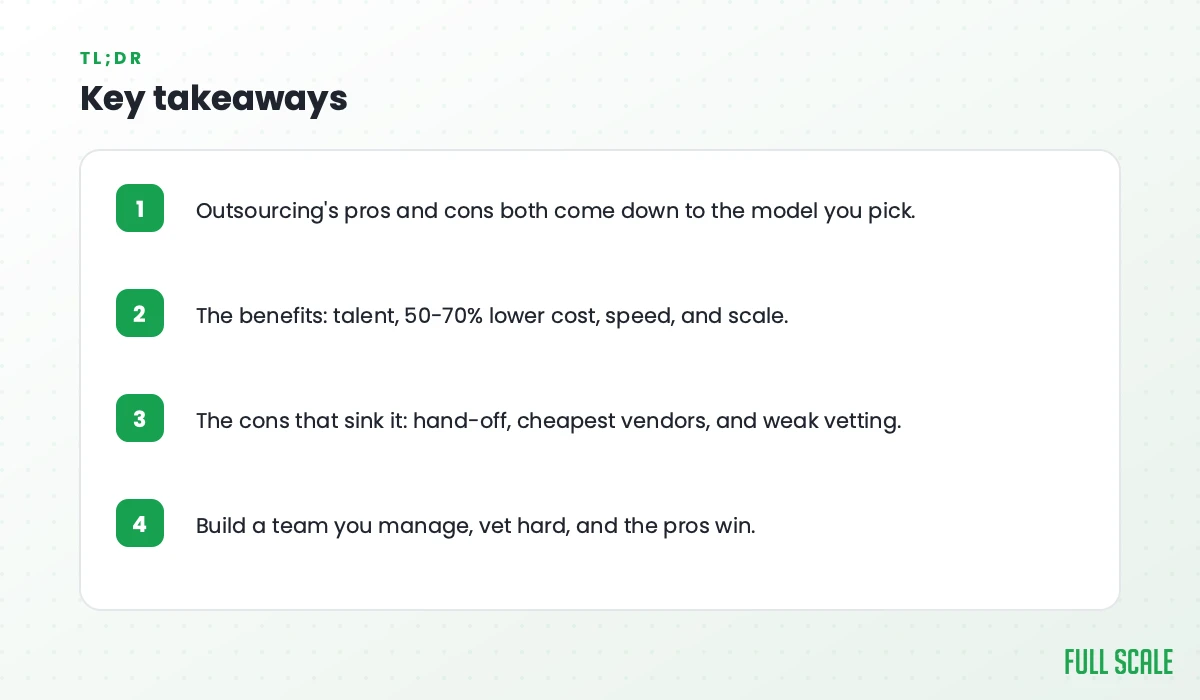
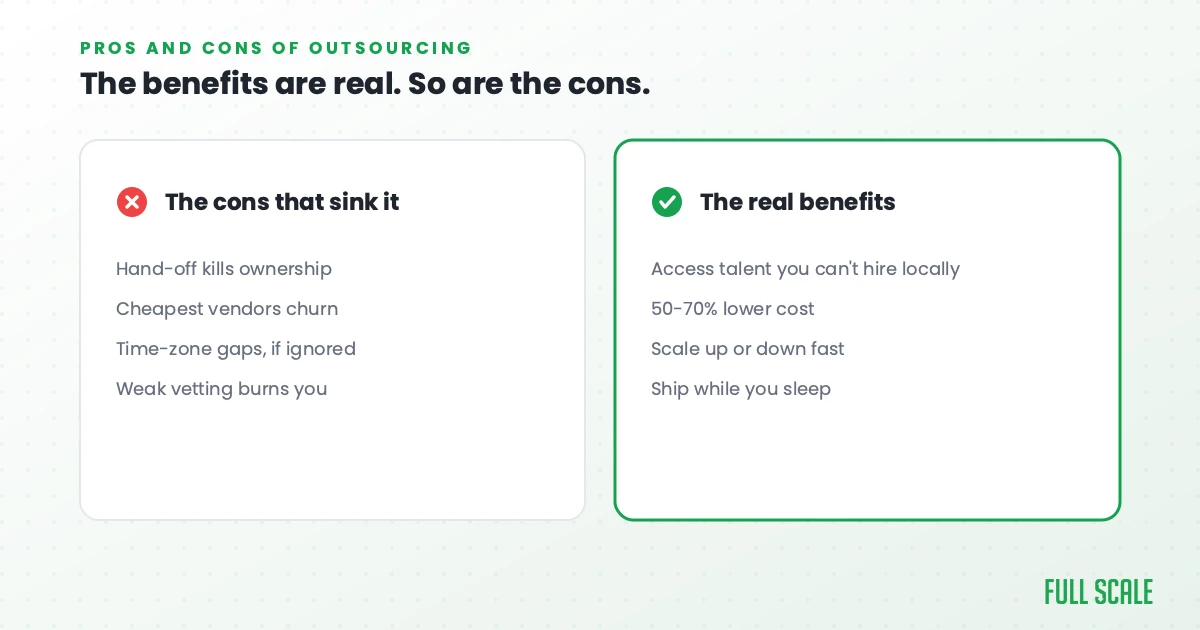
Quick Answer: Outsourcing software development has real pros and real cons, and which one wins depends on the engagement model, not the country. The benefits are talent access, 50-70% lower cost, and speed. The risks are lost ownership, cheap vendors that churn, and weak vetting. At Full Scale we run it as a dedicated team you manage, which keeps the pros and closes the cons.
I run Full Scale, a company that builds offshore software teams in the Philippines. So when I walk through the honest pros and cons of outsourcing software development, you should assume I have a reason to care about your answer. Here is that honest version anyway, because the dishonest one is what gets founders burned. The honest version starts with admitting most dev teams dread working with bad offshore developers for good reason. It helps to understand what Trump-era policy actually means for outsourcing before you decide.
I have been hiring and managing engineers outside the US for almost two decades. I co-founded VinSolutions and bootstrapped it to $35 million in revenue before it sold. Then I built Stackify. Some of those hires were the best engineers I ever worked with, and some engagements fell apart in ways that cost me months. The pattern was never about the country or the hourly rate. It was about what I kept in-house and how much control I handed away.
That is the real story behind the pros and cons of outsourcing software development. The benefits are real and the drawbacks are real, but most lists get the cons wrong. They treat them as vague risks you can manage with a better Slack habit. The cons that actually sink projects come down to control and continuity, not cost. Both are far easier to hold onto with a long-term team, which is why outsourcing IT work to the Philippines succeeds when it is run as staff augmentation. You can see that pattern across these successful outsourcing examples.
Control and continuity were not always the deciding factors. how offshoring got here traces how the industry started as a pure cost play and only later learned that lesson the hard way.
What outsourcing software development actually means
Outsourcing software development covers a few different models, and the pros and cons shift with the one you pick. Project-based outsourcing means you hand a project, or a whole function, to an outside company and they deliver it back to you. You are buying an outcome, not building a team. That is a different thing from staff augmentation or a dedicated team, where you hire specific people who work as an extension of your own staff and answer to you. How you pay shifts too, which is why it helps to understand the software outsourcing payment models before you sign.
The distinction matters because it decides who owns the result. With project-based outsourcing, the vendor owns the how. With a dedicated team, you do. Most of the pain I have watched founders walk into comes from picking the first model when they needed the second. If you want the wider market view first, our guide to software development outsourcing breaks down the models in detail.
The real benefits of outsourcing software development
Start with why companies do this at all. The reasons companies outsource software development come down to four things, and they hold up. The global IT outsourcing market was worth over $500 billion in 2022 for a reason (Grand View Research).
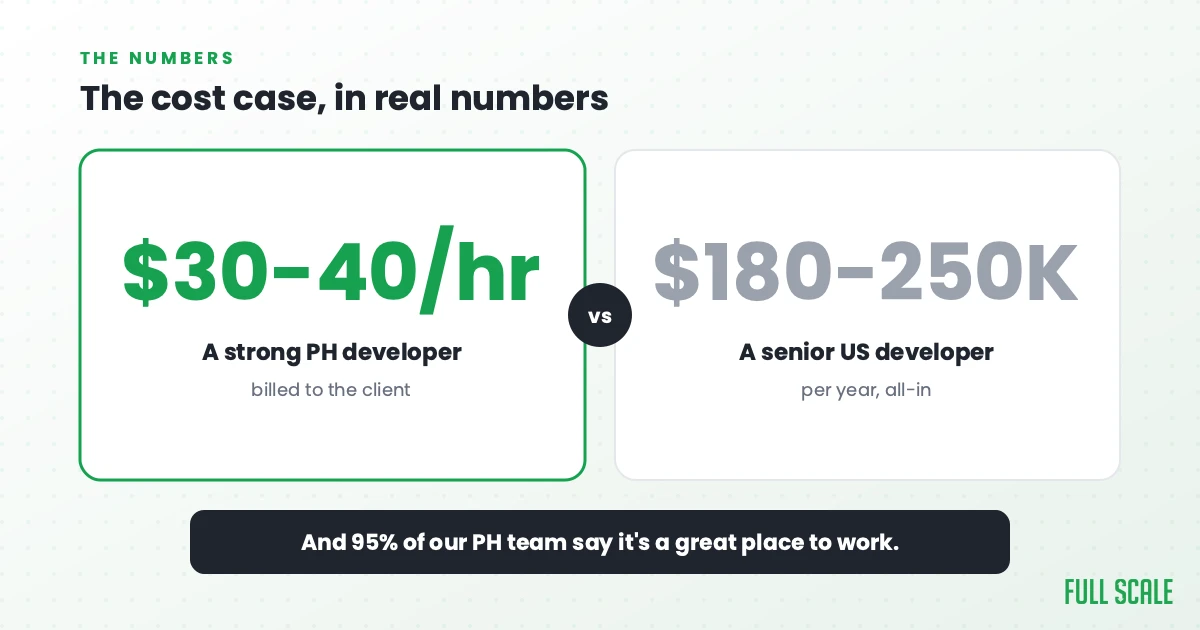
Cost is the obvious benefit, and it is bigger than people expect. A senior developer in the US runs $180,000 to $250,000 all-in once you add benefits, payroll tax, and recruiting fees. A strong developer in the Philippines might bill at $30 to $40 an hour. That is not a margin you split hairs over. It is the difference between affording two engineers and affording five. A Deloitte survey found cost was the top reason companies outsource, and the math is why.
The bigger win is talent you cannot hire at home. You stop fishing in one zip code and start hiring from a global pool. The Philippines alone is the third-largest English-speaking country in the world (Philippine Embassy), which is part of why we built there. If your local market has no senior Go engineers this quarter, that is no longer your problem. For a country-by-country read on what this costs, we keep offshore development rates by country current.
The third benefit is speed and scale. You can add four engineers for a push and scale back when it ends, without the cost and the human mess of hiring and laying off full-time staff. That flexibility is hard to match with an in-house-only team.
The fourth is focus. Handing routine build work to a dedicated team frees your core people to work on the parts of the product only they can do. For a cash-strapped startup, that focus can be worth more than the cost savings.
The cons that actually sink projects
Here is where the generic lists let you down. They will tell you the cons are “communication” and “time zones,” as if a standup at 9pm fixes everything. The cons that actually kill projects run deeper than that.
You give up control, and control is the whole game. When you outsource a project, you do not get to pick who writes your code or how they write it. You are renting a team, not building one. The result slides away from the product you pictured, and by the time you notice, you have paid for months of it.
Tribal knowledge walks out the door when the contract ends. Everything the vendor learned about your product, your edge cases, and your customers leaves with them. You start from square one on the next pivot. For a company whose product is software, that lost knowledge is the expensive part, not the invoice. Moving to a new offshore development team the slow way, with real overlap, is how you keep that knowledge from walking out the door in the first place.
Then there are the failure modes nobody warns you about. I have watched a freelancer vanish mid-sprint, an agency bill for ten engineers while three of them did the real work, and a shop that demoed beautifully ship something else entirely. They are some of the most common Upwork scams seen from the buyer’s side. All three happened to me or to founders I have advised. The full list of outsourcing risks is worth reading before you sign anything, because security gaps and quality problems usually show up after the deliverable is already wired into your system. A lot of these start on freelance platforms like Toptal and Upwork, where the vetting is on you.
When you should not outsource software development
Some things should never leave your building. Do not outsource your product vision, and do not outsource your engineering leadership. If software is your product, the core of it is your company, and you cannot rent a company. I wrote a whole piece on why outsourcing product development still needs your vision and input, and it comes back to this every time.
Skip outsourcing if your requirements change every week, if your codebase is deeply tangled with in-house systems, or if your intellectual property is the kind you cannot hand to a third party. In those cases the coordination cost eats the savings.
Critics will tell you offshoring is just a race to the bottom on wages, and that the work is worse because it is cheaper. I disagree, and the data does too: the right offshore engineer is not a discount, they are a senior professional you happened to find in a lower-cost market. But the critique has a real core. When you hire on price alone and pick the cheapest body you can find, you get the bad outcomes that give offshoring its reputation. I call that cheapshoring, and it is the opposite of how this should work. Treat people like interchangeable headcount on a spreadsheet and the work suffers. Treat them like your own team and it does not.
Advantages and disadvantages of outsourcing software development at a glance
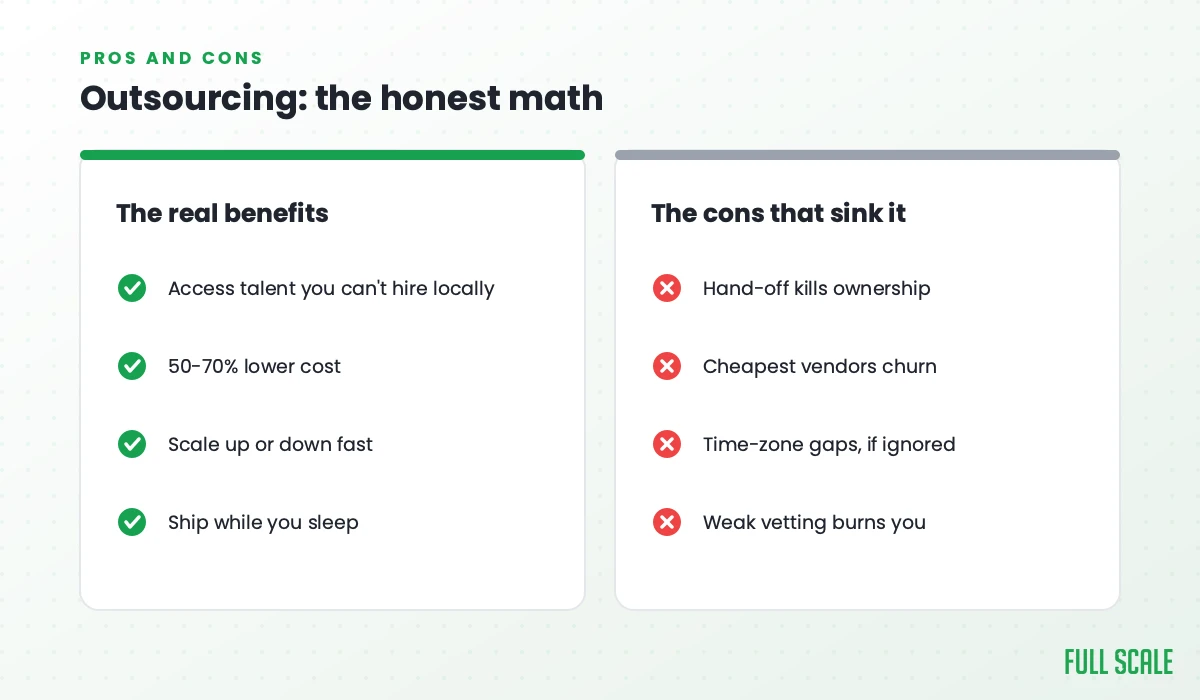
If you want the short version of the advantages and disadvantages of outsourcing software development, here it is. Read the rows as a checklist, not a verdict, because which column wins depends entirely on the model you choose.
| Pros | Cons |
|---|---|
| Lower cost per engineer, often half of US all-in | You give up control over who codes and how |
| Access to talent your local market cannot supply | Tribal knowledge leaves when the contract ends |
| Scale up and down without hiring and firing | Quality and security gaps surface after integration |
| Core team stays focused on the real product | Hidden costs in coordination and oversight |
| Faster path to shipping with a team that is ready | Wrong for your core IP and your engineering leadership |
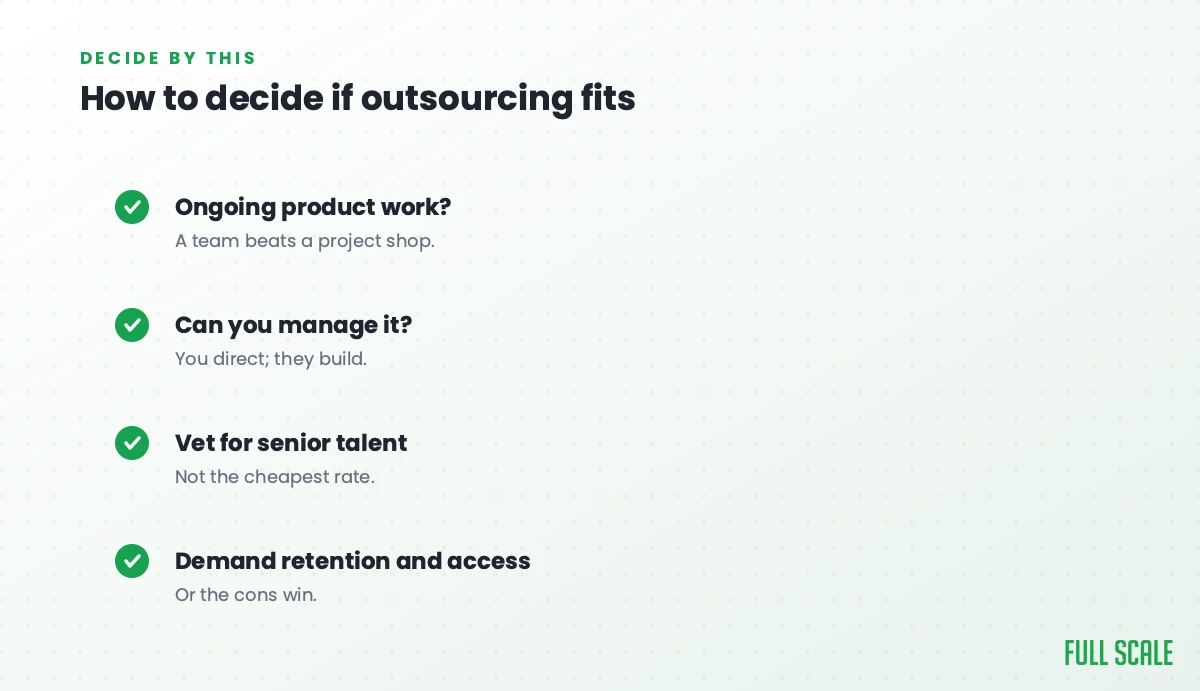
How to decide if outsourcing is right for you
Run three honest checks before you decide. First, is this work core or supporting? Core product and architecture stay close to you. Supporting features and clear, well-scoped builds are safe to send out. Second, do you have someone in-house who can lead engineers, even ones you do not employ directly? If nobody owns the technical direction, no vendor will save you. Third, is the work well-defined or still changing? Clear specs travel well across a time zone. Constant churn does not. If the scope is stable enough to fit in a statement of work, project-based outsourcing can work; if requirements keep shifting, you need a team. If the checks point you toward sending the work out, the next step is vetting a software development outsourcing company before you sign anything.
If you answered “supporting work, yes I have a lead, and the scope is clear,” outsourcing or a dedicated team is a strong move. If you answered the other way, keep it in-house until that changes. For the full side-by-side, our breakdown of outsourcing versus in-house development walks through the tradeoffs.
The model I would actually use
After all of it, the model I trust is a dedicated team you manage like your own, not a project you toss over a wall. That is what we build at Full Scale: vetted engineers in the Philippines who work only on your product, with payroll, benefits, and HR handled by us. It keeps the cost and talent benefits while closing the control and continuity gaps that wreck project outsourcing. It is also the Product Driven approach I lay out in my book, where ownership sits with the team building the thing.
It is the same model behind our work with LendingStandard, and it is why our developers stay: we are on the Inc. 5000 five years running, and 95% of our Philippines team says it is a great place to work, against 65% at a typical company (Great Place to Work). If you want the team without the project-outsourcing baggage, that is what staff augmentation and a dedicated team in the Philippines are for.
Frequently Asked Questions
Is outsourcing software development worth it?
It is worth it when the work is well-scoped supporting work and you keep your product vision and engineering leadership in-house. It is not worth it when you outsource the core of your product or have nobody to lead the work.
What are the biggest risks of outsourcing software development?
The biggest risks are losing control of how your code is built, tribal knowledge leaving when the contract ends, and quality or security gaps that only surface after the work is integrated. Cost overruns and communication friction are real but secondary.
How much can you save by outsourcing software development?
A senior US developer costs $180,000 to $250,000 all-in, while a strong developer in the Philippines often bills at $30 to $40 an hour. For most teams that cuts the cost per engineer roughly in half, which means more engineers for the same budget.
Should startups outsource software development?
For a startup, the real comparison is usually offshore vs. local, not outsourcing vs. in-house. A local senior developer runs $180,000 to $250,000 all-in; a strong offshore developer in the Philippines bills $30 to $40 an hour, which usually means two or three engineers for the price of one. Startups should not hand their core product to a project shop either way, but a dedicated offshore team or staff augmentation gets you more engineering for the same runway. The goal is a team that grows with you, not one that disappears.
What is the difference between outsourcing and staff augmentation?
With outsourcing you buy a finished outcome and the vendor controls how it gets built. With staff augmentation you hire specific people who work as part of your team and report to you, so you keep control and continuity.
What are the pros and cons of project-based outsourcing?
Project-based outsourcing hands a defined scope to an outside company and you get a finished deliverable back, which moves fast when the work is well-specified. The tradeoff is that the vendor owns the how, so it only works cleanly when you already know what you want, and it breaks down fast when the project changes underneath you, which is where most of the real damage in outsourcing happens.