
Your Development Budget Planning Template: The CFO s Guide to Predictable Development Budgeting
Budgeting for software development feels like predicting the weather six months out. Most CFOs struggle with 40% budget overruns and unpredictable development expenses.
This development budget planning template uses Monte Carlo simulation to achieve 95% accuracy. One of our clients, let’s call them HealthTech Solutions, cut their budget variance from 40% to just 5% using this exact framework.
Traditional methods fail because they assume development is predictable and linear. But software creation involves discovery, problem-solving, and constant adaptation. That’s why you need a probabilistic approach that accounts for real-world variability.
Quick Summary: Development Budget Planning Template
- What: Monte Carlo simulation-based budgeting framework
- Result: 95% budget accuracy (vs 40% overruns with traditional methods)
- Key Inputs: Developer hours, rates, velocity, overhead, risk factors
- Time to Implement: 3 months for full deployment
- Average Savings: $400K annually for mid-size tech companies
How HealthTech Solutions Achieved 95% Budget Accuracy
HealthTech Solutions burned through $2.8 million in 2023 with nothing to show for it. Their development projects consistently ran 40% over budget, causing board tensions.
Everything changed when their CFO implemented Monte Carlo budgeting for development projects. Within 18 months, they achieved 95% budget accuracy and saved $400,000 annually.
Why Traditional Development Budgeting Fails Every Time
Traditional software development budget planning templates fail because they ignore reality. Development isn’t manufacturing; you can’t predict creativity and problem-solving with spreadsheets.
Here’s why your current IT project budget forecasting keeps missing the mark:
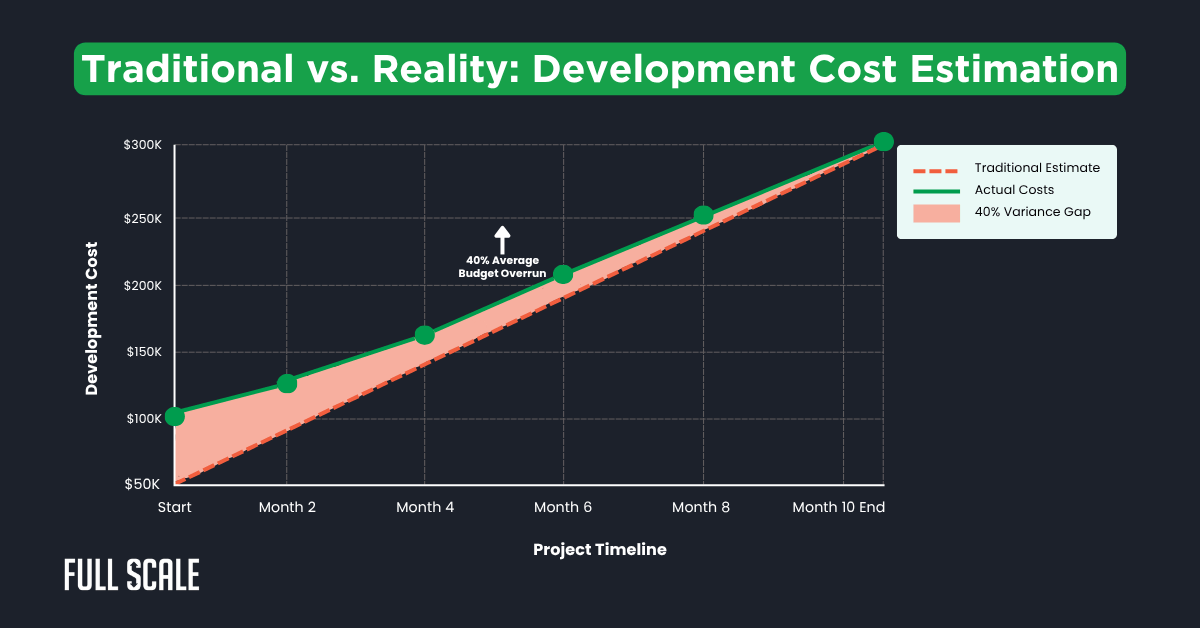
This graph shows why linear estimates fail. Development follows curves, not straight lines.
The Three Fatal Flaws Destroying Your Budget
Every failed development budget planning template shares these three fundamental problems. Understanding them is the first step to fixing your forecasting accuracy.
These flaws compound each other, creating cascading budget failures. Let’s examine each one and see why they devastate traditional planning.
Single-Point Estimates Kill Accuracy
Developers estimate tasks at 40 hours, but reality ranges from 25 to 80. According to McKinsey, 66% of software projects exceed budgets by 200% (McKinsey, 2024).
Ignoring Team Velocity Changes
Your senior developer works at 0.9 efficiency while juniors operate at 0.5-0.7. Traditional budgets assume everyone performs equally, creating systematic errors.
Hidden Cost Multipliers Everywhere
Communication overhead adds 15-30% to distributed team costs. Context switching burns another 20% of productive hours, especially in offshore development scenarios.
Monte Carlo Budgeting: Your Development Budget Planning Template Solution
Monte Carlo simulation transforms development cost estimation methods from guesswork to science. It runs thousands of scenarios to predict realistic outcomes based on probability.
What Makes Monte Carlo Different
Instead of one estimate, you input ranges for every variable. The simulation runs 10,000 scenarios with different combinations, revealing true budget probabilities.
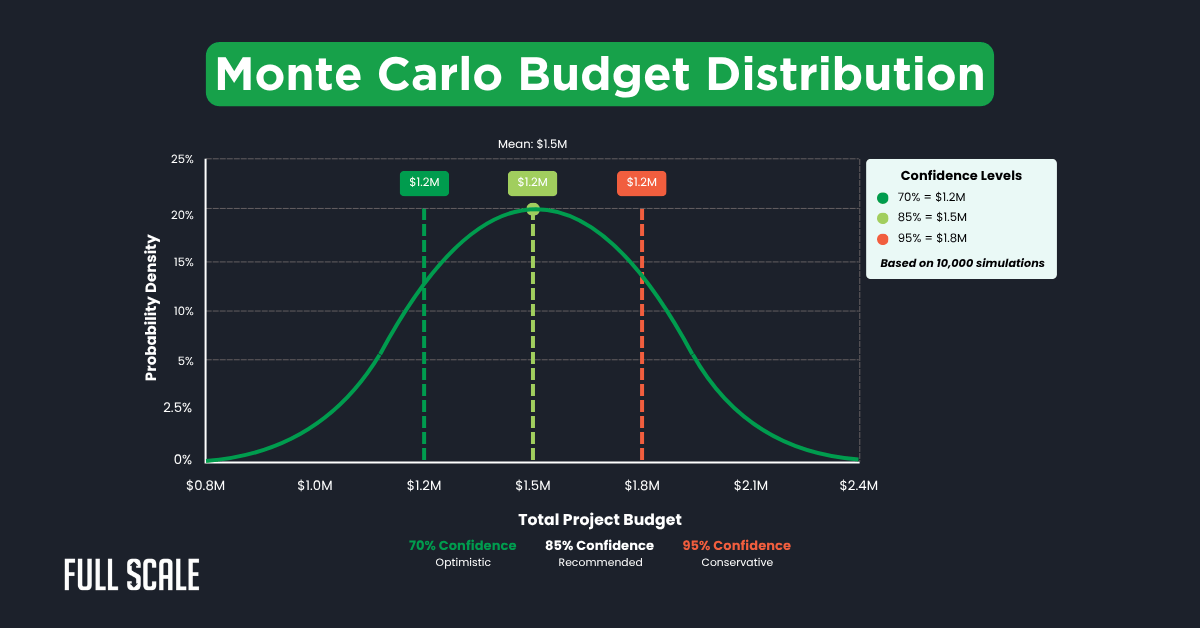
This distribution shows your budget probabilities. Pick your confidence level based on risk tolerance and stakeholder requirements.
The Five-Input Framework for Predictable Development Budgeting
Your development team cost calculator needs five key inputs. Each input uses ranges, not fixed numbers, to capture real-world variability.
| Input Variable | Range Example | Impact on Budget |
| Base Development Hours | 120-180 hours | 33% of variance |
| Team Velocity Factor | 0.6-1.0 | 25% of variance |
| Communication Overhead | 15-30% | 20% of variance |
| Risk Factor | 10-40% | 15% of variance |
| Market Rate Variability | ±20% | 7% of variance |
These five variables drive 90% of your budget uncertainty. Control them to achieve predictable software costs and reduce development expenses.
Your Interactive Development Budget Calculator
Calculate your development budget with confidence intervals. Input your project variables below to see Monte Carlo results instantly.
Monte Carlo Development Budget Calculator
Run 10,000 simulations to see your budget confidence intervals
This calculator demonstrates a Monte Carlo simulation for software project budget planning. Adjust variables to match your specific project needs and team composition.
Implementation Roadmap for Your Development Budget Planning Template
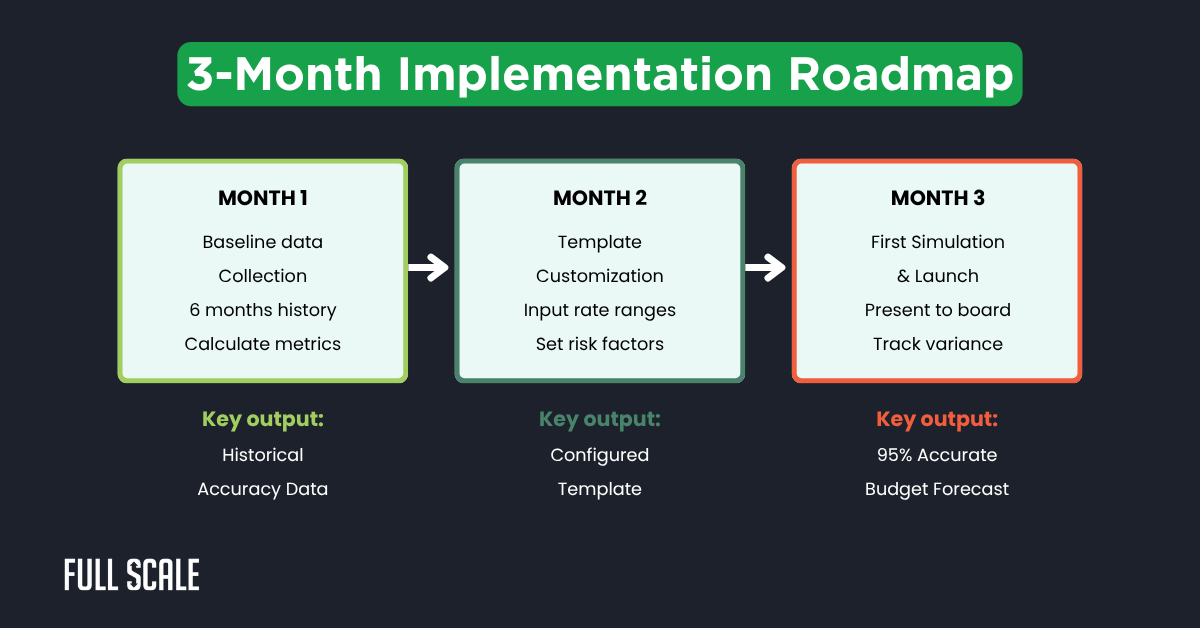
Starting with Monte Carlo budgeting for offshore development requires three months. Each phase builds on previous data collection and analysis to ensure accuracy.
Working from the Philippine timezone provides 12-hour coverage advantages. This natural workflow separation reduces communication overhead by 25% compared to same-timezone teams.
Month 1: Baseline Your Current Data
Collect your last six months of development project financial data. Document actual hours versus original estimates for every project completed.
Calculate these critical metrics from your historical data:
| Metric | Calculation | Target Range |
| Estimate Accuracy | Actual Hours / Estimated Hours | 0.8 – 1.2 |
| Team Velocity | Completed Points / Planned Points | 0.6 – 0.9 |
| Budget Variance | (Actual – Budget) / Budget | < 15% |
| Communication Overhead | Meeting Hours / Total Hours | 15 – 25% |
Month 2: Customize Your Template
Input your specific rate ranges for offshore development budget planning template. Adjust risk factors based on your industry and project complexity levels.
The Gartner Group reports that 75% of companies using probabilistic budgeting reduce overruns by 35%. Your communication overhead percentages directly impact development expense forecasting accuracy.
Month 3: Run Your First Simulation
Execute your quarterly budget simulation using the development budget planning template. Present the 85% confidence scenario to your board for approval.
Track actual spending against projections weekly. Adjust your model monthly based on variance analysis results and team performance data.
Cost Reduction Strategies Using Predictable Development Budgeting
Smart engineering team budget optimization starts with the right staffing mix. Your ideal ratio balances experience with cost efficiency while maintaining quality.
Philippine-based developers offer 40-60% cost savings with equivalent skill levels. The 12-hour time difference enables continuous development cycles, maximizing productivity.
The Optimal Staffing Formula
A 60% senior to 40% junior developer ratio maximizes both quality and budget. When these ratios are locked in permanently, staff augmentation budgeting becomes predictable.
According to Deloitte, companies using staff augmentation reduce development costs by 43% on average. Stack Overflow’s 2024 Developer Survey shows offshore teams now match onshore quality metrics.
Risk-Adjusted Planning That Works
Build a 15% buffer when presenting 85% confidence budgets to stakeholders. This approach eliminates emergency hiring at 3x normal rates completely.
Your software project cost management improves when you plan for variability. Monthly budget surprise meetings disappear when executives trust your projections consistently.
Quick Implementation Actions You Should Do
Use our development budget planning template to start immediately. Input your last project’s actual hours, estimates, and final costs today.
Run your first Monte Carlo simulation using conservative inputs. Compare results to your traditional budget to see the accuracy improvement.
Present confidence intervals to stakeholders instead of single-point estimates. This transparency builds trust and reduces budget-related conflicts significantly.
Use Our Development Budget Planning Template
Ready to implement Monte Carlo budgeting for your development projects? Our comprehensive Excel template gives you everything needed to achieve 95% budget accuracy.
This template transforms complex probability calculations into simple, actionable insights. Use it now and start reducing your budget overruns immediately.
Monte Carlo Budget Planning Tool
Build your development team budget with real-time Monte Carlo simulation. Input your team composition and get instant budget recommendations.
Step 1: Define Your Team Composition
Add developers to your team and set their parameters. The tool will calculate budget ranges automatically.
Step 2: Set Project Parameters
Step 3: Assess Project Risks
Select the risk level for each category. Higher risks increase budget variability.
The Bottom Line on Development ROI
Traditional budgeting creates 40% average overruns and 65% project failures. Monte Carlo budgeting achieves 70% confidence within 5% of budget reliably.
At 85% confidence, you stay within 15% of the planned budget. The 95% confidence level ensures you never exceed 25% over budget.
With predictable staffing models, you remove rate variability completely. IT budget optimization becomes automatic when you eliminate hiring cost surprises.
Why Full Scale Makes Your Development Budget Planning Template Work
Traditional offshore development creates budget chaos with fluctuating rates and unpredictable team changes. Full Scale’s model transforms those variables into constants:
- Fixed Monthly Pricing Removes Rate Volatility – Your Monte Carlo simulations rely on stable inputs. Our locked-in monthly rates eliminate the 20% rate variance that destroys budget accuracy.
- 95% Developer Retention = Consistent Velocity – Most offshore teams suffer 40-60% turnover, making velocity unpredictable. Our developers average 2+ years, keeping your velocity stable at 0.85-0.95 instead of 0.5-1.0.
- Direct Developer Access Reduces Overhead by 25% – Traditional outsourcing adds 30-40% communication overhead through project managers. Direct Slack and daily standup access keep your overhead at just 15%.
- Real Budget Data from 60+ Implementations – Our clients report 90% budget accuracy within 90 days. Their actual variance data helps calibrate your Monte Carlo model for offshore development.
Stop guessing with unreliable offshore variables. Full Scale provides the predictable inputs that make your development budget planning template actually work. See how we turn Monte Carlo theory into 95% accurate budgets.
Stop Guessing. Be Smart in Managing Your Development Budget.
FAQs: Development Budget Planning Template
What’s the minimum data needed to start Monte Carlo budgeting?
You need at least three months of historical project data. Include actual hours worked, original estimates, and final costs for accuracy.
How does this development budget planning template handle agile projects?
The template accommodates sprint-based planning through iterative simulations. Update your inputs monthly as velocity data becomes available.
Can small teams benefit from Monte Carlo budgeting?
Teams as small as five developers see 20-30% accuracy improvements. The framework scales from startups to enterprise development organizations.
How often should I update my budget simulations?
Run new simulations monthly for active projects. Quarterly updates suffice for annual planning cycles and long-term forecasting needs.