
Top PHP MVC Frameworks for 2026: The CTO’s Guide to Building Scalable Offshore Teams

In this article
- The Quick Answer: Best PHP MVC Frameworks 2026
- Why Framework Choice Isn’t the Real Problem
- Why We Default to Laravel for New Projects in the AI Era
- The 10 PHP MVC Frameworks for 2026 (Ranked with Offshore Context)
- Laravel: The Popular Choice (With Caveats)
- Symfony: The Enterprise Architect’s Framework
- CodeIgniter: The Underrated Speed Demon
- Yii: The Performance Optimizer
- CakePHP: The Rapid Scaffolder
- Other PHP MVC Frameworks (6-10)
- The Full Scale Framework Selection Method (Proprietary Framework)
- Real-World Implementation: How Companies Actually Choose PHP MVC Frameworks
- Framework Migration Strategy: When You Need to Switch PHP MVC Frameworks
- Common Framework Selection Mistakes (And How to Avoid Them)
- PHP Framework Comparison: Offshore Hiring Reality
- PHP MVC Framework Feature Comparison
- Offshore PHP Team Cost Example
- Framework Learning Curve Chart
- Offshore Talent Availability by Framework
- Framework Matters Less Than You Think (But More Than Nothing)
- Ready to Build Your PHP Team?
- Frequently asked questions
Every CTO I talk to asks the same question: “Which PHP framework should we use?” For most modern PHP applications, Laravel is the answer, and when you need to scale the team, the Philippines’ twenty-year PHP history means offshore Laravel teams tap a deeper talent pipeline than almost any other market.
I give them the same answer: “It doesn’t matter nearly as much as you think.”
I’ve built companies on Laravel, Symfony, and even good old CodeIgniter. Know what they all had in common? They succeeded or failed based on the team, not the framework. Which is the whole argument for hiring on judgment, the same lens behind modern PHP developer skills.
After placing PHP developers across every major PHP MVC framework since 2018, I’ve learned something most CTOs miss. Choosing between PHP MVC frameworks wastes months while competitors ship features. Your framework choice accounts for maybe 20% of success.
The other 80%? Your hiring strategy, team expertise, and offshore talent availability.
This is a strategic guide connecting framework choice to business outcomes: hiring speed, team retention, and offshore success. We’ll examine how different PHP MVC frameworks impact your ability to build and scale offshore teams, and why the conventional wisdom about framework selection often leads CTOs astray. Framework choice is only one input to scalable software architecture, and rarely the one that matters most.
What You’ll Learn in This Guide:
- Why framework choice matters less than you think (and what actually matters more)
- The 10 top PHP MVC frameworks ranked with offshore hiring data you won’t find elsewhere
- The Full Scale Framework Selection Method, our 7-factor decision framework
- Real client stories showing when framework decisions went right (and disastrously wrong)
- Framework migration strategies for companies stuck on legacy code
- Offshore talent availability data including hiring timelines and salary ranges by framework
The Quick Answer: Best PHP MVC Frameworks 2026
The top PHP MVC frameworks for 2026 are Laravel (most packages), Symfony (most flexible), and CodeIgniter (fastest learning curve). For offshore teams, Laravel offers the deepest talent pool of any PHP framework, while Symfony attracts more senior developers at a higher quality. Your choice depends on team size, project complexity, timeline, and offshore hiring strategy, not just popularity.
Framework fundamentals haven’t changed despite shifting trends. Our offshore placement experience reveals clear patterns across all major PHP MVC frameworks.
Laravel excels at speed and package depth. Symfony delivers long-term flexibility for complex enterprise needs. CodeIgniter provides simplicity and velocity for straightforward projects.
But here’s the uncomfortable truth: We’ve seen teams succeed wildly with every PHP MVC framework. We’ve also watched teams fail spectacularly with the “best” framework. The difference? Never the technology. Always the people.
One newer factor worth weighing: Laravel has the strongest AI-assisted development story of any PHP framework, with its own MCP tooling, which matters more on a greenfield build than it did even two years ago.
Why Framework Choice Isn’t the Real Problem
CTOs lose sleep over choosing between PHP MVC frameworks. They should lose sleep over hiring instead.
I’ve watched teams bikeshed php framework comparison discussions for 3 months while competitors shipped 2 major features. That isn’t strategic thinking. It’s procrastination with a technical vocabulary.
Framework Religious Wars Destroy Teams
Framework debates are the adult version of “my dad can beat up your dad.” They’re ego battles disguised as technical discussions. Your senior developer who loves Symfony will find 47 reasons why Laravel is “magic” and therefore dangerous.
Meanwhile, your Laravel expert will produce a manifesto on why Symfony’s learning curve “wastes time.”
Both are wrong. Both are right. Neither matters as much as shipping.
Team Quality Trumps Framework Features
Our retention data across 700+ placements tells the real story. Our developer retention holds at 93%+ across every PHP MVC framework. That’s Laravel, Symfony, CodeIgniter, and even legacy frameworks people claim are “dead.”
The retention rate doesn’t correlate with framework popularity. It correlates with team quality, management approach, and company culture. A mediocre developer on Laravel underperforms an excellent developer on CodeIgniter every single time.
When Framework Actually Matters
Framework choice among PHP MVC frameworks matters in exactly three scenarios:
Performance at extreme scale. If you’re handling 50,000+ requests per second with sub-100ms latency requirements, framework overhead becomes measurable. But according to W3Techs, PHP powers 77% of all websites with a known server-side language. Most don’t have these requirements.
Package needs. If your project requires 15 specialized packages that only exist for Laravel, that’s a valid reason. But don’t confuse “nice to have” with “essential.”
Existing expertise. If your entire 8-person team knows CodeIgniter cold, switching to Symfony because it’s “more modern” is organizational self-harm. Productivity crater for 4-6 months. Developer frustration mounts. Deadlines slip.
So what DOES matter when evaluating PHP MVC frameworks?
Why We Default to Laravel for New Projects in the AI Era
I just spent several sections telling you the framework matters less than the team. That’s still true. But I want to be honest about the one thing that has actually moved the math in the last two years, because pretending nothing changed would be its own kind of lie.
AI coding tools changed which framework I reach for on a brand-new project.
At Full Scale Ventures, when we start something greenfield, we default to Laravel. Not because it wins a feature checklist, and not because the talent pool is the deepest, though it is. We pick it because it’s opinionated and full-featured, and that turns out to be exactly what AI coding agents are best at.
Here’s the part most framework comparisons miss. An AI agent does its best work when there’s one obvious way to do something. Laravel has a convention for almost everything: routing, auth, queues, the ORM, testing, the directory layout. The agent has a stable target, so the code it writes looks like the code a senior Laravel developer would write. Compare that to the JavaScript world, where the stack gets assembled a hundred different ways and no two projects share the same shape. The agent has to guess, and you spend your review time correcting its guesses.
Laravel also went and built its own AI tooling instead of waiting for everyone else to. Laravel Boost, which shipped in 2025, is a Model Context Protocol (MCP) server that gives your AI agent real context about your actual app: your schema, your routes, your installed packages, your Laravel version. There’s a separate Laravel MCP package for exposing your own app to AI clients. So the agent stops writing generic PHP and starts writing code that fits the project in front of it. That’s a real edge on a new build, and the Laravel team earned it by out-innovating the rest of the PHP space over the last few years.
The hiring side of this is just as clean, and it ties straight back to the rest of this guide.
When you hire a Laravel developer, you know they know the whole stack, top to bottom.
The framework is opinionated enough that experience with it means experience with all of it. A full-stack JavaScript developer can mean fifteen different combinations of runtime, framework, and tooling, and two people with that title on their resume may have almost no overlap in what they’ve actually built. A Laravel developer is a known quantity. For an offshore team you’re scaling fast, that predictability is worth a lot.
None of this overrides the 80/20. A strong team on Symfony or CodeIgniter still beats a weak team on Laravel, every time. If your team already knows another framework cold, the advice earlier in this guide holds and you shouldn’t switch for AI reasons alone. But when we get to pick from a blank slate, AI-friendliness is now a real factor in the decision, and it’s why Laravel is our default for new work. The same logic extends to mobile: see the mobile app development frameworks guide for how it plays out there.
The 10 PHP MVC Frameworks for 2026 (Ranked with Offshore Context)
Here’s what most PHP framework comparison articles miss: offshore hiring reality.
Every ranking focuses on features and performance. Nobody tells you that Laravel developers take about twice as long to hire as CodeIgniter developers. Or that Symfony developers command noticeably higher salaries offshore.
This PHP framework comparison includes the data that actually impacts your business. We’ve analyzed all major PHP MVC frameworks through the lens of offshore team building, because that’s where theory meets reality.
Laravel: The Popular Choice (With Caveats)
#1 Most Popular
Talent Pool
Largest
Hiring Time
14-21 days
Client Rate
From $35/hr
Competition
HIGH
Best At:
- Rapid prototyping
- Massive package library
- Excellent documentation
- Clean syntax
- AI-assisted development (first-class MCP tooling via Laravel Boost)
Terrible At:
- Performance at extreme scale (requires tuning)
- Hiring competition is brutal
- “Magic” methods obscure debugging
- Everyone wants Laravel on their resume
Matt Watson’s Take:
“Laravel is the iPhone of PHP MVC frameworks—everyone wants one, which means you’ll pay premium and fight for talent. That said, if speed to market is everything and you can afford the hiring competition, Laravel’s package library is genuinely unmatched. Just don’t fool yourself into thinking you’re being ‘strategic’ by choosing the most popular option. Sometimes you’re just following the crowd. One thing that has genuinely shifted my thinking: Laravel’s conventions and its own AI tooling make it the framework where AI coding agents are most productive, which is why it’s our default for new projects at Full Scale Ventures.”
When Laravel Works:
Fast-moving product companies, teams with existing Laravel expertise, and projects requiring extensive third-party integrations.
When Laravel Fails:
Teams choosing it purely for resume reasons, companies unable to compete for top Laravel talent, and projects with extreme performance requirements.
Symfony: The Enterprise Architect’s Framework
#2 Enterprise
Talent Pool
Smaller, senior
Hiring Time
21-28 days
Client Rate
From $35/hr
Developer Seniority
Skews senior
Best At:
- Long-term flexibility
- Complex enterprise applications
- Component reusability
- Gradual adoption without full commitment
Terrible At:
- Steep learning curve (2-3 months)
- Slower initial development
- Overwhelming configuration options
- Documentation assumes expertise
Matt Watson’s Take:
“Symfony developers tend to be more seasoned—they’ve been burned by framework lock-in before. They understand trade-offs. If you can afford ramp-up time, you’re getting architects, not just coders. Plus, there’s far less competition for talent. Everyone’s fighting over Laravel devs while excellent Symfony developers go unnoticed.”
Best Use Case:
Building for a 5+ year timeline, need architectural flexibility, timeline allows a 3-month learning curve, complex multi-tenant requirements.
CodeIgniter: The Underrated Speed Demon
#3 Fastest Hire
Talent Pool
Deep
Hiring Time
7-14 days
Client Rate
From $35/hr
Learning Curve
SHORTEST
Best At:
- Fastest learning curve (productive in days, not weeks)
- Minimal framework overhead
- Excellent performance out-of-the-box
- Simple codebase
Terrible At:
- Modern features lag behind Laravel/Symfony
- Smaller package library
- Perception problem (“seen as outdated”)
- Less community momentum
Matt Watson’s Take:
“CodeIgniter gets dismissed as ‘old school.’ That’s exactly why it’s strategic. Experienced developers know it, juniors learn it fast, and you’re not competing for the same talent pool as every Laravel shop. We’ve placed CodeIgniter developers in 7-14 days consistently. Try doing that with Laravel. Sometimes boring wins. Sometimes ‘mature’ beats ‘trendy.’”
Best Use Case:
Ship functional product in 90 days, straightforward project without exotic requirements, value simplicity over sophistication, want to avoid hiring competition.
Yii: The Performance Optimizer
#4 Performance
Talent Pool
Specialized
Hiring Time
14-21 days
Client Rate
From $35/hr
Focus
Performance
Best At:
- High-performance applications
- Excellent caching mechanisms
- Code generation tools (Gii)
- Enterprise features
Terrible At:
- Smaller community than Laravel/Symfony
- Less modern package library
- Steeper initial setup
Matt Watson’s Take:
“Yii is the framework you choose when you’re optimizing for performance, not popularity. If milliseconds matter and you don’t need trendy packages, Yii delivers.”
Best Use Case:
Performance-critical applications where framework overhead measurably impacts user experience, teams valuing built-in tools over package breadth.
CakePHP: The Rapid Scaffolder
#5 CRUD Speed
Talent Pool
Niche
Hiring Time
21-30 days
Client Rate
From $35/hr
Philosophy
Convention
Best At:
- Rapid CRUD development
- Convention over configuration philosophy
- Excellent scaffolding capabilities
Terrible At:
- Flexibility when breaking conventions needed
- Smaller talent pool
- Less modern architecture
Matt Watson’s Take:
“CakePHP is perfect for internal tools where you value speed over flexibility. But if your project doesn’t fit conventions, you’ll fight the framework.”
Best Use Case:
Internal tools, admin panels following standard patterns, teams valuing speed over flexibility.
Other PHP MVC Frameworks (6-10)
Specialized
Zend Framework/Laminas
Focus: Enterprise-focused with corporate backing from Zend (now Laminas). Excellent for large organizations requiring vendor support.
Offshore Talent: Small pool; expect 30-45 day hiring cycles.
Choose for: Enterprises requiring vendor relationships, legacy Zend migrations.
Slim
Focus: Microframework perfect for APIs and microservices. Minimal overhead, maximum flexibility.
Offshore Talent: Small but specialized pool.
Choose for: RESTful APIs, microservice architectures, minimalist approaches.
Phalcon
Focus: C-extension framework offering extreme performance through compiled code. Steep learning curve.
Offshore Talent: Tiny, highly specialized pool.
Choose for: Performance-critical applications, teams with C/PHP expertise, willingness to invest in specialized skill development.
FuelPHP
Focus: HMVC architecture framework with strong security focus. Niche community, declining adoption.
Offshore Talent: Very small pool.
Choose for: Teams already using FuelPHP, specific HMVC requirements.
PHPixie
Focus: Newer HMVC framework emphasizing performance and simplicity. Minimal adoption.
Offshore Talent: Extremely small; plan to train.
Choose for: Experimental projects, teams willing to invest in framework development.
Now you know what’s available among PHP MVC frameworks. But how do you actually choose?
Ready to Build Your PHP Development Team?
Stop competing for the same overpriced Laravel talent. Let Full Scale match you with experienced PHP developers in the framework that actually fits your project, whether that’s Symfony architects, CodeIgniter speed demons, or performance-focused Yii specialists.
The Full Scale Framework Selection Method (Proprietary Framework)
After placing PHP developers and watching companies succeed (and fail) with every PHP MVC framework, we developed this decision method.
It’s not about which PHP MVC framework is “best.” It’s about which is best for YOUR specific situation.
Here are the 7 weighted decision factors that actually matter:
Factor 1: Team Existing Expertise (Weight: 35%)
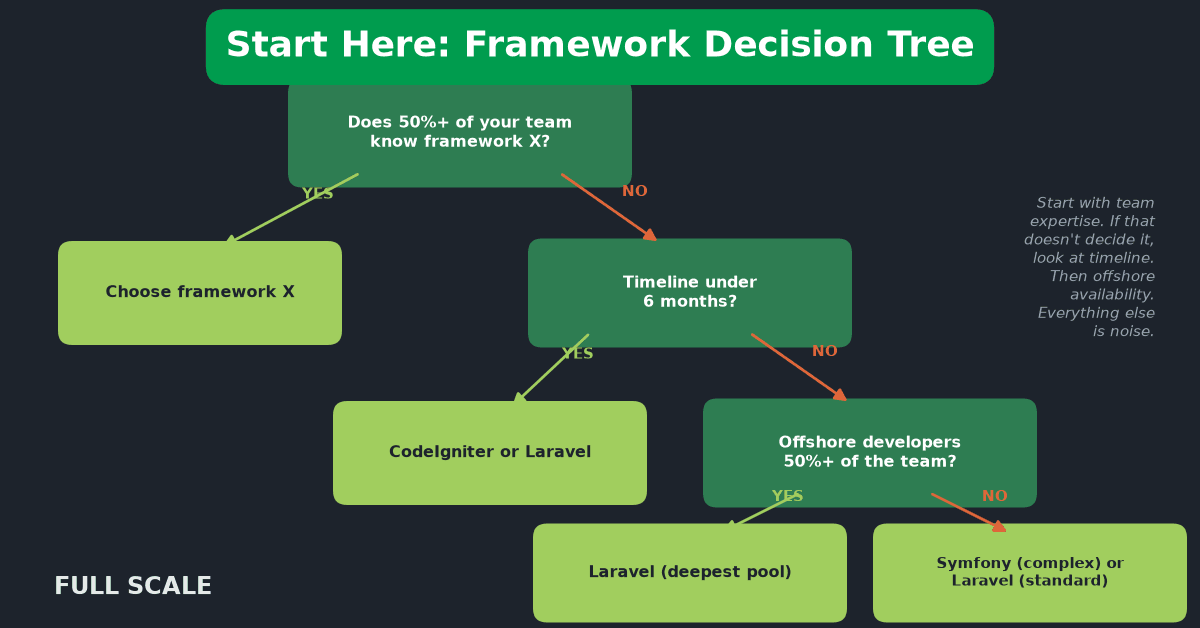
The Rule: If 50%+ of your team knows a specific PHP MVC framework well, that framework represents 35% of your decision, even if it’s not objectively “best.”
Why It Matters:
- Productivity dip during learning: 2-4 months minimum
- Developer satisfaction directly impacts retention
- Hiring becomes easier when you can use the existing team for technical interviews
- Knowledge transfer happens naturally within similar frameworks
Decision Criteria:
- Do 50%+ of developers know framework X? → Strongly favor it unless major red flags exist
- If nobody has framework expertise? → This factor weighs zero
Real Example: Client wanted to switch CodeIgniter→Laravel for “an upgrade.” The entire 8-person team knew CodeIgniter cold. I advised: Don’t switch. They switched anyway. Result: 6 months of pain, 2 developers quit, project delayed 4 months, $180,000 over budget.
Factor 2: Project Timeline (Weight: 25%)
The Rule: If you need to ship in less than 6 months, the learning curve is your #1 enemy when selecting PHP MVC frameworks.
Decision Matrix:
- <3 months: Use what the team knows OR CodeIgniter (1-2 week learning curve)
- 3-6 months: Laravel acceptable with experienced lead (4-6 week learning curve)
- 6-12 months: Symfony viable with dedicated learning time (8-12 week learning curve)
- 12+ months: Any PHP MVC framework works with proper planning
Matt Watson’s Take:
“I’ve seen teams pick Symfony with a 4-month deadline. It’s tech masochism. Choose the PHP MVC framework that your team can be productive in next week, not next quarter. Ship first. Refactor later if needed. You won’t get to ‘later’ if you don’t ship ‘now.’”
Factor 3: Offshore Developer Availability (Weight: 20%)
The Rule: If you plan to scale with offshore developers, talent pool depth matters significantly across different PHP MVC frameworks.
Full Scale Hiring Data:
Easiest to Hire:
- Laravel: 14-21 days
- CodeIgniter: 7-14 days
Moderate Difficulty:
- Symfony: 21-28 days
- Yii: 14-21 days
Challenging:
- Zend/Laminas: 30-45 days
- Niche frameworks: 45-60+ days
Decision Criteria:
- Will offshore developers represent 50%+ of the team? → Favor Laravel or CodeIgniter
- Planning to stay predominantly local? → This factor weighs less
Real Example: FinTech client insisted on Zend Framework for “enterprise credibility.” Finding qualified offshore Zend developers took 6 weeks per hire. Lost 4 months to hiring delays. Competitors using Laravel scaled to 12 developers in the same timeframe.
Factor 4: Project Complexity (Weight: 10%)
Decision Matrix:
- Simple CRUD applications: CodeIgniter, CakePHP
- Standard web applications: Laravel, Yii
- Complex enterprise systems: Symfony
- Microservices/API-only: Slim, Lumen
Matt Watson’s Take:
“Don’t bring Symfony to a CRUD fight. Don’t bring CodeIgniter to an enterprise architecture war. Match complexity to requirements.”
Factor 5: Performance Requirements (Weight: 5%)
The Controversial Truth: Framework performance matters for approximately 2% of applications. You’re probably not building that 2%.
When Performance Matters:
- 10,000+ requests/second
- Sub-100ms latency requirements
- IoT applications with thousands of concurrent connections
- Real-time financial trading systems
When Performance Doesn’t Matter:
- Most web applications
- Internal tools and dashboards
- B2B SaaS applications
- Standard e-commerce sites
Decision: Don’t optimize prematurely. All modern PHP MVC frameworks handle 1,000+ requests/second easily. Focus on code quality and database tuning first.
Factor 6-7: Packages & Long-Term Viability (Weight: 5% Combined)
Factor 6: Package Needs (3%):
- Need an extensive package library? → Laravel
- Require specific enterprise integrations? → Symfony
- Building custom from scratch? → Any PHP MVC framework works
Factor 7: Long-Term Viability (2%):
- All top 5 PHP MVC frameworks pass the health test
- Laravel: 13 years, active development
- Symfony: 19 years, corporate backing
- CodeIgniter: 18 years, maintained
- Stop worrying about this
Decision Flowchart
Real-World Implementation: How Companies Actually Choose PHP MVC Frameworks
Theory is nice. Reality is messy. Here’s what actually happens when companies apply (or ignore) this framework selection method.
Case Study 1: FinTech Startup Chose Symfony (Despite Timeline Pressure)
The Situation:
- Series A FinTech with $8M funding
- 8-person engineering team
- Ship MVP in 6 months (aggressive)
- Complex multi-tenancy requirements
- 5-year product roadmap
The Pressure: The Engineering team wanted Laravel for rapid development speed. CTO insisted on Symfony for architectural flexibility. The board pushed for “just ship something.”
The Decision: Choose Symfony despite the learning curve and timeline pressure.
Why It Worked:
- Hired 2 senior Symfony developers from Full Scale within 3 weeks
- Learning curve: 10 weeks, but the team emerged dramatically stronger
- Long-term flexibility paid dividends in year 2
- Scaled from 8 to 20 developers without major architectural rewrites
The Outcome:
- MVP launched in month 7 (1 month late but acceptable)
- Zero technical debt from framework limitations
- 93%+ developer retention over 18 months
- Avoided an entire rewrite that competitors faced
Matt Watson’s Lesson:
“They optimized for year 3, not month 3. That’s CTO thinking, not startup desperation. Sometimes the ‘slow’ choice is actually faster long-term. But only if you can stomach short-term pressure from people who don’t understand trade-offs.”
Case Study 2: E-Commerce Platform Stayed With CodeIgniter (And Won)
The Situation:
- Established e-commerce company
- 200,000 lines of CodeIgniter code
- 12 developers (all CodeIgniter veterans)
- Consistent pressure to “modernize” to Laravel
The Pressure: New VP of Engineering hired from the Laravel shop. Wanted a complete Laravel rewrite “for recruiting.” Argued CodeIgniter was “dead” and “embarrassing.” The board worried about technical debt.
The Decision: Stayed with CodeIgniter. Optimized what they had instead of rewriting.
Why It Worked:
- Team productivity stayed high (zero learning curve)
- Hired offshore CodeIgniter developers in 8 days on average (vs. 21 for Laravel)
- Invested “rewrite time” in performance tuning instead
- Site load time improved 40% through caching and database tuning
The Outcome:
- Avoided 18-month rewrite project
- Shipped 3 major features that competitors delayed
- Developer satisfaction remained high (no forced technology change)
- Revenue grew 60% while competitors rewrote
Matt Watson’s Lesson:
“Best PHP MVC framework is the one that lets you ship value. They shipped. Competitors who rewrote to Laravel? Still rewriting 2 years later. Sometimes the ‘boring’ choice is the smartest choice. CodeIgniter isn’t sexy. Know what is sexy? Revenue growth.”
When Framework Choice Goes Wrong: Lessons from Failures
Not every story ends well. Here are patterns we’ve seen destroy companies choosing PHP MVC frameworks:
Scenario 1: Choose Niche Framework, Couldn’t Hire
- The company chose Phalcon for “performance.”
- Spent 60 days per hiring cycle finding developers
- Lost 6 months to hiring delays
- Competitors scaled while they waited
- Lesson: Talent availability matters more than benchmark results
Scenario 2: Wrong Framework for Team Skill Level
- The startup gave the junior team Symfony
- Developers drowned in complexity
- Productivity never ramped
- Attrition hit 40%
- Lesson: Match framework complexity to team experience
Scenario 3: Choose Based on Hype, Overengineered Simple Project
- Internal tool project chose Laravel for a 10-table CRUD app
- Spent 4 months configuring the architecture
- CodeIgniter would’ve shipped in 6 weeks
- Lesson: Don’t bring enterprise tools to simple problems
The Pattern: All ignored the Full Scale Framework Selection Method factors. All prioritized “best practice” over business reality.
Framework Migration Strategy: When You Need to Switch PHP MVC Frameworks
You inherited a codebase with no framework. Or you’re stuck on a dying PHP MVC framework. Rewrite from scratch? Migrate gradually? Neither is simple.
Let’s start with the obvious question: legacy PHP migrations.
Should You Migrate? The Decision Matrix
Migrate IF:
- Framework truly dead (no security patches for 2+ years)
- Recruiting becomes impossible (can’t hire even offshore)
- Technical debt actively blocks critical features
- You have 12+ months and a realistic budget
Don’t Migrate IF:
- Current PHP MVC framework is “just old” but actively maintained
- Team remains productive with existing tools
- Timeline is tight (less than 12 months realistic)
- The system works fine and makes money
Matt Watson’s Rule:
“If it ain’t broke, don’t break it. Legacy CodeIgniter that generates $2M annual revenue beats trendy Laravel that doesn’t ship. I’ve recommended clients NOT migrate. Sometimes the best technology decision is no decision at all.”
The Incremental Migration Approach (Recommended)
The Strategy:
- Strangler Fig Pattern: New features built in a new PHP MVC framework alongside the old system
- Service Extraction: Pull out modules gradually as microservices
- Gradual Replacement: Replace piece by piece over 18-36 months
- No feature freeze: Continue shipping during migration
Realistic Timeline:
- Month 1-3: Set upa new framework alongside the old, establish patterns
- Month 4-12: All new features in the new framework only
- Month 13-24: Begin replacing critical paths in the old system
- Month 25-36: Complete migration, retire old system
Best PHP MVC Frameworks for Incremental Migration:
- Symfony: Designed explicitly for incremental adoption
- Laravel: Possible but requires more careful planning
- CodeIgniter 4: Can coexist with CI3 code
Matt Watson’s Reality Check:
“Every client tells me ‘6 months for migration.’ I tell them 18 minimum, probably 24. They finish in 20 months and thank me for setting realistic expectations. Never believe initial estimates on migrations. Triple them.”
The Big-Bang Rewrite Approach (High Risk)
When Justified:
- Complete platform reboot necessary
- Old codebase truly unsalvageable (not just “messy”)
- 18+ months available AND can freeze features
- Board/investors understand multi-year timeline
The Risks:
- 90% of rewrites go over the timeline (source: our experience across 60+ companies)
- Business pressure forces premature launch of half-done system
- Team forgets why old code existed (“Chesterton’s fence”)
- Competitors ship features while you rewrite
How to Mitigate Risk:
- Feature freeze: Hardest part, non-negotiable
- Dedicated team: Not “spare time” work, full-time focus
- Regular demos: Show progress every sprint
- 2x timeline planning: If the estimate says 12 months, plan for 24
Matt Watson’s Warning:
“I’ve seen 2 successful big-bang rewrites and 10 complete disasters in my career. Successful ones had patient boards who understood rewrites take years, not months. Failed ones had optimistic engineers and impatient investors. That’s a toxic combination.”
Common Framework Selection Mistakes (And How to Avoid Them)
After 700+ placements, we’ve seen every mistake possible when companies choose PHP MVC frameworks. Here are the biggest ones.
Mistake 1: Choosing Based on GitHub Stars
The Trap: “Laravel has 75,000 GitHub stars. Must be best for our project.”
Why It’s Wrong: Popularity ≠ Right for your specific situation. GitHub stars measure hype, not fitness for purpose.
How to Avoid: Use The Full Scale Framework Selection Method. Consider your team, timeline, and offshore needs.
Mistake 2: Letting Junior Developers Choose Architecture
The Trap: “Let’s democratize the decision. Team vote decides framework.”
Why It’s Wrong: Democracy doesn’t work for architecture. Junior developers optimize for their resumes when they should optimize for business outcomes.
Matt Watson’s Take: “I love democratic, empowered teams. But the PHP MVC framework choice isn’t democracy. It’s strategy. Would you let your sales team vote on AWS infrastructure? No. The same principle applies here. CTOs who abdicate architectural decisions to team votes abdicate leadership.”
Mistake 3: Ignoring Offshore Talent Availability
The Trap: “We’ll figure out hiring after we choose the PHP MVC framework.”
Why It’s Wrong: Talent availability makes or breaks offshore scaling. Choosing a framework with 45-day hiring cycles adds 4-6 months to scaling plans.
How to Avoid: Factor offshore hiring data (Factor 3 in our method, 20% weight) into the decision upfront. Check hiring timelines before committing.
Mistake 4: Premature Tuning for Scale You Don’t Have
The Trap: “We might need to handle 1 million requests per second someday. Better choose Phalcon now.”
Why It’s Wrong: Premature tuning kills more startups than lack of tuning. You won’t reach scale problems if you can’t ship.
Matt Watson’s Take: “I’ve met 50 CTOs who worried about scaling to 10 million users. I’ve met 2 whose products actually got there. Optimize for shipping month 3, not theoretical scaling year 3. You won’t get to year 3 if you don’t ship month 3. Focus on problems you have, not problems you might have.”
PHP Framework Comparison: Offshore Hiring Reality
Most PHP framework comparison articles focus on features. This one focuses on what actually impacts your business: hiring speed and costs across PHP MVC frameworks.
| Framework | Talent Pool | Hiring Time | Learning Curve | Best For |
|---|---|---|---|---|
| Laravel | Largest pool | 14-21 days | 4-6 weeks | Rapid development, rich package library |
| Symfony | Smaller, more senior | 21-28 days | 8-12 weeks | Enterprise flexibility, long-term |
| CodeIgniter | Deep, fastest to hire | 7-14 days | 1-2 weeks | Fast deployment, simplicity |
| Yii | Specialized | 14-21 days | 3-4 weeks | Performance tuning |
| CakePHP | Niche | 21-30 days | 2-3 weeks | Rapid CRUD, conventions |
Across the PHP developers we hire, Laravel makes up the largest share of our applicants, followed by CodeIgniter and Symfony, with Yii and CakePHP further behind. Our client rate starts at $35 an hour whatever the framework, so the real difference between these options is how fast we can staff the role and how long the ramp-up takes. See Full Scale pricing.
PHP MVC Framework Feature Comparison
The same comparison the interactive tool produced, as a quick-reference table. Ratings reflect our placement and project experience across these PHP MVC frameworks.
| Feature | Laravel | Symfony | CodeIgniter | Yii | CakePHP |
|---|---|---|---|---|---|
| Rapid development (quick MVP) | Strong | Moderate | Strong | Moderate | Strong |
| Enterprise flexibility | Moderate | Strong | Basic | Moderate | Basic |
| Simplicity / easy learning curve | Moderate | Basic | Strong | Moderate | Strong |
| Raw performance | Moderate | Moderate | Strong | Strong | Moderate |
| Package library | Strong | Strong | Basic | Moderate | Moderate |
| Offshore talent pool depth | Strong | Moderate | Strong | Moderate | Basic |
No framework wins every column, which is the point of the selection method above: match the framework to your timeline, team, and hiring plan instead of chasing a universal “best.”
Offshore PHP Team Cost Example
The calculator used to live here. The math behind it is simple enough to show directly, using a five-developer PHP team as the example.
US loaded cost (annual)
$750,000+
Full Scale (annual)
from $364,000
Your annual savings
~$386,000 (51%)
A US-based senior PHP developer runs $150,000 or more per year once you add benefits, taxes, and overhead, so five of them cost $750,000 and up. The same five through Full Scale staff augmentation start at $35/hr each, about $364,000 a year at 2,080 hours. That is roughly half the cost, and it holds for every framework in this guide. One thing not to do: pick a framework because its developers are the cheapest to hire. I call that cheapshoring, and the savings evaporate the first time a hire doesn’t work out.
For numbers tailored to your team size and mix, see Full Scale pricing.
Framework Learning Curve Chart
How long until your team becomes productive with different PHP MVC frameworks? This chart shows realistic timelines from our placement experience across these frameworks.
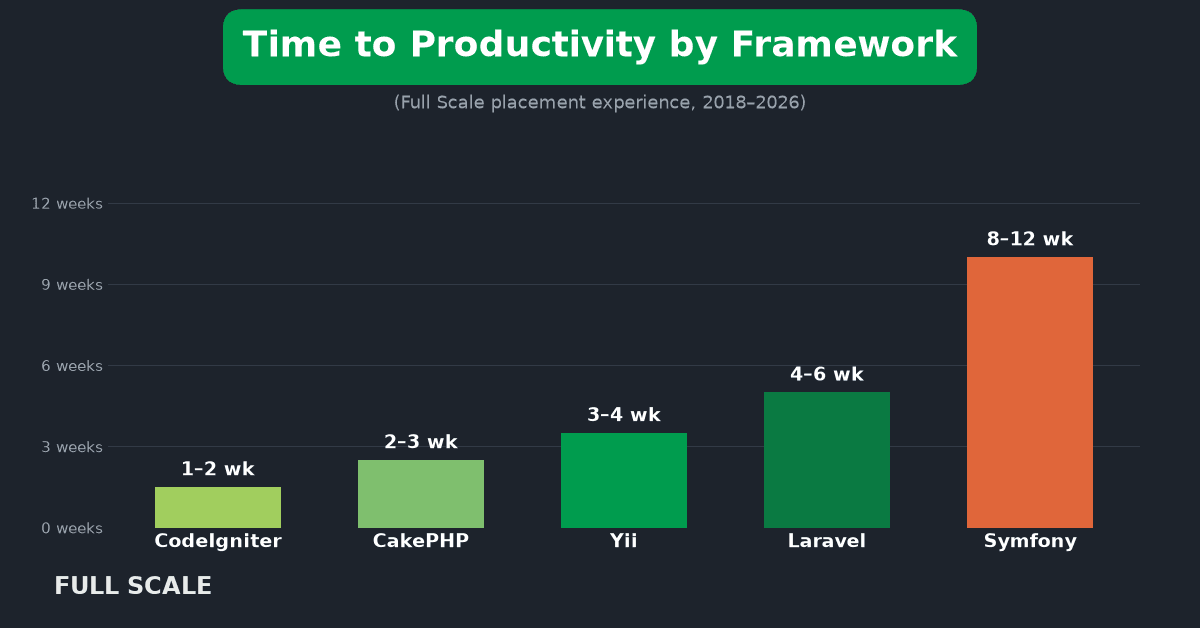
Shorter learning curves mean faster time to value. But don’t choose purely on speed. Match complexity to your project needs among PHP MVC frameworks.
Offshore Talent Availability by Framework
Where the rubber meets the road: how fast can you actually hire developers for each PHP MVC framework?
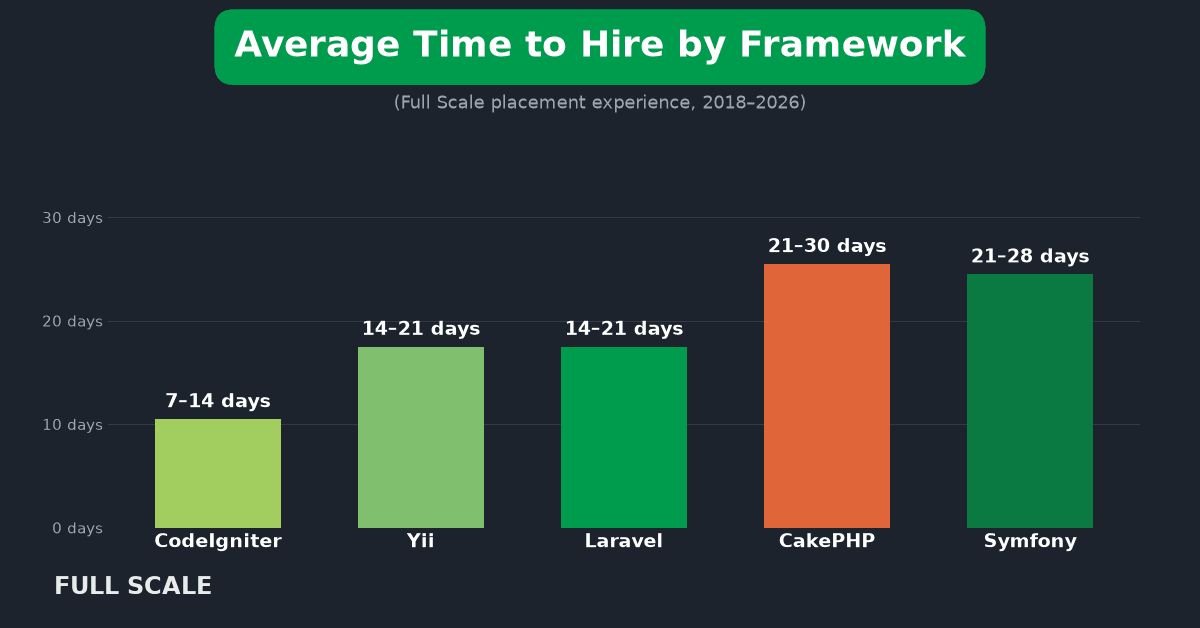
Every day waiting to hire adds delay to your timeline. Choose PHP MVC frameworks where talent is actually available when you need it.
Framework Matters Less Than You Think (But More Than Nothing)
Your PHP MVC framework choice matters for approximately 20% of success. The other 80%? Your team quality, hiring process, and offshore strategy. The team beats the tools every time, which is the core argument of my book Product Driven.
Here’s what actually matters when evaluating PHP MVC frameworks:
Developer Quality > Framework Features
Excellent developers produce excellent work in any PHP MVC framework. Mediocre developers produce mediocre work in the “best” framework. Focus on hiring quality over technology popularity.
Team Expertise > Framework Popularity
If your team knows CodeIgniter cold, that expertise beats Laravel’s larger package library. Productivity today matters more than theoretical advantages tomorrow when comparing PHP MVC frameworks.
Timeline Realism > Framework Perfection
Ship something functional, beats perfect architecture that never launches. Choose PHP MVC frameworks that enable shipping, not frameworks that enable endless refinement.
Offshore Hiring Strategy > Framework Hype
7-day hiring cycles for CodeIgniter developers beat 21-day cycles for Laravel developers if timeline matters. Talent availability makes or breaks scaling plans across all PHP MVC frameworks.
The Decision Framework Recap:
- Team Expertise (35%): Does your team know it?
- Timeline (25%): Can you learn it in time?
- Offshore Availability (20%): Can you hire for it?
- Project Complexity (10%): Does it fit your needs?
- Performance (5%): Does speed actually matter?
- Packages (3%): Do you need specific packages?
- Viability (2%): Will it exist in 5 years?
Everything else is noise.
Matt Watson’s Final Word:
“Choose a PHP MVC framework your team can win with. Then focus on hiring people who can actually build something valuable with it. Framework debates are comfortable. Hiring decisions are hard. Most CTOs spend 3 months on the comfortable decision and 3 days on the hard one. That’s backwards. Spend 3 days choosing your PHP MVC framework. Spend 3 months building your hiring system. That’s how you actually win.”
Ready to Build Your PHP Team?
Framework choice among PHP MVC frameworks matters for maybe 20% of success. The other 80%? Your team quality, hiring strategy, and offshore partnership.
We’ve placed PHP developers across every PHP MVC framework since 2018. We know exactly how long each framework takes to hire for, which salary ranges work, and which red flags to watch.
Why Partner with Full Scale:
- Pre-Vetted Talent Pool: Access senior, vetted PHP developers across Laravel, Symfony, CodeIgniter, and more
- 7-14 Day Hiring Timelines: New developers can start in as little as 7 days, not next quarter
- Transparent Pricing: starting at $35 an hour per developer, all-inclusive, no recruiting fees or hidden costs
- 93%+ Retention Rate: Our developers stay because we treat them like valued team members, not disposable contractors
- Framework Flexibility: We don’t push our preferred PHP MVC framework. We match developers to YOUR stack
- Direct Integration Model: Your developers work directly with you, no middlemen or project managers
- US-Based Contracts: Full IP protection and legal security
Secure Your IP. Scale Your Team Today.
Frequently asked questions
Which PHP framework is best for beginners?
CodeIgniter is the easiest PHP MVC framework for beginners, with a 1-2 week learning curve compared to 4-6 weeks for Laravel or 8-12 weeks for Symfony. Laravel offers better resources and documentation but requires more initial investment. For complete PHP beginners, start with raw PHP fundamentals first, then move to CodeIgniter for framework concepts.
Laravel vs. Symfony: Which should I choose?
Laravel excels for rapid development with its rich package library and 4-6 week learning curve. Symfony delivers long-term architectural flexibility for complex enterprise applications but requires 8-12 weeks to proficiency. Choose Laravel for startups, prioritizing speed to market. Choose Symfony for 5+ year projects requiring flexibility. Both maintain active development and strong offshore talent pools among PHP MVC frameworks.
Is PHP still relevant in 2026?
Yes. PHP powers 77% of websites with known server-side languages according to W3Techs (January 2026). WordPress alone accounts for 43% of all websites, and Facebook, Wikipedia, and Slack rely on PHP. Modern PHP 8.x offers significant performance improvements, strong typing, and contemporary features. The language evolves continuously with annual releases and corporate backing. We break down the full case in why companies still use PHP.
Which PHP framework is best for offshore teams?
Laravel offers the deepest offshore talent pool of any PHP framework, with 14-21 day hiring timelines. CodeIgniter provides the fastest hiring (7-14 days). Symfony attracts more senior developers but requires 21-28 days to hire. For offshore success, choose PHP MVC frameworks with talent availability matching your scaling timeline. Learn more about offshore hiring.
How long does it take to learn a PHP framework?
Learning curves vary dramatically by PHP MVC framework and developer experience. CodeIgniter: 1-2 weeks to productivity. Laravel: 4-6 weeks to comfort. Symfony: 8-12 weeks to proficiency. These assume existing PHP knowledge. Complete beginners need an additional 2-3 months for PHP fundamentals first. Timelines extend 50% for developers without MVC architecture experience.
Which PHP framework is best for AI-assisted development?
Laravel has the strongest AI story of any PHP MVC framework. Its conventions give AI coding agents one obvious way to do things, so the code they generate looks like what a senior developer would write. Laravel also ships its own AI tooling: Laravel Boost is a Model Context Protocol (MCP) server that gives your AI agent real context about your app’s schema, routes, and packages, and the separate Laravel MCP package lets you expose your own app to AI clients. For a new project where AI-assisted development matters, Laravel is the safest default. For an existing codebase, the framework your team already knows still wins.